20 Best Turing Alternatives for Fast, Reliable Developer Hiring
Noxx Team

You need a reliable remote developer quickly, but hiring often drags on with weak matches, lengthy technical rounds, and unexpected costs. Recruitment automation can change that by automating sourcing, technical screening, interview scheduling, and matching from a global talent pool. If you are exploring Turing Alternatives, this guide shows how talent marketplaces, developer matching, pre-vetted engineers, interview automation, and skills assessment cut time to hire and reduce hiring costs so you can quickly and confidently hire highly skilled, reliable remote developers through a trusted platform that saves time, reduces costs, and delivers consistent project success.
To reach that goal, Noxx’s AI recruiter finds, vets, and matches skilled remote developers quickly, so you spend less time on screening and more time shipping product.
Table of Content
- Summary
- What Is Turing and Why Should You Consider Alternatives?
- Top 20 Turing Alternatives for Global Developer Hiring
- Upload a Job and Get 10 Candidates within 7 Days with Noxx (No Risk, No Upfront Fees)
Summary

- Vetting intensity varies widely across providers, with acceptance rates ranging from approximately 2.3% to roughly 5% or the top 3% pools, and that variance directly affects candidate quality and funnel depth.
- Regional sourcing yields significant cost savings, with flat senior rates reported as low as $35 per hour, typical ranges of $45 to $85 per hour, and claims of up to 70% lower rates compared to US market norms.
- Time-to-hire compresses dramatically when automation is applied, with matching windows reported at 24 to 72 hours and typical shortlists delivered within 3 to 7 days, shifting hiring from weeks into days.
- Pricing models create predictability tradeoffs, ranging from platform fees of around 15 to 20% and 10% commission structures to flat hourly pricing and refundable deposits, which significantly impact budgeting and forecasting.
- Deeper, multi-stage vetting correlates with better outcomes, as demonstrated by examples such as 95% retention rates across trial periods and claimed matching accuracy of nearly 97%, indicating that stronger screening reduces churn.
- Relying on single benchmarks or single-source marketplaces is risky, as reflected by 85% of AI researchers saying the Turing Test is not a sufficient measure, which is why multi-signal screening and diverse talent pools are increasingly preferred.
- This is where Noxx's AI recruiter comes in; it addresses screening and shortlisting by evaluating over 1,000 applicants and surfacing a top-10 shortlist in just seven days, utilizing multi-signal automated vetting.
What Is Turing and Why Should You Consider Alternatives?
Turing is an AI-driven talent cloud that matches companies with pre-vetted remote developers, using automated assessments and an internal workspace to accelerate hiring. It combines technical and soft-skill evaluation, short trial periods, and marketplace-style pricing, allowing teams to scale their engineering capacity quickly.
What Services Does Turing Actually Provide?
Turing operates as a sourcing and matching platform for remote engineers, combining automated vetting, coding assessments, and an employer-facing workspace that supports onboarding and performance tracking. The platform covers both freelance and full-time remote roles, offers a short risk-free trial window, and positions itself as a fast route from brief to hire.
Turing claims to have a 97%success rate in matching developers with companies, which is why many hiring managers start there when speed and a Silicon Valley quality bar matter.
Why Would Teams Look for Alternatives to a Platform Like This?
Cost and fit are the two usual fault lines. Premium vetting and fast matching come with premium pricing, which can be a squeeze for early-stage startups and tight-budget teams. The pool, while deep, may overlook niche specialists or the regional expertise a product team requires, leading to longer searches or compromises in expertise.
Vendor Lock-in and Single Benchmarks
When volume rises, vendor lock-in and marginally inconsistent outcomes make maintaining continuity and predictability harder. These practical frictions help explain broader industry skepticism about single metrics or single-source solutions, reflected in research showing that 85% of AI researchers believe the Turing Test isnot a sufficient measure of machine intelligence, a reminder that one benchmark rarely fits every use case.
How Do Those Tradeoffs Play Out Day to Day?
If you are a startup hiring your first five engineers, a quick match feels like a win, but those hourly premiums can double your burn rate compared with targeted regional hires. If you lead an enterprise program that requires niche ML operations talent, a generalist-heavy pool can cost you time in refactoring and ramping.
Think of hiring as tailoring a suit: Off-the-rack gets you dressed fast, bespoke fits better but costs more, and sometimes you need a hybrid approach so the jacket and trousers actually match.
The Hidden Cost of Patching Specialized Roles
Most teams handle this by using marketplaces for speed, then relying on manual screening to fill the gaps, as that approach feels familiar and scalable in the early stages. As hiring needs grow and roles become increasingly specialized, those manual patches create hidden costs: duplicate screens, longer onboarding processes, and churn that steals engineering cycles.
Platforms like Noxx provide an alternative path, automating intake and multi-signal screening across regional datasets, so teams receive recruiter-quality shortlists quickly. This reduces time-to-hire from weeks to days while keeping fees predictable and small.
When Should You Consider Switching Platforms or Mixing Suppliers?
Consider alternatives when cost sensitivity is binding, when you need targeted regional depth in LATAM or Asia, or when your hiring funnel requires predictable shortlists rather than ad hoc matches. If your primary constraint is velocity and budget, look for providers that charge a small success fee and automate evaluation across multiple signals, allowing you to achieve consistency without incurring high agency commissions.
Unexpected Reshaping of Cost, Speed, and Quality
The choices you make now not only affect cost and speed, but also who stays on your team and how quickly your product ships. That sounds like the end of the explanation, but what most teams discover next is a surprising tradeoff that reshapes hiring cost, speed, and quality in ways they did not expect.
Related Reading
- Recruitment Automation Tools
- Software Development Outsourcing Costa Rica
- Hire Software Developers in Chile
- Software Development Colombia
- Hire Developers in Argentina
- Hire Software Developers in Brazil
Top 20 Turing Alternatives for Global Developer Hiring
These profiles provide a clear overview of each top Turing alternative, including what they do, who they serve, and the concrete trade-offs you should expect when you balance speed for cost or specialization for scale.
1. Noxx
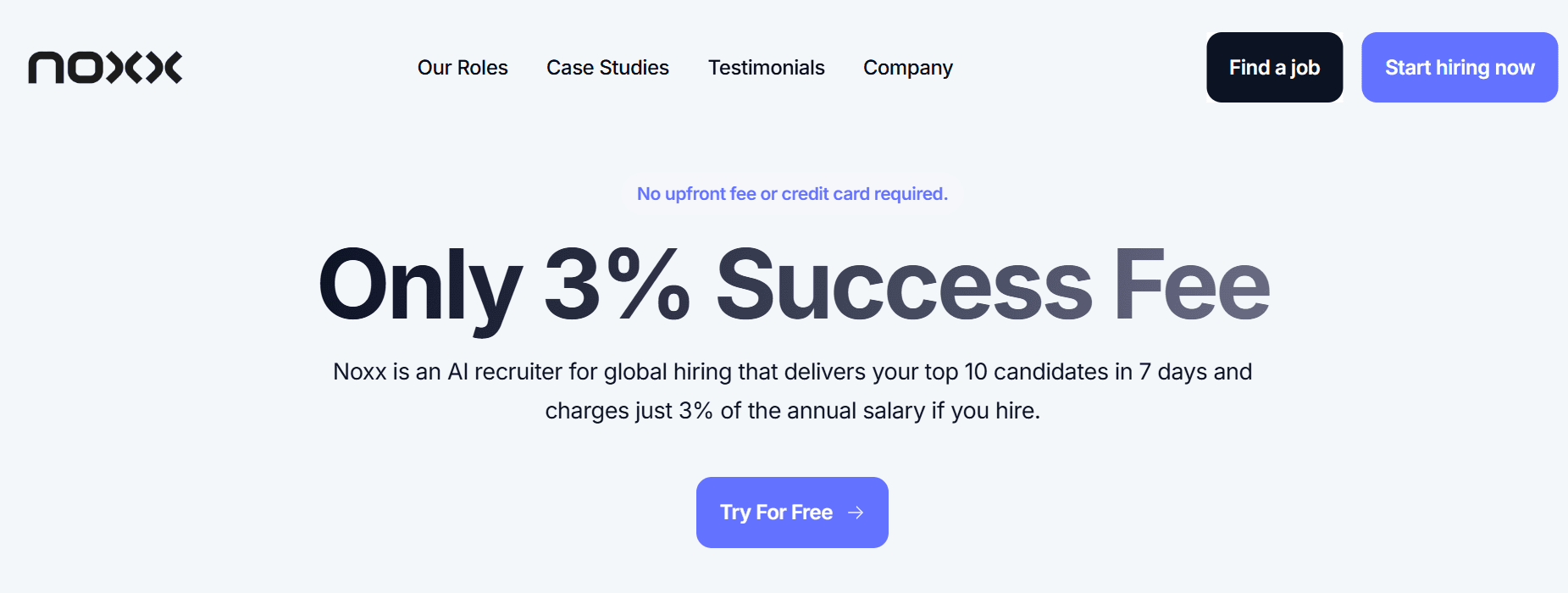
Noxx is the fast, low-cost alternative to legacy recruiters and premium marketplaces. Our AI recruiter screens over 1,000 applicants, surfaces the top 10 candidates in seven days, shows salary expectations up front, and charges only 3% if you hire, with no upfront fees or agency commissions. We focus on sourcing engineers, marketers, and salespeople from LATAM and Asia, allowing you to find quality talent at up to 70% less than US rates.
Key Differentiators and Metrics
- Automated intake and multi-signal screening, 40+ signals and regional datasets tuned for remote performance.
- Outcome-based pricing, 3% success fee only, no retainers or deposit.
- Typical shortlist delivered in 7 calendar days, designed for startup hiring velocity.
Best for
- Early-stage startups and small hiring teams that need a fast, predictable shortlist.
- Roles where cost and speed matter more than brand-name talent.
- Hiring across LATAM and Asia for full-time remote hires.
Features or Highlights
- AI recruiter handles job intake, screening, salary benchmarking, and shortlisting.
- Transparent salary expectations and candidate profiles.
- Pay only on hire; replacement and basic onboarding help included.
Why Choose Noxx vs Turing
You trade a massive marketplace for surgical efficiency. Where Turing’s breadth can feel like excess for a single hire, Noxx compresses screening into one recruiter-quality shortlist, removes upfront costs, and makes hiring predictable and affordable for small teams.
2. Index.dev
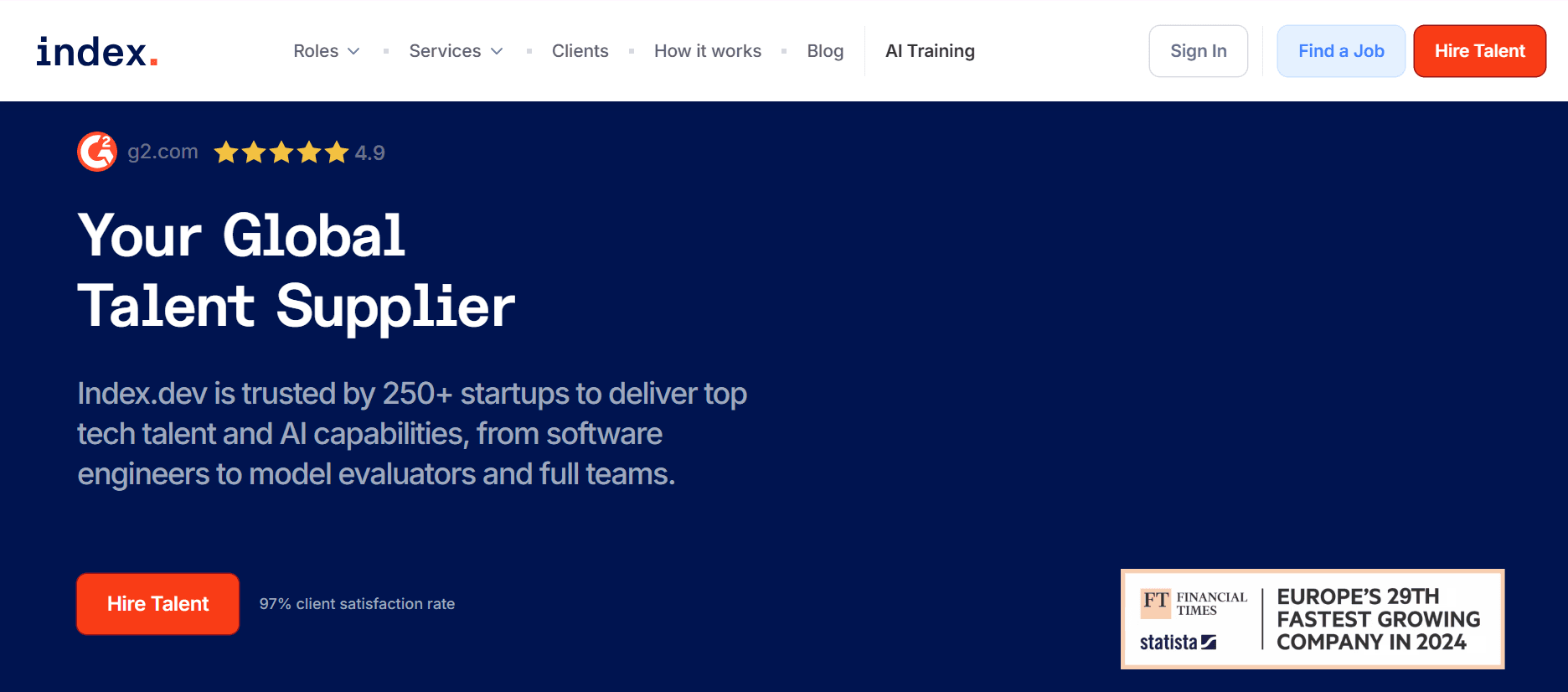
Index.dev is a curated platform for hiring and retaining vetted senior remote developers globally, focused on long-term fits and low churn. They serve scaleups and engineering teams that need senior full-time contractors, offering a talent network of 15,000 pre-screened senior engineers:
- Who are proficient in English
- Who have demonstrated remote performance
- Who possess relevant hard skills
- Who are adaptable to different cultures
Index.dev admits about 5% of applicants from a 200,000 applicant funnel, then places candidates with 6+ years of experience and a minimum overlap of four shared working hours.
Key Differentiators and Metrics
- 4-stage vetting, claimed 9% matching accuracy, and a 30-day risk-free trial.
- 95% retention across trial periods, so nearly all trial hires convert to ongoing engagements.
- Pricing ranges by role, with mid-senior developers costing roughly $50–$85 per hour and leads and those with hard-to-find skills costing $80–$120 per hour.
Best For
- Global companies and startups that want full-time remote engineers on predictable contracts.
- Projects needing long-term continuity and hands-on account management.
Features or Highlights
- Dedicated account manager, no hidden platform or deposit fees, and fast 3–5 day hiring throughput.
- Regional coverage in CEE, Latin America, and Asia to maximize cost savings.
Why Choose Index.dev vs Turing
Index.dev offers dedicated human support and clearer long-term cost predictability, which can beat Turing when you need account-managed placements and lower ongoing rates rather than a large marketplace match.
3. Toptal
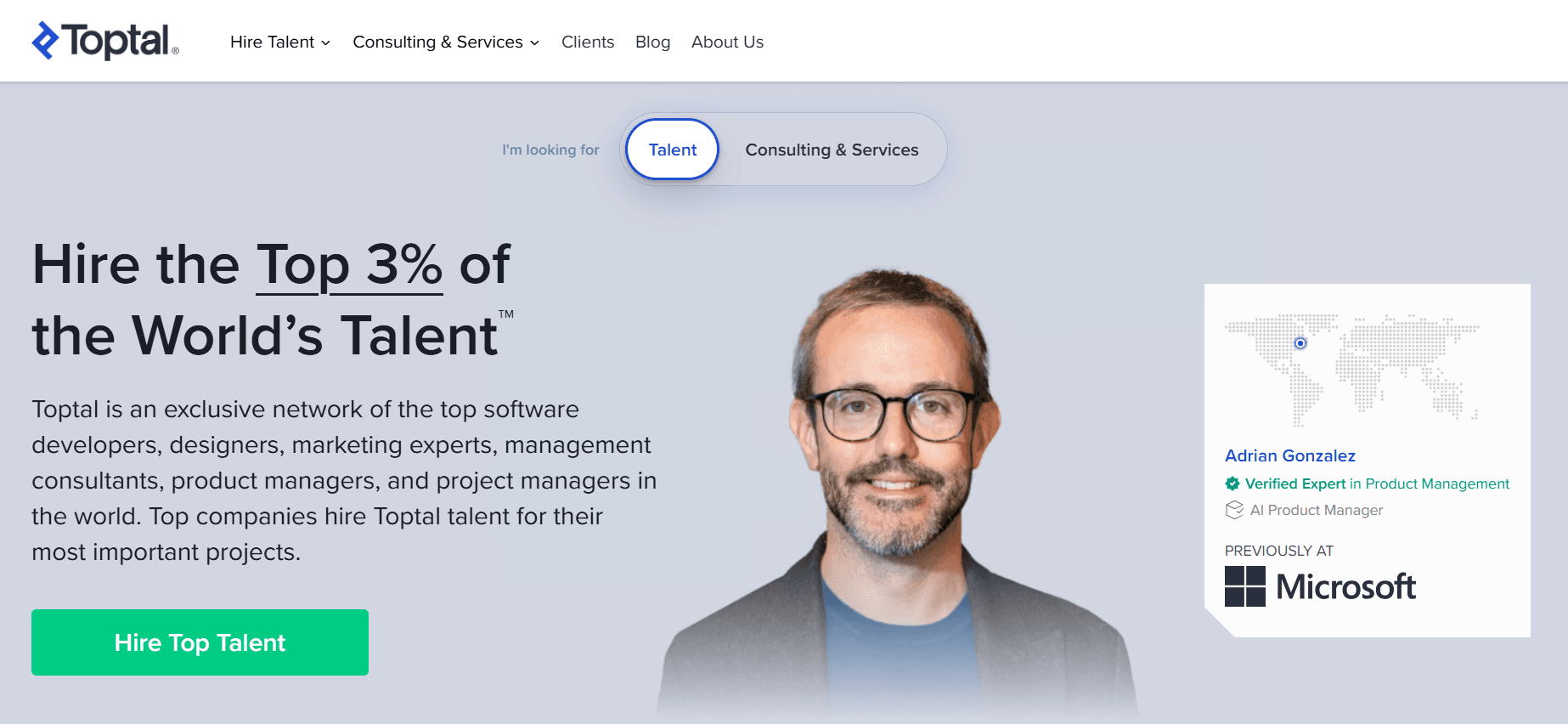
Toptal connects companies with the top tier of freelance and full-time talent across engineering, design, product, and finance. The platform positions itself as high-end, with strict vetting that limits the pool to roughly the top 3% of applicants, and a two-week trial so you can test fit before committing.
Key Differentiators and Metrics
- Focus on elite contractors for complex, high-impact projects.
- Two-week risk-free trial, but an initial deposit is required.
- Emphasis on fast placements for senior roles, with hands-on matching support.
Best For
- High-growth startups and enterprises with complex technical needs and the budget to match.
- Short-term specialist projects or CTO-level advisory work.
Features or Highlights
- Multi-stage vetting, including live screening and test projects.
- Flexible engagement: freelance, part-time, or full-time.
Why Choose Toptal vs Turing
Toptal is a fit when you need boutique-level talent and are willing to pay a premium for tighter vetting and hands-on matching; it can be faster to quality for specialized roles than sourcing through a massive marketplace.
4. Upwork
Upwork is a broad freelance marketplace that offers you volume, flexibility, and a wide price range. You post roles, receive bids, and choose from a wide set of candidates, with optional enterprise-level vetting if you upgrade.
Key Differentiators and Metrics
- Massive, open marketplace that supports rates ranging from very low to high-end consultants.
- Built-in work tracking, invoicing, and time logs for hourly billing.
- “Expert Vetted” and “Top Rated” badges help find higher-caliber freelancers without platform-wide vetting.
Best For
- Small to medium projects, quick tasks, and teams that need flexible contractors across many disciplines.
- Cost-sensitive projects where budget variety matters.
Features or Highlights
- Marketplace bidding, hourly or fixed-price contracts, and 24-hour hiring throughput for some briefs.
- The enterprise upgrade offers dedicated support and more rigorous vetting.
Why Choose Upwork vs Turing
Upwork beats Turing on price range and flexibility for ad hoc work, but you trade consistency in vetting; if you need reliable, pre-vetted high-seniority candidates, Upwork requires more hands-on screening or an enterprise plan.
5. Arc.dev
Arc.dev is an AI-powered jobs marketplace built for remote software hiring, focusing on high-quality, vetted developers. The platform screens intensively and reports that roughly 2.3% of applicants pass their vetting, while providing an AI recruiter, HireAI, to speed matches.
Key Differentiators and Metrics
- Access to a community of 250,000 remote developers and AI-assisted shortlists.
- Deposit fee for placement services and two-week risk-free trials.
- Strong compliance and payroll support for long-term hires.
Best For
- Teams that want deep remote hiring support plus compliance and payroll for offshoring.
- Roles where legal and payroll handling are as important as sourcing.
Features or Highlights
- AI matching, manual review pipelines, and onboarding support.
- Models for both full-time placements and freelance engagements.
Why Choose Arc.dev vs Turing
Arc.dev competes on compliance and operational support, making it preferable when you want the platform to manage payroll and legal complexity in addition to sourcing vetted developers.
6. CloudDevs (LatAm & Europe Pool)
CloudDevs matches companies with pre-vetted developers from Latin America and Europe, focusing on technical depth and synchronous collaboration. Their pool consists of approximately 8,000 engineers, who are screened through a five-stage process that includes live coding and language checks. They then assign a dedicated Slack workspace after matching.
Key Differentiators and Metrics
- Regional specialization in LatAm and Europe, with a five-stage screening workflow.
- 24–48 hour matching window in many cases, and a refundable deposit to start engagements.
- Project rates start around $45 per hour for senior engineers.
Best For
- Teams that want LatAm or Eastern Europe talent with quick time zone overlap.
- Ongoing, long-term development where cultural and time alignment matter.
Features or Highlights
- Live coding, algorithmic problem solving, and background checks as part of vetting.
- 7-day risk-free options and payroll/compliance assistance.
Why Choose CloudDevs vs Turing
CloudDevs is more regionally focused and can deliver fast, timezone-friendly hires, which helps teams that prioritize synchronous collaboration over a sprawling global marketplace.
7. Lemon.io
Lemon.io targets startups seeking vetted developers from Ukraine and Eastern Europe, utilizing a hands-on matching process that begins with a job brief and concludes with a replacement guarantee, rather than a free trial. They charge about a 20% platform fee and require an initial pre-payment for one month of work.
Key Differentiators and Metrics
- Strong focus on Eastern Europe specialties like Ruby on Rails, Python, and JS frameworks.
- Rigorous 90-minute assessments and code reviews; a replacement guarantee if the first match fails.
- Hourly rates typically in the $45–$80 range for startup plans, with minimum engagement thresholds.
Best For
- Startups that prefer Eastern European development expertise and a fast single-hire flow.
- Projects that benefit from hands-on matchmaking rather than self-serve marketplaces.
Features or Highlights
- Deep live testing, background checks, and weekly progress reports.
- No free trial, but time-tracking and steady reporting.
Why Choose Lemon.io vs Turing
Lemon.io can be a more cost-effective and hands-on option for hiring in Eastern Europe, especially when you require a narrowly curated match and a straightforward replacement policy.
8. Unicorn.dev
Unicorn.dev focuses exclusively on senior engineering talent from Latin America, offering flexible contracts and timezone overlap guarantees. Their pool comprises approximately 8,000 pre-vetted engineers with 5+ years of experience, and they price talent at a flat rate of $35 per hour for senior developers.
Key Differentiators and Metrics
- Flat-rate senior pricing and timezone overlap of at least four hours.
- Refundable deposit that converts to account credit on the first invoice.
- One-week risk-free trial to validate fit.
Best For
- Teams that want predictable pricing for senior LatAm talent.
- Small companies that need fast, low-variance budgeting for remote contractors.
Features or Highlights
- Private Slack workspace for matched talent and simple contract flexibility.
- Option to swap developers at no cost if fit issues arise.
Why Choose Unicorn.dev vs Turing
Unicorn.dev wins when cost predictability and regional sourcing beat raw marketplace scale, making budgeting and overlap easier for distributed dev teams.
Status Quo Disruption: How Hiring Typically Breaks Down, and How AI Shortlists Change the Game
Most teams recruit by posting to marketplaces or handing the brief to an agency because that workflow is familiar and appears to be low-lift. As roles multiply, interview cycles balloon, duplicate screens appear, and hiring lead time stretches from weeks into months, quietly costing engineering velocity and product deadlines.
Platforms like AI Recruiter centralize intake, automate multi-signal screening, and deliver recruiter-quality shortlists in days, compressing review cycles and cutting the hidden operational costs of scheduling interviews across calendars.
9. YouTeam
YouTeam is an invitation-only marketplace of top small and medium development agencies, enabling companies to outstaff engineers from those agencies as full-time contractors. The network claims access to over 50,000 vetted engineers across 500-plus agencies, and it charges a commission on engineer rates rather than a placement fee.
Key Differentiators and Metrics
- Access through agency partners, not individual freelancers, with agency re-vetting for quality.
- One-month trial and 10% commission structure.
- Customer Success Managers to handle legal and financial aspects.
Best For
- Companies that want agency-level hiring and full-time outstaffing without building local entities.
- Projects that benefit from agency-backed teams and process maturity.
Features or Highlights
- Agency-based vetting, timezone matching, and proactive quality monitoring.
- Clients choose CVs and conduct interviews before engaging the agency.
Why Choose YouTeam vs Turing
YouTeam is superior when you want to engage agency-employed engineers with established delivery processes, making it easier to scale teams that need managed QA and consistency.
10. Gigster
Gigster provides end-to-end software delivery by assembling a whole, managed team for your product, combining human roles with AI to optimize staffing. The model suits large or complex projects, but the minimum project fee is high, so projects must justify the need for managed full-team delivery.
Key Differentiators and Metrics
- Full teams with product, engineering, and design roles assembled to spec.
- Minimum per-project fee that typically exceeds typical single-hire budgets.
- Engagement managers and milestone-driven delivery with ownership handed to the client.
Best For
- Enterprises and startups with well-funded, complex projects that need a managed, outcome-focused build.
- Teams that prefer an end-to-end partner rather than piecing together contractors.
Features or Highlights
- “Rapid Results” workshops, curated talent competition, and engagement-level management.
- Clients retain IP and receive help training internal teams after delivery.
Why Choose Gigster vs Turing
Gigster replaces the need to assemble and orchestrate many contractors; pick Gigster when you need a managed program rather than individual hires. Also note that over 300 companies have used Turing to hire developers, which explains why many teams compare marketplaces to managed teams when deciding procurement strategy.
11. Flexiple
Flexiple is an invite-only network of handpicked developers and designers that emphasizes speed to start, claiming deployments in 72 hours after the brief. Their vetting process includes a thorough review of past work, technical tests, and live interviews.
Key Differentiators and Metrics
- Rapid deployment model with dedicated account managers.
- Starter plans and predictable pricing for full-time hires, plus a short risk-free period.
Best For
- Businesses that need vetted talent quickly and want a human-curated match.
- Projects that combine design and development and benefit from matched pairs.
Features or Highlights
- Three-stage screening, one-week trial, and deployment-ready candidates.
- Pricing includes starter fees and an add-on for full-time placements.
Why Choose Flexiple vs Turing
Flexiple is tighter and more curated than open marketplaces, making it better when you want vetted, rapidly deployable talent without enterprise friction.
12. ClanX
ClanX packages cloud-based teams for SMEs and SMBs, handling matching, payroll, compliance, and project management through a dedicated project manager. It is designed to mitigate common failure points in outsourced builds by providing visibility and accountability.
Key Differentiators and Metrics
- Dedicated PM oversight and hourly billing so clients pay only for work performed.
- Emphasis on IP protection, confidentiality standards, and frequent progress tracking.
Best For
- Small companies that need end-to-end delivery without building in-house teams.
- Projects where close vendor oversight and transparency are required.
Features or Highlights
- Cloud teams matched by skill, with continuous reporting and client control over milestones.
- Compliance and payroll handled by the vendor.
Why Choose ClanX vs Turing
ClanX focuses on visible, manager-led delivery for SMEs, making it an attractive option when you need a single, accountable partner for delivery rather than marketplace matches.
13. CodersLink
CodersLink is a Latin America-focused staffing and recruitment service that emphasizes long-term placements, payroll, and integration support. Their pool exceeds 25,000 developers, and the model centers on human-led matching and onboarding.
Key Differentiators and Metrics
- Large LatAm talent pool and end-to-end payroll and onboarding services.
- Five-step human-centric recruitment that prioritizes fit and cultural alignment.
Best For
- Companies targeting LatAm sourcing for sustained, long-term staffing.
- Organizations that want a human recruiter to own the match and onboarding.
Features or Highlights
- Talent marketplace plus managed payroll and performance support.
- Transparent pricing and tailored hiring solutions.
Why choose CodersLink vs Turing
CodersLink alleviates the operational burden of remote hiring in LatAm, which can surpass Turing when you require a white-glove, locally grounded staffing relationship.
14. EliteBrains
EliteBrains markets a handpicked network of approximately 8,300 developers and employs a four-phase vetting process, which includes resume review, coding challenges, senior developer interviews, and a real-world project. They offer flexible engagement models and keep platform fees relatively low, typically a 15% fee on hourly rates.
Key Differentiators and Metrics
- Real-world project requirement and senior developer interview step.
- Closed matching rather than browse-your-own profiles, emphasizing quality control.
Best For
- Teams that want vetted developers for web and mobile projects without browsing open profiles.
- Projects needing mid-to-senior engineers with demonstrable project work.
Features or Highlights
- Multi-step vetting, account management, and flexible engagement terms.
- Flat 15% platform fee on the developer’s hourly rate.
Why Choose EliteBrains vs Turing
EliteBrains trades marketplace visibility for curated quality and a lower commission than some premium networks, functional when you prefer a matchmaker model over self-serve sourcing.
15. Micro1

Micro1 focuses on the top 1% of engineers and covers contracting, payroll, and compliance for international hires. They emphasize a tight skills focus, particularly in React, Python, RoR, and Node.js, and utilize an algorithm to match projects with candidates.
Key Differentiators and Metrics
- Elite talent focus with strong IP and NDA protections built into engagements.
- Full administrative handling of benefits and payroll for remote hires.
Best For
- Teams that need elite engineers in a narrow technology stack and want compliant international employment.
- Companies willing to trade larger candidate variety for top-shelf specialists.
Features or Highlights
- Proprietary matching, account dashboard, and daily feedback loops for quality control.
- Emphasis on developer work-life balance to preserve retention.
Why Choose Micro1 vs Turing
Micro1 is a good fit when you cannot compromise on individual engineer quality and want the vendor to own compliance, at the expense of a smaller candidate set and higher cost.
16. Superside
Superside provides managed creative teams and subscription models for design at scale, promising top-tier creatives and a tech-enabled workflow for iterative creative work. They position design as a function that can be scaled like engineering, and they claim substantial operational cost savings compared to in-house teams.
Key Differentiators and Metrics
- Purpose-built collaboration platform, subscription pricing, and a four-step vetting process for designers.
- Reported savings on operational costs through subscription models and consolidated creative delivery.
Best For
- Brands and product teams that need predictable, ongoing creative capacity.
- Companies that prefer subscription-based creative operations to ad hoc agency work.
Features or Highlights
- Creative director and project manager assignment per account, plus AR and motion capabilities.
- Portfolio-based vetting and test projects for quality assurance.
Why Choose Superside vs Turing
Superside is for creative scaling, not for engineering hires; choose it when design velocity and predictable creative throughput matter more than developer sourcing.
17. MVP Match
MVP Match builds remote teams around an idea, placing a CXO-level expert to translate product concepts into staffed teams. They maintain a network invite-only with minimal seniority requirements and focus on rapidly delivering a functioning remote team.
Key Differentiators and Metrics
- CXO-level stewardship for team formation and onboarding, plus patent-protected vetting logic.
- Minimum experience thresholds and team-first delivery models.
Best For
- Founders building an MVP who want an integrated remote team and senior oversight.
- Short to medium-term product launches that need rapid assembly.
Features or Highlights
- Team augmentation or complete remote team options, with a focus on execution and seamless handoffs.
Why Choose MVP Match vs Turing
MVP Match is team-first and execution-focused, better when you need a curated, mission-aligned team assembled under senior leadership rather than piecing together individual hires from a marketplace.
18. CloudDevs (24–48 Hour Match Emphasis)
This CloudDevs entry highlights the platform’s responsiveness and hands-on matching, promising agent-assisted onboarding and a dedicated Slack workspace to smooth day-one collaboration. The platform prioritizes human support over automated queues and promises a match within 24 to 48 hours in most cases.
Key Differentiators and Metrics
- Fast human-assisted matching with a live agent at intake rather than automated responses.
- Post-match Slack workspace and flexible overlap hours for synchronous work.
Best For
- Teams that need a live human to shepherd hiring quickly and want early transparency.
- Projects sensitive to time zone coordination and real-time collaboration.
Features or Highlights
- Agent-assisted intake, dedicated workspace, and payroll support.
- Refundable deposit applied as credit against the first invoice.
Why Choose CloudDevs vs Turing
Choose this version of CloudDevs when you want a live, responsive matching experience that removes the initial automation friction many marketplaces have.
19. Revelo
Revelo is a LatAm-focused job board and sourcing platform that provides a shortlist of screened candidates from Mexico, Brazil, Colombia, and other markets. You submit skills and experience requirements, then interview and hire from the curated slate.
Key Differentiators and Metrics
- Localized talent sourcing for Latin America, with screening tuned to regional hires.
- Shortlist-driven process aimed at full-hire conversions.
Best For
- Companies committed to LatAm hiring and looking for a straightforward job board plus screening service.
- Teams that want direct control over interviews and hiring.
Features or Highlights
- Regional sourcing, shortlist delivery, and support for interviews and offers.
Why Choose Revelo vs Turing
Revelo simplifies LatAm hiring without the overhead of a large international marketplace, which helps when regional insight and direct shortlists matter most.
20. Gun.io
Gun.io is a developer-first marketplace that focuses on U.S.-based engineers and provides hands-on client support. They keep a smaller, highly vetted pool and assign each client a dedicated project manager to ensure smooth onboarding and follow-through.
Key Differentiators and Metrics
- Developer-focused experience and a smaller, thoroughly vetted talent base.
- Dedicated project manager for every engagement to reduce coordination friction.
Best For
- Startups seeking US-based talent and personalized service during the hiring process.
- Projects that require careful vetting and high-touch client support.
Features or Highlights
- Small, high-quality pool, tailored matching, and PM-driven onboarding.
Why Choose Gun.io vs Turing
Gun.io trades marketplace scale for intimacy and U.S. hiring experience, making it a clear pick when you want hands-on attention and domestic talent coverage. That comparison raises a question you’ll want answered next, because the hiring shortcut no one admits to changes everything about cost, speed, and retention.
Related Reading
• Remote Developers Eastern Europe
• AI Recruiting Startups
• Automated Candidate Screening
• AI Recruiters
• AI and Recruiting
Upload a Job and Get 10 Candidates within 7 Days with Noxx (No Risk, No Upfront Fees)
Suppose you are stretched between product deadlines and endless interviews. Consider Noxx as a practical Turing alternative that makes hiring predictable: it delivers 10 candidates within 7 days and keeps risk low with no upfront fees, so you only pay when a hire truly meets your needs.
Related Reading
• Toptal Alternatives
• Companies using AI for Recruitment
• AI Screening
• Toptal vs Gigster
• Andela Competitors