35 Best Recruitment Agencies for Startups to Hire Top Talent Fast
Noxx Team

Growing a startup today means hiring faster and smarter, and AI recruitment strategy for startups has moved from optional to essential. When product momentum meets a tiny team, one wrong hire can slow progress while the right recruitment partner fills technical gaps and protects company culture. This guide on best recruitment agencies for startups shows how top hiring agencies, talent acquisition firms, executive search teams, and startup recruiters source startup-ready candidates who help you scale without losing speed. Want to know which partners cut time to Hire Offshore Developers and improve the quality of hire?
To quickly find a trusted recruitment partner that can deliver exceptional startup-ready talent so that they can scale their team without slowing business growth, Noxx's AI recruiter helps shortlist prescreened candidates, align them to your hiring needs, and learn your preferences as you hire. It speeds up sourcing, improves cultural fit, and frees founders to focus on product and customers.
Table of Contents
- What is a Startup Recruitment Agency?
- 35 Best Recruitment Agencies for Startups
- What Makes a Recruitment Agency Ideal for Your Startup?
- Upload a Job and Get 10 Candidates within 7 Days with Noxx (No Risk, No Upfront Fees)
What is a Startup Recruitment Agency?

A startup recruitment agency focuses on early-stage companies and the specific pressures they face, rather than filling roles for large corporations or established firms. They match candidates who can move fast, tolerate uncertainty, and take on evolving responsibilities. While general recruiting firms often prioritize matching resumes to job descriptions, startup recruiters evaluate:
- Adaptability
- Ownership
- Cultural fit, alongside technical ability
They fill roles like founding engineers, product managers, growth marketers, head of operations, customer success leads, and hybrid positions that mix product and support work.
How These Agencies Adapt to Rapid Growth, Niche Skills, and Tight Budgets
Startup recruiters design hiring plans that shift with your runway and milestones. After a funding round, they can ramp up sourcing quickly to hire multiple engineers or sales reps. If cash is tight, they help prioritize hires and suggest cost-efficient alternatives, such as hiring:
- Senior remote talent in lower-cost regions
- Contractors for short-term projects
Specialized Talent Acquisition
They also reach niche skill pools for areas like machine learning infrastructure, mobile product design, or DevOps automation, using targeted outreach and sector-specific networks. They manage cost by recommending a mix of equity and salary packages and by presenting carefully screened candidates, so you spend less time interviewing the wrong people.
Core Services Startup Recruitment Agencies Provide
- Defining candidate requirements: They translate vague role needs into clear skills, outcomes, and cultural markers so you hire for impact.
- Sourcing and screening: They tap active and passive candidates through networks, social media, and industry communities, then run technical and behavioral screens.
- Interview support: They design interview plans, coordinate panels, and provide scorecards to reduce bias and ensure consistency.
- Onboarding help: They provide structured onboarding plans and check-ins to speed new hire productivity.
- Talent management support: They advise on retention, career ladders, and performance benchmarks for early teams.
They also spot transferable skills in candidates who do not identify as startup people but who bring resilience and generalist strength.
Why Startup Hiring Needs Its Strategy
Limited Runway Demands Efficiency
When cash is scarce, you cannot afford long hiring cycles or the wrong hire. Startups need recruiters who prioritize speed and fit, not just fill. Recruiters reduce time to hire by delivering vetted shortlists and aligning role priorities with the founder team.
Need for Versatile Early Hires
Early employees wear many hats. Your first engineer may ship code, answer support tickets, and work on deployment scripts. Your growth lead might also prepare investor decks and run customer interviews. Recruiting for that flexibility requires evaluating mindset and problem-solving, not just a narrow skills checklist.
Cultural Impact is Amplified
At small headcounts, each person changes the team dynamic. Recruiters use structured behavioral interviews and reference checks to surface traits like humility, bias for action, and collaborative instincts so hires improve culture rather than disrupt it.
Scaling Needs Differ from Corporate Hiring
Startups scale in bursts. After a fundraiser, you may hire fast. When the runway tightens, you need stopgap solutions. Good recruiters offer flexible models such as retained search, volume hiring, fractional talent, and contractor to full-time conversions that match shifting hiring rhythms.
Why Your Startup Should Work with a Recruitment Partner
- Sharpen role definitions and sourcing strategy: Founders often start with fuzzy job descriptions. Recruiters refine success metrics and candidate profiles that reduce interview noise.
- Surface candidates beyond job boards: The best hires are often passive candidates who need targeted outreach.
- Reduce costly hiring mistakes: A wrong hire at a small scale costs productivity and morale as much as salary.
- Maintain continuity: Agencies provide process and candidate pipelines so hiring does not stall when internal bandwidth is limited.
Top Benefits of Specialized Recruitment for Startups
- Expertise in startup hiring: Specialized recruiters know which personality and skill mixes thrive in early companies. They can position your opportunity to attract builders who want ownership and measurable impact.
- Time and cost savings: Agencies maintain pre-vetted talent pools and can present qualified candidates in days rather than weeks.
- Access to niche skills: Recruiters reach targeted talent for roles like data science, infrastructure engineering, mobile product design, and growth analytics.
- Flexibility and scalability: Agencies scale hiring effort up or down and offer hybrid hiring models to match funding cycles.
- Access to affordable global talent: Some firms specialize in cross-border hiring so that you can tap high-quality talent in places like Latin America at lower cost.
- Market knowledge and salary intelligence: Recruiters provide current salary ranges, typical benefits, and candidate expectations so your offers land and convert.
How Global Hiring Can Stretch Your Runway Without Cutting Quality
Hiring outside the United States often yields considerable cost advantages while keeping high skill levels. Recruiters with global networks help handle sourcing, compliance, payroll, and local contracts.
Nearshore Staffing
Instead of paying a US market rate above $130K for a senior developer, you can hire a comparably experienced engineer in Latin America for around $69K if you work with a partner that manages the hiring complexities. That option preserves product velocity while keeping cash runway longer.
How Recruiters Reach Candidates Who Aren’t Actively Looking
About 70% of the workforce are passive candidates. Startup recruiters use targeted messages, referrals, and professional communities to engage them. They position startup opportunities as places for growth and ownership rather than just a job.
Recruiters also assess transferable skills from candidates with corporate backgrounds or adjacent industry experience who can adapt to a startup pace.
Practical Role Examples and How Recruiters Find Them
- Full-stack engineer who can own frontend and backend work while mentoring juniors: Found via developer meetups, open source contributions, and GitHub activity.
- Growth marketer who runs experiments and can build pitch decks for investors: Sourced from startup growth forums and referral networks.
- Head of operations who understands tooling and can set up finance and HR processes: Located through operator circles and CFO communities.
- Customer success lead who can scale onboarding documentation and improve retention metrics: Found in industry-specific user groups and LinkedIn outreach.
Each role requires specific sourcing tactics and screening exercises that specialized recruiters design and use.
What Good Startup Recruiters Measure and Report
- Track time-to-hire and candidate pipeline velocity to ensure your hiring stays on budget.
- Source quality and conversion rates to optimize channels.
- Offer acceptance and compensation benchmarks to keep offers competitive.
- Early performance indicators for new hires, so onboarding and role design improve over time.
Questions to Ask a Recruitment Agency Before You Hire Them
- Do you specialize in startup hiring, and what stages do you work with?
- Can you show examples of hires you placed in similar roles or markets?
- How do you assess cultural fit and candidate adaptability?
- What are your fees,s and what services are included?
- How do you handle international hiring, contracts, and compliance?
- What guarantees or replacement policies do you offer?
How to Work With a Recruiter for Maximum Impact
- Define success metrics for each role and share clear priorities.
- Give recruiters feedback on each shortlist quickly to tighten their search.
- Ask for a brief candidate profile template to evaluate talent objectively.
- Use recruiters to run parallel sourcing while founders handle high-priority interviews.
How Market Insight from Recruiters Helps Your Offers Land
Recruiters track current salary bands, benefits that attract senior hires, and candidate expectations for remote work and equity. They advise on competitive packages for roles such as:
- Senior engineers
- VP-level hires
- Design leads
You do not overpay or undercompensate for the market you are trying to win. Ready to hire but unsure where to start? Ask your recruiter to map a 90-day hiring plan tied to your next milestone and budget so each hire directly advances product and growth goals.
Related Reading
- Hire Offshore Developers
- How to Recruit Engineers
- Recruitment Process Outsourcing
- Recruitment Automation Trends
- How to Recruit Tech Talent
- Best Company Hiring Practices
- Types of Recruitment Agencies
- Benefits of Outsourcing Recruitment and Selection Process
- How to Recruit IT Talent
- Strategic Recruiting
- Top 10 Recruiting Apps
35 Best Recruitment Agencies for Startups
1. Noxx: AI Recruiter That Finds Top Candidates Fast
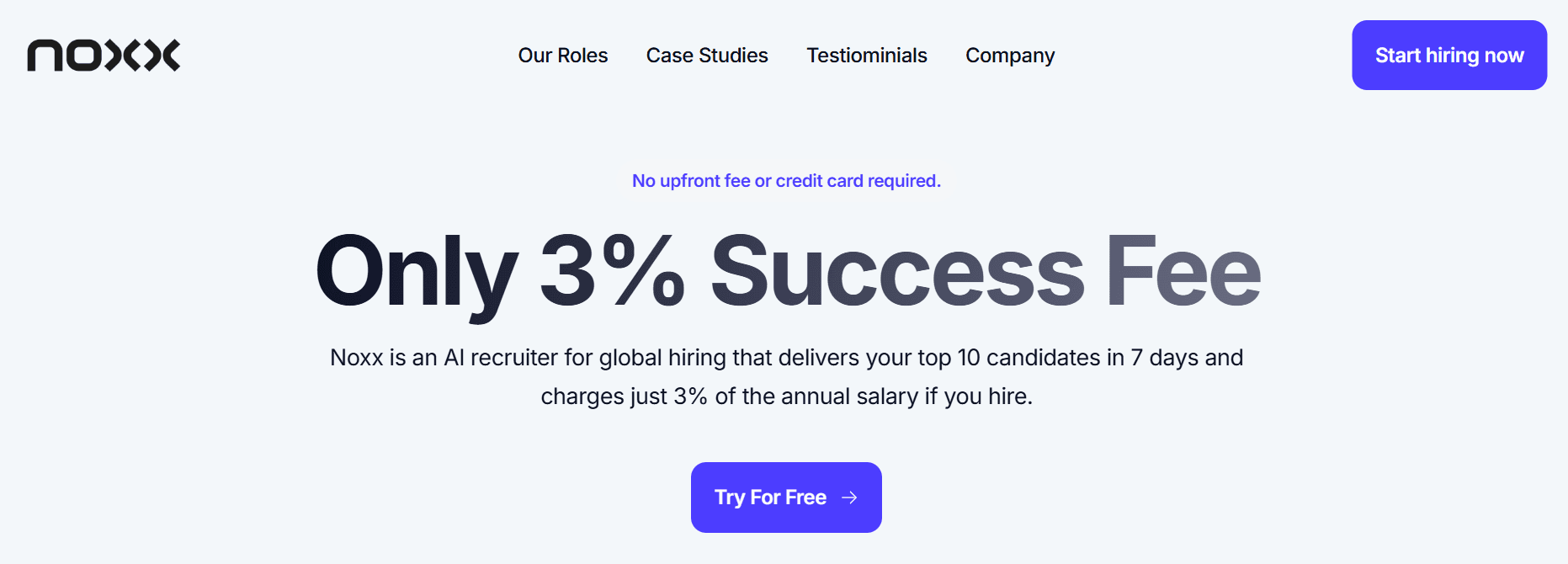
Noxx automates screening so hiring does not take months or cost a fortune. Upload your job description and its AI screens over 1,000 applicants to surface the top 10 candidates in seven days. You pay only 3% if you hire someone, with no upfront fees or recruiter commission.
The platform shows salary expectations up front and focuses on quality engineers, marketers, and sales hires at up to 70 percent below US rates while retaining time zone alignment.
2. Near: LatAm Remote Teams for Early Stage Founders
Near builds high-performing remote teams with a boutique approach for early-stage ventures. They focus on LatAm professionals who work in US time zones and often ask for salaries up to 70 percent lower than their US counterparts. Near handles screening, payroll administration, and compliance so founders avoid international hiring complexity.
They charge a monthly fee per hire that varies by role and avoid upfront costs unless a hire is made.
3. Hunt Club: Referral-Driven Talent with Tech at the Core
Hunt Club leverages a referral network and machine learning to reach active and passive candidates quickly. They tap over 25,000 subject matter experts for warm introductions and use AI to speed candidate discovery, cutting time to fill by as much as half.
The service tailors searches to the startup stage so you get candidates who match your maturity and growth needs. They supplement referrals with advisory work on compensation and organizational fit.
4. Pearl Talent: Turnkey Hiring for Founders with No Infrastructure
Pearl Talent manages the full recruitment lifecycle for startups that lack internal hiring processes. They define roles, map the market, run technical screening, verify cultural fit, and handle offer negotiation.
Pearl has scaled teams for over 200 founders and aims to deliver candidates within 15 business days. Their focus is on low-burn and high-potential hires who want to grow with early-stage companies.
5. Wiseful: Scale Referrals with Technology and Pre-vetted Pools
Wiseful turns referral-based hiring into a scalable talent acquisition channel. Their platform connects startups to pre-vetted talent pools assessed by industry professionals. That model shortens hiring cycles while preserving the quality you expect from personal recommendations. Startups gain access to vetted candidates without the high fee structure of legacy search firms.
6. Wellfound: Large Startup Job Platform with DIY and Concierge Options
Wellfound connects early-stage and high-growth companies to millions of job seekers and tens of thousands of startups. Founders can search candidate profiles directly and view skills and salary expectations before outreach. The platform integrates with standard ATS systems like Greenhouse and Lever to keep hiring workflows aligned.
Wellfound is useful when you want control over candidate selection but need a large, targeted audience.
7. Hunt Club: Network First Search Tailored to Growth Stage Needs
Hunt Club returns with a focus on relationship-driven introductions and machine learning sourcing. They maintain a network of more than 20,000 experts to surface passive candidates who rarely appear on job boards.
Hunt Club also supports org planning and compensation insights to ensure hires fit beyond skills alone. Their hybrid model suits startups that need executive-level or niche operator hires.
8. Hired By Startups: UK Focused Startup Recruitment for Commercial Talent
Hired By Startups specializes in Sales, Marketing, Operations, and Customer Experience roles for UK startups. They cover hires from graduate level through C level, operating with a network of about 20,000 startup-focused candidates. Their model supports single hires or rapid scaling while keeping startup speed and employer brand in mind.
If you need commercial teams that understand startup metrics, they position candidates with that experience.
9. Hanover: Developer Recruitment with Direct Interview Visibility
Hanover focuses on developer hiring and emphasizes transparency through Hinterviews, letting clients watch interviews live. They pair a personable recruiting style with digital tools to assess culture fit and technical ability. The approach helps startups quickly vet skills and collaboration style. Hanover works well for teams that want to see candidate interactions live.
10. RecWorks: Java Specialist for Targeted Technical Roles
RecWorks finds Java developers and plugs them into positions that match skills and community involvement. They support local tech ecosystems while sourcing startups that need focused technical hires. Their specialization reduces search noise and delivers candidates who already fit your technical stack. If your project relies on Java expertise, RecWorks targets that pool.
11. Salt Digital Recruitment: Broad Digital and Developer Coverage
Salt covers a wide variety of sectors and fills permanent, contract, and temporary roles across digital and developer disciplines. They offer scale and candidate variety for startups that need multiple role types fast. Salt is valuable when you want one partner to handle diverse hiring across:
- Product
- Engineering
- Marketing
12. Hired: Candidate-Centric Marketplace Where Companies Apply to Talent
Hired flips the hiring dynamic by letting companies apply to curated profiles. Tech professionals create detailed profiles, and hiring teams request interviews with people who match skill needs. That marketplace model reduces time to interview and focuses outreach on engaged candidates. Hiring works best when you want to attract candidates already open to new roles.
13. Honeypot: Developer Focused Platform with Screening and Visa Support
Honeypot concentrates on developer roles and adds screening, analytics, and free visa support for eligible candidates. Employers pay only after a successful hire, which aligns incentives and reduces upfront spend. The platform brings vetted developer talent and employer-facing analytics to speed decision-making.
For startups hiring engineers who may need relocation or work authorization help, Honeypot provides practical support.
14. Kandidate: Commercial and Sales Hiring with Integrated Talent Managers
Kandidate helps high-growth startups fill commercial and sales roles using a matching platform. They place candidates from graduate level through senior leadership and embed Talent Managers to work in-house. Their pool of over 12,000 targeted candidates supports rapid growth. Kandidate suits startups needing focused sales and revenue hiring with hands-on support.
15. Reecru: Platform Plus Independent Recruiter Marketplace
Reecru markets vacancies across 50-plus job boards and runs social campaigns before passing shortlisted candidates to an independent recruiter. The recruiter screens, schedules interviews, and handles salary negotiation within the platform workflow.
Once you select a hire, the system completes the transaction, so you avoid juggling multiple vendors. This hybrid model balances wide distribution with personalized recruiter engagement.
16. TalentPool: Affordable Platform for Early Career Talent
TalentPool matches startups to fresh professionals and graduates who are hungry to grow. You define the role and criteria and receive candidates from a community of over 50,000 members. Pricing is flexible with options to pay up front or on hire, which helps tight budgets. Use TalentPool when you want entry-level hires who can develop within your startup culture.
17. Wellpaid.io: Contractor Marketplace for Tech Talent Without Agency Fees
Wellpaid.io is a recruiter-free marketplace focused on tech contractors and contract roles. Hirers post contracting jobs and reach experienced contractors across:
- Full stack
- Product
- Data science
- DevOps
The platform vets applicants before they join, so quality remains high without agency commission. This is a cost-effective option for startups that rely on contract expertise for sprints and short projects.
18. SF Recruiters: Salesforce Ecosystem Recruitment and Technical Screening
SF Recruiters specializes in Salesforce roles from Admins to Technical Architects and supports global remote sourcing. They run technical interviews and reference checks with a deep understanding of Salesforce modules and integrations.
For startups that use Salesforce as their CRM backbone, this specialization reduces the time needed to explain role nuances. Their remote focus lets them place talent from regions where experience is available quickly.
19. Hunt Club: Referral Network Repeated Because Referral Works for Multiple Use Cases
Hunt Club appears again as a model that blends relationship sourcing and machine learning for passive candidate outreach. Their expert network provides warm introductions, and their platform automates candidate engagement at scale.
For startups that need both speed and highly vetted referrals, this mix reduces cold outreach inefficiencies. Hunt Club also advises on placement strategy to align hires with the company stage.
20. Paro: Fractional Finance and Accounting Experts on Demand
Paro supplies pre-vetted finance and accounting professionals, including controllers, CFOs, and bookkeepers, on a fractional basis. Startups can engage senior talent part-time to support fundraising, financial planning, and reporting needs without a full-time hire.
The platform emphasizes cost-effectiveness and vetted credentials for short-term or ongoing engagements. Paro works when you want expert finance capacity without the fixed cost of a senior hire.
21. Korn Ferry: Global Executive Search and Talent Advisory for Strategic Hires
Korn Ferry brings global reach and leadership advisory to startups that need experienced executives. They offer:
- Candidate sourcing plus leadership assessment
- Organizational design
- Compensation benchmarking
That advisory layer helps startups structure roles and onboarding to increase hire retention. For critical hires like a first CFO or VP of Engineering, Korn Ferry combines search scale with consulting expertise.
22. Ladders: Senior Talent Board for $100k Plus Roles
Ladders targets professionals seeking $100k plus roles and gives startups access to experienced candidates without percentage-based recruiter fees. Their network reaches millions of professionals in North America and focuses on leadership and senior contributor roles.
Job posts start at a fixed fee, which can be more budget-friendly than retained search. Use Ladders when you have internal screening capacity and need to reach senior candidates quickly.
23. Candidate Labs: Data Science-Driven Matching for Product and GTM Hires
Candidate Labs uses data science and human expertise to place talent in product, marketing, and engineering roles at venture-backed startups. Their proprietary AI platform filters thousands of profiles to surface candidates who match context and skill needs. They focus on scaling high-growth teams with services that include:
- Executive search
- Strategic hiring support
Candidate Labs suits startups that want a tech-enabled search combined with recruiter judgment.
24. Blueprint Expansion: Go to Market Hires with High Retention Metrics
Blueprint Expansion focuses on sales, marketing, and customer success hiring and reports strong retention for placed candidates. They advise on whether your first sales hire should be a hunter or a consultative seller, and then source for that profile.
Blueprint Expansion’s recruiters look beyond resumes to find remote and non-traditional talent sources. Startups building revenue teams benefit from their tactical approach to GTM staffing.
25. Sales Talent Agency: Pure Play Sales Recruitment and Assessment
Sales Talent Agency recruits B2B sales and revenue talent and runs behavioral and skill-based assessments geared to sales performance. They screen thousands of candidates annually and place sales teams that can ramp quickly. Services include executive search, contingency work, and a rent-a-recruiter option for hands-on support.
For startups where sales hiring determines runway extension, their focused practice delivers relevant candidates.
26. Wow Remote Teams: LatAm Sourced Remote Marketing and Ops Hires
Wow Remote Teams sources bilingual, pre-screened professionals from Latin America for:
- Marketing
- Admin
- Customer support
- Technical roles
Candidate Sourcing and Vetting
They align candidates with US time zones, handle vetting and onboarding, and emphasize cultural compatibility. Their model works for both venture-backed and bootstrapped founders who need to conserve runway. Wow Remote Teams lets startup leaders offload sourcing and focus on execution.
27. Emerald Staffing: Local Hires for Admin, Ops, and Accounting
Emerald Staffing serves startups with needs in administrative, operational, and accounting roles through a personalized recruiting approach. They prioritize cultural fit and long-term alignment for small teams that need flexible support.
Emerald helps founders reduce time to hire while handling routine recruitment tasks. Their hands-on style fits startups that need a local recruiter with whom they can partner closely.
28. Artisan Talent: Creative Staffing for Marketing, Design, and UX
Artisan Talent supplies design, content, UX, and marketing professionals on freelance, contract, or direct hire terms. They focus on brand-forward creatives who can:
- Launch campaigns
- Iterate quickly for consumer-facing startups
Artisan gives flexibility to scale creative capacity based on campaign needs and funding cycles. Use them when product market fit depends on a clear brand and design execution.
29. Aerotek: Operations and Technical Staffing for Physical Scale
Aerotek provides staffing for logistics, light industrial, and technical roles applicable to hardware and D2C startups. They place technicians, fulfillment staff, and assembly teams for short bursts of scale without long-term commitments.
Aerotek’s compliance and high-volume sourcing help startups execute product rollouts and seasonal spikes. Their infrastructure suits founders who need operational hires quickly.
30. Insight Global: Technical Hires with HR and Onboarding Support
Insight Global offers project-based staffing and HR support for startups that lack formal people operations. They provide contract roles, managed services, and fast sourcing for customer success and support functions.
Recruiters trained to work with founder-led companies align hires with startup culture and early-stage priorities. Insight Global fits teams that want staffing plus help standing up basic HR workflows.
31. HireEZ: AI Sourcing Tools to Build an Internal Talent Pipeline
HireEZ gives startups AI-enabled tools to find and engage passive candidates without outsourcing search. The platform accelerates:
- Candidate discovery
- Outreach
- Pipeline building for lean hiring teams
It suits startups that want to own hiring but need speed and automation to scale recruiting. Use HireEZ to reduce time to hire while building repeatable sourcing playbooks.
32. Scion Technology: Technical Recruiting for Engineering First Startups
Scion Technology recruits software developers, data engineers, DevOps experts, and IT pros for VC-backed SaaS and fintech startups. They understand engineering culture and prioritize candidates who can operate independently in fast-moving product teams.
Scion offers contract-to-hire arrangements to reduce hiring risk during growth sprints. Their technical focus aligns with startups that need deep engineering bench strength.
33. Betts Recruiting: Go to Market Hiring for Scaling Revenue Teams
Betts Recruiting places sales, marketing, and revenue operations talent for startups moving fast after product-market fit. Their network gives access to performers who can build a pipeline and scale repeatable growth. Betts works well for Series A and B companies that need to staff their first:
- AEs
- SDRs
- Demand gen leads
34. Kforce: Nationwide Staffing with Startup Solutions Unit
Kforce provides temporary, contract, and direct hire placements in IT, finance, and business operations, and runs a dedicated startup solutions unit. They handle sourcing, compliance, and onboarding across titles, including fractional leadership and systems integration specialists.
Kforce helps growth-stage startups plug skill gaps without building a full-time hiring infrastructure. Their reach and operational support make scaling hires less administratively heavy
35. Motion Recruitment: Regional Tech Recruiting with Local Market Insight
Motion Recruitment focuses on tech roles across startup hubs like Austin, San Francisco, and New York City. Their regional recruiters combine local market knowledge with candidate sourcing to fill backend engineering, security, and QA roles. Motion helps startups transition from freelance development to structured product teams after funding.
Their localized approach gives founders tactical insight into market rates and candidate availability.
Related Reading
- Best AI Recruiting Tools
- How to Hire for a Startup
- How to Attract Top Talent
- How to Find a Developer for Your Startup
- Where to Hire Developers
- Hire Latin American Developers
- Nearshore Software Development
- Software Development Recruitment Agencies
What Makes a Recruitment Agency Ideal for Your Startup?

Startups don’t hire like Fortune 500s. Every hire matters, budgets are tight, and timelines are compressed. The best technical recruiters for startups match that urgency. They focus on candidates who adapt, take ownership, and can wear multiple hats. Ask your hiring partner how they prioritize agency and cross-functional ability when sourcing:
- Engineering
- Product
- Growth candidates
Proven Track Record in Startup Hiring: What to Ask for and Look For
Ask for measurable results, not platitudes. Look for case studies that show hires placed at companies of a similar size and stage, with retention metrics like six-month and 12-month stay rates. A reliable recruitment agency for startups will share:
- Client references
- Candidate satisfaction scores
- Examples of hires who scaled from individual contributor to team lead
Example: If you are in the seed stage and need a full-stack engineer who can also lead customer conversations, ask for a case where the firm placed that exact profile and what the outcome was.
Industry Expertise and Stage Fit: Why That Match Matters
You need recruiters who know your sector and funding stage. Hiring a machine learning lead for a healthcare startup requires different sourcing channels, regulatory awareness, and interview rubrics than hiring for consumer mobile. The right agency will say which sourcing pools they use for seed stage versus growth stage hiring and why.
Question to ask
Which clients at our stage have you placed engineering or product leaders for?
What were the hard-to-find skills you had to surface?
Understanding of Startup Operating Realities: Hiring to Solve Multiple Problems
A startup hire often solves more than one role. Your next backend engineer may own infrastructure, instrument analytics, and meet early customers. Top startup staffing firms design role profiles that map:
- Core responsibilities
- Stretch responsibilities
- Potential career paths
Scenario
Tell the recruiter you need someone to own payments and help with compliance. A capable hiring partner will propose a candidate profile that includes:
- Payment experience
- A track record of getting things production-ready quickly
- Examples of customer-facing work
Rigorous and Transparent Screening Process: The Steps You Should Expect
Demand end-to-end screening that goes beyond resume checks. The best agencies use:
- Screening interviews
- Skills assessments
- Motivation checks
- Substantive reference calls
Ask them to walk you through each step and provide sample screen notes or assessment templates.
Example process
Phone screen to confirm experience and motivations, a live coding or work sample for:
- Technical roles
- A culture fit conversation tied to your values
- Two-referenced conversations that probe execution and learning under pressure
Speed of Hiring and Candidate Flow: Metrics That Matter
Speed is not the same as rushing. You want rapid sourcing and high-quality flow. Key metrics to request:
- Time to first qualified slate
- Average time to offer
- Offer acceptance rate for similar roles
Rapid Sourcing and Placement
A strong startup hiring partner can show how they shorten time to hire with:
- Targeted pipelines
- Passive candidate outreach
- Maintained talent pools for repeat hiring
Practical question
- How soon can you show three vetted candidates for a given role?
- What does your candidate pipeline look like?
Real-Time Communication and Reporting: How They Keep You Aligned
You should never be left guessing. Look for agencies that provide weekly status updates, live dashboards, and honest signals about market feedback. Good recruiters flag when job descriptions are blocking interest, or when compensation expectations need adjusting. Ask for sample reports and a contact cadence.
Example: A recruiter sends a candidate tracker every Monday with screening notes and flags for blockers so your hiring manager can act that same day.
Cultural Alignment as a Priority: How They Assess Fit
Culture fit in an early company affects team dynamics and velocity. The right agency asks about your team's rituals, decision-making style, and what behaviors have led to success or friction. They then screen for those behaviors. Ask for the specific cultural questions they use and how they validate answers in reference checks.
Scenario
If you prize rapid iteration and blunt feedback, the recruiter should include examples that:
- Test for comfort with fast feedback cycles
- Learning from failures
Transparent Fees, Flexible Pricing, and Clear Contract Terms: What Fair Looks Like
You need cost predictability and risk protection. Seek agencies with clear fee structures, replacement guarantees, and options that fit seed or Series A budgets. Ask whether they offer success-based fees, staged payments, or subscription-style talent as a service for continuous hiring—demand written terms on replacement windows and candidate ownership.
Real-world check: Compare invoices across two agencies and ask which one aligns fee milestones to actual delivery, such as the start date rather than the invoice date.
What Top Agencies Do Differently: Practical Signals of Quality
Top recruitment specialists for startups:
- Build role playbooks
- Maintain active pools of passive candidates
- Run candidate experience programs that preserve your employer brand
They will propose interview loops and scorecards you can reuse. They also bring market intelligence on pay ranges and hiring velocity in your sector. Ask for one sample playbook they used recently and one benchmark report for your function.
Red Flags to Watch For: When a Hiring Partner Might Cost You
Avoid firms that only recycle canned resumes, promise impossibly fast placements without screening, or hide replacement terms in fine print. If a recruiter cannot articulate where they find talent for your niche or refuses to show case studies, pause. Also, be wary of vague communication and late-night updates that lack substance.
How to Run a Trial Engagement — Low Risk Ways to Test a Partner
Start with one role that captures the difficulty of your hiring needs. Set clear KPIs like time to first slate and quality of candidates. Limit the initial contract to one hire or a three-month pilot with defined checkpoints. This reveals whether the agency can balance speed, screening, and cultural judgment without committing to a long-term approach.
Questions to Ask Before You Sign: A Quick Checklist
- Which startups similar to ours have you placed candidates for, and can we contact them?
- What are your six and 12-month retention stats for hires at our stage?
- Show me your end-to-end screening workflow for this role.
- How fast can you deliver a first qualified slate?
- What are your fee options and replacement guarantees?
- How will you measure candidate fit against our culture and operating style?
Each answer should come with evidence, not just claims. Do you have time this week to make a shortlist of agencies and run these checks?
Upload a Job and Get 10 Candidates within 7 Days with Noxx (No Risk, No Upfront Fees)
Noxx runs an automated talent pipeline that screens more than 1,000 applicants per role. The AI applies role-specific filters, skills assessment checkpoints, and behavioral signals to reduce that pool to the best 10 matches within seven days. You get a ranked shortlist with resume highlights, skill scores, and notes on cultural fit so you can focus on interviews instead of sourcing. Want proof points or sample profiles for a specific role?
Pay Only When You Hire: Pricing That Aligns With Startup Budgets
You pay nothing up front and only 3% if you hire a candidate through Noxx. That replaces expensive recruiter commissions and retained search fees, which are familiar to recruiting agencies. This model lowers recruitment costs and reduces hiring risk while keeping your cash flow intact during growth phases.
Automated Screening That Scales Like a Recruitment Platform
Noxx combines resume parsing, automated interview questions, and skills tests to perform candidate screening at scale. The platform handles:
- Candidate shortlisting
- Interview scheduling
- Basic reference checks
This allows technical recruiters and hiring managers spend time on high-value decisions. This approach also covers volume hiring without the overhead of traditional recruitment firms.
Salary Transparency Upfront to Reduce Offer Surprises
Candidate profiles include salary expectations and market salary benchmarking, so you know the cost before you engage. That transparency speeds offer acceptance and cuts negotiation cycles. It also helps you target hiring budgets for engineers, marketers, and salespeople with realistic compensation ranges.
How Noxx Cuts Costs Compared to US Rates
Noxx sources global talent and uses salary benchmarking to present candidates who can cost up to 70 percent less than comparable US rates. That saves money on recruitment fees and ongoing payroll costs. The platform remains focused on quality so savings do not mean a drop in candidate caliber.
Roles Covered: Engineers, Marketers, and Salespeople
Noxx optimizes screening for:
- Technical engineers
- Product and growth marketers
- Sales professionals
Candidate Evaluation
For engineers, the system runs code assessments and architecture questions. For marketers, it reviews:
- Portfolio work
- Campaign metrics
- Growth experiments
For sales, it simulates calls and scorecards for pipeline building skills. These role-specific assessments mirror what top recruiting agencies for startups would test.
How to Use Noxx: Upload Your Job Description and Decide
You upload your job description, set target skills and salary range, and let the AI source and screen candidates. The dashboard tracks progress, shows shortlists, and enables you to schedule interviews. You remain in control of final hiring decisions while Noxx handles:
- Sourcing
- Matching
- Candidate communication
Candidate Quality Controls and Anti-Bias Measures
Noxx layers automated checks with human review to guard quality. The system anonymizes resumes during initial screening, weights skills and performance metrics, and flags red flags from background checks. This reduces bias and improves candidate matching and retention outcomes.
Why Startups Should Compare Noxx to Traditional Recruiting Agencies
Traditional recruiting agencies, contingency recruiters, and headhunters often charge high commissions or retained fees and add time to the hiring pipeline. Noxx delivers focused talent acquisition that matches startup pace and budget through technology-driven sourcing and candidate matching.
If you want to reduce recruitment fees and shorten time to hire, Noxx replaces much of the manual work that recruitment firms perform.
Hiring Workflow, Metrics, and Reporting
Noxx provides recruiting metrics such as time to hire, offer acceptance rate, candidate source breakdown, and skills pass rates. These reports support:
- Employer branding decisions
- Budget planning
- Recruitment process outsourcing strategies
You can export candidate data to your ATS and track conversion at each stage of the hiring pipeline.
Risk Management Guarantees and Support
Noxx offers candidate guarantees and a support channel for replacements or follow-up screening when needed. The platform documents candidate salary expectations, previous work, and test results so you can quickly validate fit. This reduces the risk you often face when using external recruitment partners.
Use Cases and Practical Examples
Need a senior backend engineer fast? Noxx will prioritize engineering assessments and present ten vetted options within a week. Hiring a growth marketer for a launch? The platform scores campaign performance and CRO skills and shows market salary benchmarks.
Building a remote sales team? Noxx evaluates pipeline building and closing simulations while handling interview scheduling.
Integrations, Data Security, and Compliance
Noxx integrates with major ATS systems and calendar apps to keep workflows synchronized. It stores candidate data securely and supports compliance for background checks and international hiring rules. That makes it a practical alternative to agencies that rely on:
- Manual data transfer
- Shared spreadsheets
Questions to Ask Before You Start
What outcome do you need in seven days? Which skill set matters most for the role? Are you seeking full-time hires, contract staffing, or a remote team? Answering these will let Noxx tune sourcing, skills assessments, and salary benchmarking for your objectives.