30 Best AI Recruiting Tools to Boost Talent Acquisition
Noxx Team

Finding top engineers feels impossible: your inbox fills with resumes, interviews slip, and passive candidates vanish before you can reach them. AI recruiting tools now handle candidate sourcing, resume screening, candidate matching, interview scheduling, and ATS integration so tech teams can focus on fit and culture. This guide to the Best AI Recruiting Tools cuts through the noise. It shows how to quickly discover and adopt the most effective AI recruiting tools that save time, improve candidate quality, and give you a competitive edge in hiring. Ready to reduce time to Hire Offshore Developers, improve candidate experience, and boost recruiter productivity?
Noxx's AI recruiter helps you do precisely that by automating outreach, ranking top fits, and scheduling interviews so you move faster without lowering standards. It fits your hiring workflow, improves candidate quality, and frees recruiters to build relationships.
Table of Contents
- How AI Recruiting Tools Are Helping Recruiters
- 30 Best AI Recruiting Tools
- Addressing the Risks and Rewards of AI in Recruiting
- Upload a Job and Get 10 Candidates within 7 Days with Noxx (No Risk, No Upfront Fees)
How AI Recruiting Tools Are Helping Recruiters

AI tools automate candidate sourcing and surface matches that recruiters would otherwise miss. They scan public profiles, internal databases, and aggregators to build talent pools, then rank candidates by fit using:
- Skill
- Experience
- Behavior signals
AI-Powered Sourcing: Achieving Unprecedented Efficiency
Real results exist. Korn Ferry used AI to increase sourcing by 50 percent and cut interview time by 66 percent. That scale comes from automating repeat searches and running continuous sourcing campaigns rather than manual keyword searches. Tools to consider for sourcing include:
- LinkedIn Recruiter
- SeekOut
- Eightfold
- Entelo
Each focused on talent rediscovery, Boolean replacement, and smart filters. What role could your team automate first to see measurable speed gains?
Smarter Resume Screening and Better Candidate Matching
AI resume screening replaces crude keyword matching with semantic parsing and scoring. Systems perform the following:
- Extract structured skills and experience
- Compare candidates to job models
- Surface high potential profiles
Unilever reported that using predictive assessments and automated screening shortened screening cycles from months to weeks, and helped find candidates who matched competencies rather than specific CV keywords.
Measuring Practical Skills with Technical Assessments
For technical roles, combine automated screening with coding assessments from HackerRank, Codility, or CodinGame to measure practical skills. When you measure precision, track the percentage of screened candidates who reach onsite interviews and the percentage who pass technical screens.
Reducing Bias and Increasing Diversity with More Objective Processes
AI can remove human shortcuts that favor familiar backgrounds by anonymizing CVs, standardizing interviews, and scoring on behavioral or skill criteria. Tools like Applied and Pymetrics focus on structured assessments and anonymized shortlists.
Enhancing Diversity Through AI and Inclusive Language
Textio improves job descriptions to attract underrepresented candidates; some customers report sizable lifts in female applicants by removing gendered language. Korn Ferry reported that AI helped diversify candidate pools as part of their screening and sourcing automation. Use blind review, standardized rubrics, and routine bias audits to keep these gains consistent.
Boosting Candidate Engagement: Chatbots, Timing, and Personalization
AI keeps candidates moving through the funnel by automating outreach, scheduling, and status updates. Hays replaced manual filtering with AI match lists and reported a 41 percent rise in candidate engagement after implementing more intelligent filtering and faster outreach. Chatbots like Paradox Olivia and XOR handle screening questions and interview scheduling 24/7:
- Reducing drop off
- Improving response rates
Measure open rates, reply rates, scheduling rate, and time from first contact to interview to see engagement lift in concrete terms.
Comparing the Best AI Recruiting Tools by Use Case
Recruiting teams should pick tools by function and integration.
- Sourcing and talent discovery: LinkedIn Recruiter, SeekOut, Eightfold, and Entelo. Strengths include passive candidate outreach and talent rediscovery.
- Screening and skills assessment: HackerRank, Codility, CodinGame, Pymetrics. Strengths include objective technical evaluation and automated grading.
- Candidate engagement and automation: Paradox Olivia, XOR, Gem, Beamery. Strengths include chatbots, cadence automation, and scheduling.
- Job description and inclusive language: Textio. Strengths include real-time wording guidance to boost applicant quality.
- Bias reduction and anonymized selection: Applied, Pymetrics. Strengths include structured assessments and anonymized scoring.
- ATS and workflow AI: Greenhouse, Lever, iCIMS. Strengths include pipeline analytics and the vendor ecosystem.
Ask which system integrates with your ATS and which one improves a single metric by a measurable amount before signing a multi-year contract.
Measuring ROI: Metrics and a Simple Cost Model
- Track a short list of metrics: Time to interview, time to hire, candidate response rate, recruiter throughput, quality of hire, and diversity at shortlist and hire.
- Calculate a simple ROI example. If a recruiter saves 10 hours a week thanks to automation and their loaded hourly cost is $50, that is $500 a week or about $26,000 a year per recruiter.
The Financial Impact of Automation
If automation reduces average time to fill by four weeks on a role that costs the business $10,000 in vacancy impact per week, the savings compound quickly. Run pilot measurements for 90 days, compare baseline against the pilot period, and use those numbers to justify broader adoption.
Implementation Risks and Ethical Controls to Put in Place
AI depends on good data. Garbage in creates biased or wrong outcomes.
- Enforce data hygiene, threshold tests, and routine bias audits.
- Keep a human in final decisions and document why a candidate was advanced or rejected.
- Validate models on historical hires and run A/B tests to detect regressions.
- Ensure vendors provide transparency on features that score people and ask for access to model performance reports.
- Obtain candidate consent for recorded interviews or assessments and maintain an appeals path for candidates who want a human review.
Practical Playbook: Quick Wins You Can Deploy This Quarter
- Start with job description optimization. Run existing postings through Textio and repost the top 20 worst-performing jobs.
- Add a scheduling chatbot to clear the most significant administrative bottleneck.
- Pilot sourcing with an AI tool on two high-volume roles and measuring the time to interview improvement.
- Use a standardized technical assessment for all junior and mid-level engineering hires to remove resume noise.
- Run a bias audit on one high-volume role after anonymized shortlisting.
- Report weekly on the three metrics you care about and iterate every two weeks. Which pilot will you run first, and how will you measure success?
Questions to Ask Vendors Before Buying the Best AI Recruiting Tools
- How do you measure model accuracy and fairness, and can you share recent audit results?
- Which ATS and calendar systems do you integrate with out of the box?
- Can we export models, logs, and decision data for our analysis?
- What human in the loop controls exist, and how do overrides work?
- What SLA and uptime guarantees exist for candidate-facing automation?
Would you like a one-page checklist that maps these recommendations to an implementation timeline and expected metric improvements?
Related Reading
- Hire Offshore Developers
- How to Recruit Engineers
- Recruitment Process Outsourcing
- Recruitment Automation Trends
- How to Recruit Tech Talent
- Best Company Hiring Practices
- Types of Recruitment Agencies
- Benefits of Outsourcing Recruitment and Selection Process
- How to Recruit IT Talent
- Strategic Recruiting
- Top 10 Recruiting Apps
30 Best AI Recruiting Tools
1. Noxx: Fast Contingency AI Recruiter That Finds Top Talent in 7 Days
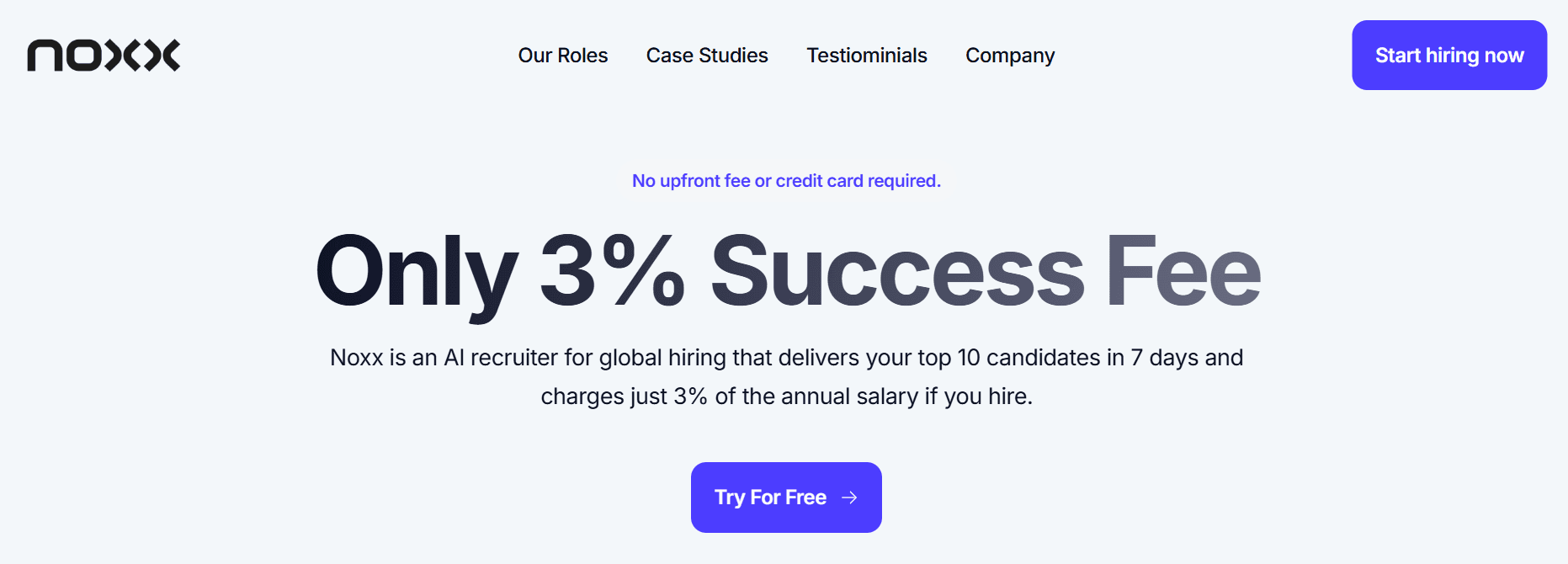
Noxx automates candidate sourcing and screening to deliver the top 10 hires for your job in seven days, charging only when you hire for a flat fee of 300. Upload a job description, establish salary expectations upfront, and reduce hiring costs compared to typical US rates.
Standout Features
- Screens more than 1,000 applicants automatically
- Shows salary expectations
- Focuses on engineers, marketers, and salespeople. Pay only on hire model—no upfront fees or recruiter commissions.
Unique Strengths
- Works like a contingency agency without high commissions.
- Delivers high velocity hiring for small teams and startups
- Pair automated sourcing with clear cost transparency to lower recruiting spend and time to hire.
2. Workable: Full Talent Acquisition Suite for SMBs
Workable provides an applicant tracking system with AI-assisted sourcing screening and onboarding tools geared to small and medium businesses.
Standout Features
- AI recommendations using a 400 million profile pool.
- Automated outreach that targets passive candidates in social feeds.
- Anonymized screening and integrated talent assessments.
- Advanced reporting and compliance features, including single sign-on.
Unique Strengths
Broad end-to-end capabilities from sourcing to onboarding, together with an extensive profile reach, make it a practical one-stop solution for SMBs that want recruitment automation and analytics.
3. Manatal: Global ATS with AI Recommendations
Manatal centralizes sourcing, applicant tracking, and recruitment CRM to expand reach and speed candidate screening for HR teams and agencies.
Standout Features
- Aggregates from more than 2,500 channels
- AI recommendation engine for best-fit candidates in seconds
- ATS and CRM in one platform
- In-depth analytics and compliance tools
Unique Strengths
Strong global reach across 135 countries with easy integrations and an emphasis on democratizing recruitment for smaller teams and agencies.
4. Fetcher: Sourcing Automation with Human Review Layer
Fetcher automates candidate sourcing and outreach so recruiters spend more time on relationships and less on repetitive tasks.
Standout Features
- Blends AI with human curation
- Integrates with ATS email calendar and Slack
- Personalized automated email campaigns that track engagement
- Smart analytics focused on diversity and engagement
- SOC 2 Type II compliance
Unique Strengths
A balanced approach combining automation and human oversight yields higher response rates and better candidate relationships than pure outbound tools.
5. Entelo: Source to Hire Platform with Diversity Focus
Entelo helps sourcing teams find and engage passive and active talent while improving diversity and time to hire.
Standout Features
- Advanced search across deep candidate databases
- Insights on career progression and the likelihood of moving
- Data-based outreach messaging
- Optional managed services team
- Strong security controls
Unique Strengths
Combines predictive signals about candidate intent with outreach advice and managed service options for teams that need tactical support and coaching.
6. Paradox: Conversational Recruiting Assistant for High-Volume Hiring
Paradox automates screening, scheduling, onboarding, and candidate questions with a conversational assistant called Olivia to speed mass hiring.
Standout Features
- Instant job matching via chat
- Text to apply and QR code application options
- Automated screening through messaging and assessments
- End-to-end offer and onboarding automation
- Ethical AI commitment
Unique Strengths
Excellent at mobile-friendly high-volume hiring for retail, restaurant, healthcare, and financial services, where conversational AI and text-based apply to drive volume and speed.
7. Skillate: Resume Matching and Job Description Intelligence
Skillate uses AI to improve job descriptions to match candidates beyond keyword search and automate prescreening via chatbot.
Standout Features
- Job description assistant trained on millions of jobs
- AI candidate matching that reads full resume content
- Integrated chatbot for screening, analytics dashboards
- PII masking to reduce bias
Unique Strengths
Strong resume to job semantics and job description optimization that improves match quality for technical and specialized roles.
8. Teamtailor: Candidate Focused Recruitment and Employer Brand Platform
Teamtailor combines ATS generative AI assistance and employer branding to improve candidate experience and internal collaboration.
Standout Features
Generative AI Co-pilot for job posts, interview questions, and candidate summaries, collaboration tools for feedback and referrals, smart triggers to advance candidates and schedule tasks, analytics, and security team support.
Unique Strengths
Employer brand-centered workflow that makes career sites and candidate communications simple while keeping recruitment automation lightweight for growing teams.
9. ClearCompany: Talent Management with AI-Assisted Hiring and Onboarding
ClearCompany unifies applicant tracking, onboarding performance, and people analytics to support hiring and talent retention.
Standout Features
- AI-assisted ATS that uses top performer profiles
- Automated recruitment campaigns via email and text
- Virtual onboarding automation
- Reporting on turnover diversity and compensation
- SOC 2 Type II compliance
Unique Strengths
Combines recruiting and post-hire performance management so hiring decisions tie directly to retention and role success metrics.
10. Textio: Inclusive Job Description and Recruiting Copy Assistant
Textio analyzes job descriptions, reviews, and other HR text to reduce bias, improve inclusion, and increase candidate response rates.
Standout Features
- Predictive score that estimates the diversity of the applicant pool.
- Optimized job description templates
- Performance review bias reports
- Analytics to track inclusive language, ATS, and LinkedIn integrations.
Unique Strengths
Focus on copy quality and bias reduction makes it a specialist tool for teams trying to improve candidate quality and diversity from the first touch.
11. HireVue: Interview Automation with Assessments and Messaging
HireVue automates chat-based job matching, candidate communications, and structured interview guides to speed evaluation.
Standout Features
- AI chat job matching
- Game-based and technical assessments
- Personalized text-based recruiting
- Built-in messaging to avoid personal device privacy risks
- Interview automation with question templates and evaluation guides.
Unique Strengths
Strong set of assessment types and candidate engagement channels that scale interviewing while preserving structured evaluation.
12. EVA: Conversational and Predictive HR Platform for End-to-End Talent Workflows
EVA supports sourcing, screening, interviewing, onboarding, training, and engagement through a conversational AI assistant and people analytics.
Standout Features
Integrated HR experience with EVA Bot for 24/7 candidate and employee Q&A, AI-driven matching by job skills and interests, workforce planning analytics, automated workflows for document categorization and compliance.
Unique Strengths
Broad HR centric automation that bridges recruiting with ongoing talent management and audit-ready compliance automation.
13. Eightfold: Talent Intelligence and Skills-Driven Hiring Platform
Eightfold uses deep learning to match candidates by skills and potential for hiring internal mobility and workforce planning.
Standout Features
- Centralized talent intelligence for acquisition and management.
- PII masking and skills focus on reducing bias.
- Tailored career planning and upskilling recommendations.
- Insights from massive career trajectory data.
- Security and ethical AI controls.
Unique Strengths
Skills-driven approach backed by a huge career data set that powers internal mobility and long-term workforce planning as well as external hiring.
14. Humanly: Conversational AI Co-Pilot for Scaling Prescreening
Humanly automates candidate screening, scheduling, follow-up, and interview note-taking while syncing with your ATS.
Standout Features
- AI co-pilot for large-scale screening
- Virtual assistant for candidate questions and scheduling
- AI note-taking for Zoom Teams and Google Meet
- Analytics on candidate interactions
- Integrations with engagement tools and ethical AI commitments
Unique Strengths
Emphasis on candidate experience and interview note automation that boosts recruiter productivity in high-volume environments.
15. hireEZ: Sourcing Platform with Massive Candidate Reach
hireEZ supports AI-driven candidate search engagement and pipeline building with broad integrations for enterprise sourcing.
Standout Features
- AI searches for diverse talent
- 30-plus ATS integrations
- Automated scheduling and email campaigns
- Market insights and analytics
- Established an AI values system for fair and transparent hiring.
Unique Strengths
Scale of candidate reach plus ethical guardrails and deep ATS interoperability help large sourcing teams move quickly while staying compliant.
16. SeekOut: AI Talent Acquisition with Diversity and Rediscovery Tools
SeekOut combines talent search with diversity insights and talent rediscovery to accelerate hiring for hard-to-fill roles.
Standout Features
- SeekOut Assist co-pilot for tailored searches with 30-plus filters.
- Data-driven diversity insights
- Automated applicant review and talent rediscovery.
- Integrations with Greenhouse, Bullhorn, and Lever.
Unique Strengths
Rich search filters and underrepresented talent pools make it a go-to for teams focused on diversity hiring and rediscovery of passive candidates.
17. Arya by Leoforce: Interactive Sourcing Assistant-Driven By Talent Intelligence
Arya automates sourcing, ranking, and engagement with AI that learns what makes candidates succeed in your roles.
Standout Features
- Sourcing from 80-plus channels
- AI ranking by success likelihood
- Integrations with 60-plus ATS and CRMs
- Candidate rediscovery and nurture campaigns
- Market intelligence on compensation and skill distribution
Unique Strengths
Predictive ranking combined with broad channel sourcing reduces time to shortlist and improves quality for staffing and enterprise recruiting.
18. Interviewer AI: Generative Video Screening and Interview Automation
Interviewer AI uses AI video and generative tools to create job questions, prescreen candidates, and produce detailed candidate profiles.
Standout Features
- AI video evaluation for communication professionalism and culture fit
- Resume to job mapping
- Automated prescreen assessments
- Collaboration tools for stakeholder feedback
- Real-time talent insights
Unique Strengths
Video first prescreening with generative question creation speeds early-stage filtering and provides richer behavioral data than resume-only screening.
19. Findem: Predictive Sourcing and Talent Rediscovery Platform
Findem centralizes top-of-funnel recruitment tasks using AI for outbound sourcing, inbound management, and candidate relationship work.
Standout Features
- Automated diverse talent pools, a generative AI assistant with conversational analytics.
- Automated candidate review against job requirements.
- Rebuilt dashboards
- Outreach analytics
Unique Strengths
Strong analytics around outbound campaigns and sourcing channel performance that help teams optimize spend and engagement.
20. Beamery: Talent Lifecycle Management with Generative TalentGPT
Purpose: Beamery offers candidate sourcing, proactive pipeline building, and employee development with generative AI features for HR teams.
Standout Features
- Real-time talent lifecycle insights
- Skills-based candidate recommendations
- TalentGPT for personalized engagement
- Integrated talent management for internal mobility
- Centralized skills intelligence
Unique Strengths
Combines talent marketing, recruitment CRM, and skills intelligence to run proactive hiring programs and internal mobility initiatives.
21. HiredScore: Responsible AI for Talent Acquisition and Internal Mobility
HiredScore automates candidate matching and prioritization across external, internal, and passive talent while providing bias audits and compliance.
Standout Features
- Instant candidate matching
- Bias audit tools
- Internal mobility and rediscovery features
- Hiring manager productivity hub
- Integrated scheduling assessments
- Video and chat
Unique Strengths
Focus on responsible AI and enterprise-scale internal mobility that aligns with strategic workforce planning and HR systems.
22. Jobvite: Comprehensive Recruiting Suite with Relationship Building
Jobvite covers employer branding, recruitment marketing, applicant management, onboarding, and referrals in one suite.
Standout Features
- Full talent lifecycle support
- Data-driven insights and benchmark reporting
- Intelligent automation to find matched candidates in one click
- AI chatbot for screening, scheduling, and communications
Unique Strengths
End-to-end recruitment marketing plus relationship management features that help companies build pipelines and reduce time to hire.
23. Pymetrics: Soft Skills and Behavioral Matching Via Gamified Assessments
Pymetrics evaluates cognitive, social, and emotional traits with gamified assessments to match candidates to roles and guide internal mobility.
Standout Features
- Gamified behavioral assessments
- Role guidance before application
- ATS integrations, including Workday and iCIMS
- Custom talent algorithms
- Unique candidate profiles for mobility
Unique Strengths
Objective behavioral data that uncovers potential beyond resume credentials and supports inclusive hiring and career coaching.
24. Recruitee: Collaborative Hiring Platform with Employer Branding
Recruitee helps teams collaborate on sourcing and hiring while making employer branding and career site creation simple.
Standout Features
- No code career site builder
- Customizable pipelines
- Automated scheduling and interview templates
- Custom dashboards
- 120 plus integrations
Unique Strengths
Strong collaboration features and employer branding tools that suit midmarket teams focused on consistent hiring processes.
25. iSmartRecruit: Recruitment Marketing ATS and Candidate CRM in One
iSmartRecruit offers recruitment marketing, ATS, CRM, and AI automation to attract, match, and engage candidates across global markets.
Standout Features
- Branded career pages, social recruiting, job board integrations, and referral management.
- AI matching for skills and cultural fit
- Customizable workflows
- Centralized candidate database
- AI chatbots for engagement
Unique Strengths
Broad mix of recruitment marketing and automation with a focus on scalability for global teams and staffing agencies.
26. Bluedot: Interview Note Taker Built By Recruiters
Bluedot records interviews via a Chrome extension and generates transcripts, speaker insights, and summaries tailored to hiring stages.
Standout Features
- No calendar bots, chrome-based silent recording across Google Meet, Zoom, and Teams.
- Interview-specific templates
- An AI assistant that analyzes CVs, creates job descriptions, and shows salary benchmarks.
Unique Strengths
Recruiter-centric design that captures conversational data accurately and produces stage-specific summaries that speed debriefs and decision-making.
27. Iris by Qureos: 24 Second Sourcing and Multilingual Recruiting
Iris automates rapid candidate sourcing, shortlisting, and outreach with substantial multilingual and job board reach.
Standout Features
- 24-second automated sourcing and shortlisting
- ATS integration
- 20 plus languages
- Access to 100-plus job boards
- Custom job description generation
- Personalized outreach and follow-ups
- AI video interviews
Unique Strengths
Speed and multilingual capabilities make Iris suited for high-velocity recruiting across global and multilingual markets.
28. ChatGPT: Free AI Job Description Writer and Generative Assistant
ChatGPT generates job descriptions, interview questions, and candidate messaging using large language model capabilities and can integrate with ATS via APIs.
Standout Features
- Contextual understanding for role-specific content
- Ability to craft inclusive language
- Custom prompts for tone and keywords
- Potential ATS integration for direct job post generation
Unique Strengths
Flexible free tool for crafting job copy and initial screening scripts that teams can customize to match employer brand and ATS needs.
29. Ashby: Modern ATS with AI Automation and Analytics
Ashby delivers an applicant tracking system that streamlines job posting screening, candidate engagement, and analytics for strategic hiring.
Standout Features
- AI-driven automation across recruitment stages.
- Real-time analytics on pipeline and engagement.
- Tools for candidate communication that improve the experience.
Unique Strengths
Clean product design combined with strong analytics and workflow automation positions Ashby as an emerging ATS for teams that want visibility and speed.
30. Phenom: Candidate Experience Platform with AI Matching and University Recruiting
Phenom uses AI to match candidates with roles and power candidate engagement, career site chatbots, and campus recruiting management.
Standout Features
- AI matching by skills and location
- Chatbot-guided application flow
- Centralized management for university events, both virtual and in-person.
Unique Strengths
Strong talent experience features and campus recruiting capabilities that make Phenom useful for large employers prioritizing employer brand and candidate engagement.
Questions about which tools fit your hiring model or how to combine sourcing, screening, and interview automation for a better time to hire? Ask which roles and volumes you hire, and I will suggest a stack tailored to those needs.
Related Reading
- Best Recruitment Agencies for Startups
- How to Hire for a Startup
- How to Attract Top Talent
- How to Find a Developer for Your Startup
- Where to Hire Developers
- Hire Latin American Developers
- Nearshore Software Development
- Software Development Recruitment Agencies
Addressing the Risks and Rewards of AI in Recruiting

AI recruitment software trims hours of manual work. Resume parsing and candidate sourcing run continuously, letting talent teams focus on higher-value work like relationship building and strategic sourcing. Recruitment automation speeds:
- Candidate outreach
- Interview scheduling
- Screening
Automating Sourcing and Initial Candidate Screening
This enables recruiters to fill pipelines faster. Predictive analytics and candidate matching improve the quality of hire when models are accurate and data-driven. Chatbots and automated outreach raise candidate engagement and reduce drop-off during the hiring funnel. Which parts of your process would you automate first to free up recruiter time?
Where AI Can Hurt Hiring: Bias, Privacy, and Overreach
Algorithms reflect their training data. If a model learns from historical hires that skew toward specific groups, it will repeat those patterns and undermine diversity hiring and DEI goals. Tools that rank, filter, or screen without regular bias checks can create a recruiting pipeline that excludes qualified applicants.
Balancing Automation with Human Touch
Data privacy gaps matter too. Many generative AI tools ingest prompts and outputs into public data sets or vendor models, risking exposure of proprietary compensation bands or interview questions. Overreliance on automation can also narrow the candidate pool and degrade candidate experience when human touch is missing.
Survey Signals: What Teams Focus On and Where They Fall Short
Many companies seek to improve efficiency when adopting AI recruiting tools. Yet only 31 percent performed a data privacy assessment, and just 28 percent worked with vendors to review algorithmic bias. Those numbers show a skewed risk profile that favors speed over safety.
Recruiting leaders must ask whether tools are GDPR and CCPA compliant, whether vendor data handling matches corporate policies, and whether algorithms have been audited for disparate impact.
Generative AI Specific Threats: Data Leakage and Model Risk
Generative models can recreate or reveal sensitive text when prompted. If recruiters paste confidential job specs, compensation structures, or candidate feedback into an LLM, that content could become part of a broader model corpus. Unchecked use of resume drafting or response generation tools can also harm authenticity and introduce credential inflation.
Ask vendors about their data retention, prompt logging, and rules for training on customer data before integrating generative AI into hiring workflows.
Train, Audit, Partner: Practical Rules for Responsible Use
Make responsible use operational. Require vendor documentation on model provenance and performance metrics. Run algorithmic audits that test for disparate impact across gender, race, age, and other protected attributes. Keep humans in the loop for decisions that materially affect hiring outcomes.
Use role-based access and encryption to protect candidate PII. Maintain audit trails and version control for models and criteria to support explanations of hiring decisions. How often do you plan to test a model once it goes live?
Choosing the Best AI Recruiting Tools: A Practical Checklist
Compatibility with existing systems is critical. Ensure the supplier integrates with your applicant tracking system ATS, HRIS, and calendar tools through open APIs. Pick user-friendly software that recruiters can adopt without heavy technical training. Verify accuracy by:
- Requesting case studies
- Error rates for resume parsing
- Success metrics for candidate matching
Ensuring Solution Scalability and Longevity
Check scalability so the solution can handle growth and increased hiring. Confirm data protection practices and legal compliance, and insist on clear vendor commitments for privacy and security. Ask about the update cadence and the vendor's roadmap to determine whether models will be maintained and improved.
Key Metrics for a High-Performing Hiring Funnel
Choose tools that make recruitment analytics easy to track with dashboards showing:
- Time to hire
- Funnel conversion
- Source quality
- Fairness metrics
Questions Recruiters Should Ask Vendors Right Now
- Does the model use your data for training, and if so, how is that controlled?
- What fairness tests have you run, and what were the results?
- How do you log prompts and outputs, and how long do you retain them?
- Can the tool integrate with our ATS and HRIS?
- What encryption and access controls do you use for candidate data?
- How do you handle model updates, and what is your rollback plan if a model degrades?
- Would you provide a contract clause for algorithmic transparency and periodic audits?
Implementation Playbook: Policies, Training, and Monitoring
Create a short policy that defines acceptable use for generative AI and automated screening. Train recruiters on:
- Prompt hygiene
- Data handling
- When to choose a human review
Pre-Deployment Model Testing
Build standard operating procedures for model testing before deployment and for ongoing monitoring after deployment. Use a combination of synthetic test sets and anonymized historical data to evaluate accuracy and bias. Schedule quarterly audits that include:
- Disparate impact testing
- Explainability checks
- Performance drift analysis
Measuring Success: Metrics That Matter Beyond Speed
Track traditional KPIs like time to hire, cost per hire, and offer acceptance rate. Add fairness metrics such as:
- Selection rates by group
- False positive and false negative rates for screening models
- Candidate satisfaction scores
Monitor model performance with continuous validation metrics and set alerts for drift. Include downstream measures like retention rates and performance of hires sourced through AI to assess long-term ROI.
Forward Motion: Balancing Innovation with Ethical Responsibility
Adopt AI thoughtfully so your team can benefit from:
- Resume screening
- Candidate matching
- Interview scheduling
- Analytics while protecting candidates and the company
Establishing a Robust Governance Framework for AI in Hiring
Pair vendor due diligence with internal practices:
- Regular privacy assessments
- Algorithmic audits
- Human oversight
- Transparent governance that ties AI use to corporate hiring policies
Ensuring Transparency and Accountability in AI Adoption
Incentivize transparency by asking for explainability and audit rights in contracts. Train every recruiter to use AI tools as assistants rather than decision makers, so accountability stays clear. Keep innovation on the table, but treat risk control as part of the cost of adoption so AI enhances long-term hiring quality and trust.
Related Reading
- Startup Recruiters
- Jobvite Alternatives
- Paradox AI
- hireEZ Alternatives
- Greenhouse Alternatives
- Workable Alternatives
- Jobvite Alternatives
- Hire Asian Develpers
- Offshore Software Development
- Best Countries for Offshore Software Development
Upload a Job and Get 10 Candidates within 7 Days with Noxx (No Risk, No Upfront Fees)
Noxx uses machine learning and natural language processing to screen over 1,000 applicants and surface the top 10 candidates in seven days. The system parses resumes, scores skills, ranks cultural fit, and filters for experience with role-specific tests. It automates:
- Candidate sourcing
- Resume screening
- Candidate ranking
- Shortlisting
This lets your hiring manager focus on interviews, not sorting files. Want a recruiting engine that reduces time to fill and improves candidate quality?
Pay Only When You Hire
You pay $300 only if you hire someone. No upfront fees, no expensive recruiter commissions, no monthly subscription traps. This shifts cost per hire down and reduces the cost of recruitment by using recruitment automation, candidate sourcing, and interview scheduling features that replace legacy recruiter markups. How would a predictable low fee change your hiring budget?
Salary Transparency Up Front
Noxx shows salary expectations for each candidate before you commit to interviews. The platform pulls salary data, applies salary benchmarking, and presents compensation ranges so you can:
- Set realistic offers
- Avoid losing candidates to unseen pay gaps
This transparency improves offer acceptance and simplifies compensation negotiation with data-driven insights.
Quality Across Engineers, Marketers, and Sales People
The AI applies role-specific screening for engineers, marketers, and salespeople. For engineers, it checks:
- Technical experience
- Project history
- Coding assessments
Tailored Skills Assessments for Marketing and Sales
For marketers, it evaluates campaign outcomes, platform experience, and analytics skills. For salespeople, it measures quota history, pipeline management, and closing ratios. The system supports skills assessment, passive candidate sourcing, and diversity hiring filters to maintain consistent quality.
Upload Your Job Description and Let AI Do the Heavy Lifting
Drop in your job description, and Noxx builds a sourcing plan. The platform:
- Posts optimized job ads
- Searches internal and external talent pools
- Runs Boolean-style queries
- Uses a sourcing engine to discover passive candidates
It integrates with applicant tracking systems and recruitment CRM workflows, automates interview scheduling, and maintains a candidate pipeline so your hiring team can focus on fit and culture.
How Noxx Reduces Hiring Cost up to 70 Percent
Compared with typical US rates, Noxx leverages global talent sourcing and salary benchmarking to find high-quality candidates at lower labor rates. Recruitment automation, predictive analytics, and efficient candidate engagement shrink the hiring funnel and bring down cost per hire.
The math works when you compare recruiter commissions and the time it takes to hire with a fixed hire fee and a faster time to fill.
Why Noxx Belongs on Any Best AI Recruiting Tools Shortlist
Noxx combines resume parsing, candidate matching, predictive analytics, interview automation, and recruitment analytics in one workflow. It scores candidates, measures quality of hire, and tracks conversion rates through the hiring funnel. If you are researching the best AI recruiting tools, consider:
- Sourcing efficiency
- Candidate experience
- ATS integration
- Recruitment analytics when you compare platforms
Recruitment Metrics and Reporting You Can Use
Noxx delivers dashboards with time to hire, candidate conversion, offer acceptance, and diversity metrics. You can:
- Export recruitment analytics for hiring reviews
- Run A/B tests on job posting optimization
- Measure candidate engagement over time
These reports help hiring teams iterate on job descriptions and refine their talent acquisition strategy.
Common Questions Hiring Managers Ask
- Can I integrate with my ATS?
Yes, Noxx supports major applicant tracking systems and can push candidates into your workflow.
- Who owns candidate data?
The client retains candidate ownership and controls outreach.
- What is the timeline?
You get the top 10 candidates in seven days after posting.
- What if none fit?
There is no upfront fee and no recruiter commission until you hire someone, so your downside stays low.
- Which roles work best?
Engineers, product people, marketers, and sales professionals align with the platform's strengths.