25 Best Startup Recruiters to Help You Hire Smarter
Noxx Team

Hiring at a startup often feels like a race against the clock. Founders can spend weeks chasing resumes, juggling interviews, and second-guessing culture fit—all while burning precious runway. The right startup recruiter changes that equation, helping you cut through the noise, connect with stronger candidates, and free up time to focus on building your company. Also, how to Hire Offshore Developers?
In this article, we’ll break down practical strategies, and introduce tools like Noxx’s AI recruiter, that act as reliable hiring partners. By automating sourcing and candidate scoring, they bring you better matches faster, reduce the stress of hiring, and keep your momentum firmly on product and growth.
Table of Contents
- What is a Startup Recruiter Service and Why Use One?
- 25 Best Startup Recruiters for Tech, SaaS, and Beyond
- What to Look for in a Startup Recruiter Service
- Upload a Job and Get 10 Candidates Within 7 Days with Noxx (No Risk, No Upfront Fees)
What is a Startup Recruiter Service and Why Use One?

A startup recruiter service finds the people a new company needs to build a product, grow sales, and run operations. They act as an external hiring partner that sources candidates from:
- Job boards
- Recruitment platforms
- Professional networks
- Talent marketplaces
They screen resumes, run interviews, recommend hires, and often handle offers and negotiations. They get paid via a service fee or a percentage of a new hire’s first year's salary, or via retainer or contract arrangements for specific searches.
How This Differs From Traditional Recruiting or In-House Hiring
Traditional corporate recruiting usually relies on:
- In-house HR teams
- Internal hiring managers
- Existing employer brand strength
Sourcing Talent for High-Growth Startups
A startup recruiter focuses on early-stage needs: speed, flexibility, and sourcing candidates who can tolerate ambiguity and wear many hats. They work without the whole infrastructure of a large HR department, and they often use contingency or retained search methods and targeted headhunting to find passive candidates. They also help shape employer branding and candidate pipelines when your company brand is still new.
The Hiring Problems Startups Run Into Fast
Startups face tight cash, small teams, and a launch timeline that forces quick hiring. Founders juggle product, fundraising, and customers, leaving little time for sourcing and screening. Startups often cannot match established companies on base salary, and they must identify people who thrive in rapid change and unclear role boundaries. Hiring mistakes at this stage cost time, morale, and runway. What happens when you need an engineer this month or a head of growth next quarter, and you have no recruiting team ready to scale?
Exactly What Recruiters Do for Startups: Tasks and Techniques
Startup recruiters build the candidate funnel and keep it flowing. They run targeted searches on job boards and recruitment platforms, mine professional networks, and tap into passive candidate pools. Typical tasks include:
- Screening resumes and applications
- Conducting phone or technical screens
- Coordinating interviews
- Delivering candidate briefs to founders
- Advising on offer strategy and benefits design
Navigating the Full
They may also handle background checks, salary negotiation, and basic onboarding setup, like paperwork and account provisioning. For executive or hard-to-fill roles, they use retained search and executive recruiting techniques.
Fee Models and Payment Options for Startups
Recruiting firms commonly charge a percentage of the hired candidate’s first year's salary, or a flat service fee. Some offer contingency search, where payment is due only if they place a candidate, and others use retained search with staged payments. Startups can sometimes negotiate graduated payment plans or milestone-based fees to spread the cost over time. Contract recruiting and talent as a service options let you buy part-time or project-based recruiting support to control cash flow.
When It Makes Sense to Bring in a Startup Recruiter
If you lack a hiring manager, if founders are stretched thin, or if you need to fill multiple roles quickly, bring in an external recruiter. Recruiters also help when:
- You need speculative sourcing for future hires
- You must hire for niche technical skills
- You plan to scale the headcount fast
Ask yourself: Is my team spending more time on screening than on customer work? If yes, a recruiting partner will recover that time and improve the candidate pipeline.
How Recruiters Improve Your Odds of Finding Culture Fit Candidates
Startup recruiters assess skills and cultural fit. They learn your mission and the behaviors that matter:
- Ownership
- Resourcefulness
- Rapid learning
Talent and Culture Alignment
They screen for alignment with your culture, not just for resume matches. Good recruiters design interview scores and structured hiring processes so bias is reduced and diversity and inclusion are built into sourcing and selection. They help you retain the consistency of culture while you scale hiring volume.
Common In-House Hiring Pain Points for Startups
Many startups lack recruiting experience, structured interview processes, or candidate tracking systems. Founders often underestimate the time to hire and miss passive candidate markets. Competing against established firms on pay leads to losing talent when you try to hire alone. Without a scalable process, you risk hiring people who are not a long-term fit, which increases churn.
Strategic Recruiting Systems
Recruiters can do the following:
- Install systems
- Cultivate employer brands
- Craft hiring messages that sell upside beyond salary
How Recruiters Compete When You Can’t Match Big Company Pay
Recruiters use creative compensation strategies and employer branding to attract talent. They highlight:
- Equity upside
- Learning opportunities
- Leadership exposure
- Flexible work
- Meaningful mission
They package benefits, craft role narratives, and present candidates with total compensation options. They also target candidates who already seek startup environments or who want faster career growth than a large company offers.
How Recruiters Build Inclusive, Scalable Hiring Processes
Recruiters help set up structured job descriptions, scorecards, and interview guides that focus on skills and potential. They source diverse candidate pools through specialized networks and affinity groups. They recommend recruiting metrics and ATS workflows so interviewing and onboarding scale with headcount. That early investment pays off by:
- Reducing bias
- Improving retention for the long run
Advantages You Get from Working with Startup Recruiters
- Higher quality hires due to industry knowledge, technical recruiting experience, and executive search capabilities.
- Better candidate flow because recruiters access extended networks and passive talent.
- A larger, more diverse pool of qualified applicants from targeted sourcing.
- Time savings on sourcing, screening, scheduling, and negotiating so the founding team focuses on product and revenue.
- The ability to scale hiring faster with repeatable processes and candidate pipelines.
- Flexible payment models, such as graduated or milestone fees, can help cash-strapped startups.
- Strong return on investment when a senior hire drives product, revenue, or fundraising success.
Questions to Ask Before You Hire a Startup Recruiter
- What is their track record with early-stage companies in your sector?
- How do they source passive candidates and measure time to hire?
- Can they provide references for similar roles?
- Do they offer contingency, retained, or contract arrangements?
- What role will founders play in interviews and decision-making?
These questions show whether the recruiting partner will integrate with your team and hiring rhythm.
A Quick Checklist of Services to Expect From a Startup Recruiter
- Candidate sourcing from job boards, platforms, and networks
- Resume screening and phone or technical screens
- Interview scheduling and candidate briefing
- Hiring recommendations and scorecard summaries
- Offer creation, salary, and benefits negotiation
- Basic onboarding coordination and background checks
- Employer branding and talent pipeline development
If you want help shortlisting recruiters or building a hiring playbook, what role should they fill first in your company right now?
Related Reading
- Hire Offshore Developers
- How to Recruit Engineers
- Recruitment Process Outsourcing
- Recruitment Automation Trends
- How to Recruit Tech Talent
- Best Company Hiring Practices
- Types of Recruitment Agencies
- Benefits of Outsourcing Recruitment and Selection Process
- How to Recruit IT Talent
- Strategic Recruiting
- Top 10 Recruiting Apps
25 Best Startup Recruiters for Tech, SaaS, and Beyond
1. Fast Hires, Low Risk, AI First: Noxx for Startups
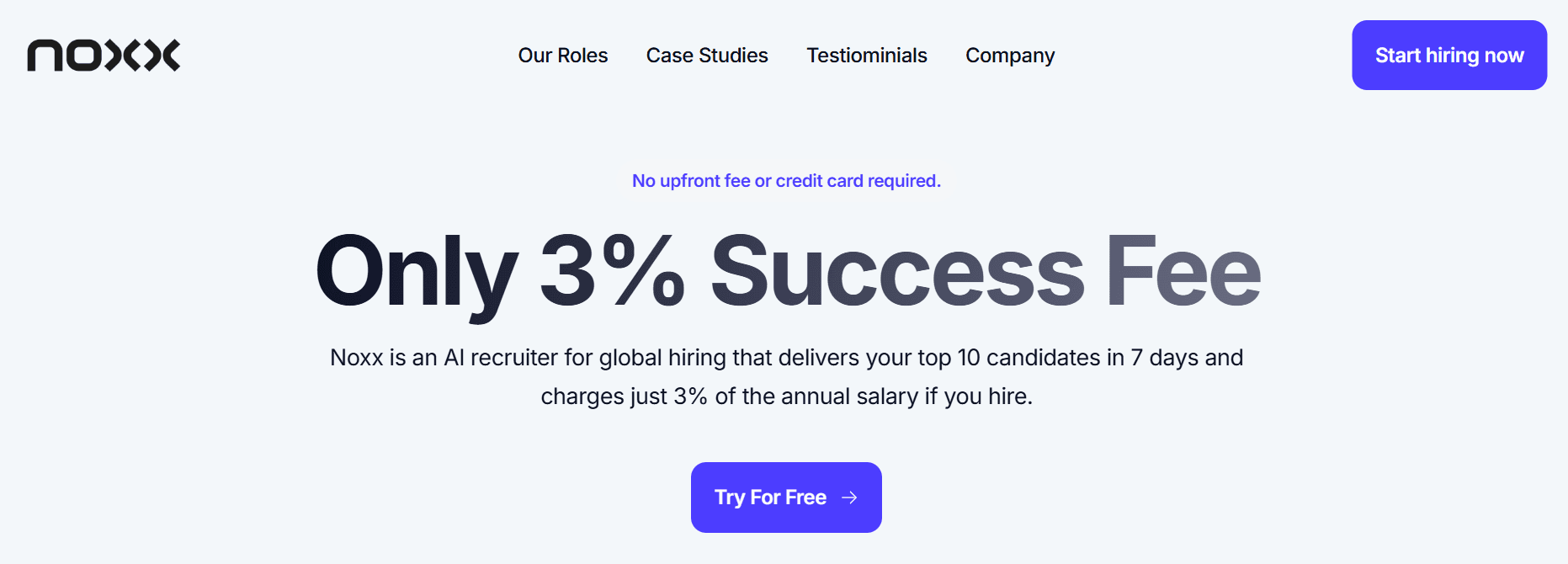
Noxx uses an AI recruiter to screen large applicant pools and surface the top candidates fast. Upload a job description and the platform automatically reviews over 1,000 applicants, delivers the top 10 candidates in seven days, and shows salary expectations up front. You pay only a 3% success fee if you hire someone, with no upfront payment or percentage recruiter commissions.
Specialties and clients
Noxx focuses on engineers, marketers, and sales talent for startups and small teams that need speed and cost control. They target hiring needs across early-stage and growth-stage companies.
What Makes Them Stand Out For Startups
They reduce time to hire and lower acquisition costs by automating screening and salary transparency. The payment model shifts hiring risk away from the startup and aligns incentives to actual hires.
Key Features
- AI-driven screening of 1,000-plus applicants
- Shortlist of top 10 candidates within seven days
- Salary expectation visibility up front
- Pay only when you hire: 3% success fee
- No retainer or percentage commissions
How do These Features Help Startups?
The AI screening saves founder and hiring manager hours, the fast shortlist preserves momentum during hypergrowth, and the low placement fee keeps burn under control while enabling access to talent pools that usually cost much more.
2. Latin America Talent Aligned with Your Time Zone: Near
Near is a staffing and recruiting agency that fills remote roles for US companies from Latin America. They source across:
- Finance
- Sales
- Software engineering
- Design
- AI
- Data
- Marketing
- Operations
- Virtual assistance
Specialties and Industries
Startups seeking remote skill sets with time zone overlap and cost efficiency use Near for engineering, data, and customer-facing roles.
What Makes Them Stand Out For Startups
Focused sourcing in LatAm means candidates often expect salaries 30 to 70 percent lower than US peers and work overlapping hours with US teams.
Key Features
- Candidate profiles delivered within three days
- Typical time to fill is around 21 days
- End-to-end services: sourcing, screening, contracts, payroll, and local compliance.
- Flexible fee models: pay per hire or a monthly staffing model, and a replacement guarantee.
How These Features Help Startups
Fast candidate delivery keeps product and go-to-market timelines on track, while payroll and compliance management remove cross-border hiring friction for lean teams.
3. Referral Powered Hiring with Tech at the Core: Hunt Club
Hunt Club blends a referral network with machine learning to find active and passive candidates for startups and growth companies. They operate as a membership and technology-driven search engine rather than a traditional contingency firm.
Specialties and Industries
Executive and senior hires for sales, engineering, product, and growth roles. They work with Series A and beyond startups that need experienced operators.
What Makes Them Stand Out For Startups
Their extensive network of operators and industry experts accelerates warm introductions, and their AI helps surface fits faster than cold outreach alone.
Key Features
- Network of 25,000 plus industry experts and executives
- AI-powered candidate search and engagement
- Tailored searches by company stage and role needs
How These Features Help Startups
Referrals respond faster, and stage-informed search increases the chance of cultural and operational fit for key hires who must ramp quickly.
4. Fractional Finance Talent on Demand: Paro
Paro connects companies to vetted finance and accounting professionals, including controllers, CFOs, and bookkeepers, on a fractional or project basis.
Specialties and Industries
Startups with fundraising, FP&A, or accounting needs that cannot yet afford a full-time senior finance hire.
What Makes Them Stand Out For Startups
Access to senior credentialed talent without the full-time salary commitment helps early companies keep runway while getting quality financial leadership.
Key Features
- Network of over 8,000 vetted finance experts
- Fractional engagements, short-term projects, and end-to-end recruitment
- Professionals with CPA or MBA-level credentials and senior experience
How These Features Help Startups
Fractional and project models let founders get immediate expertise for fundraising, metrics, and controls without the commitment of burn or long-term hiring risk.
5. Global Executive Search Plus Talent Advisory: Korn Ferry
Korn Ferry is a global talent advisory and search firm that places senior leaders and provides organizational consulting, leadership assessment, and compensation benchmarking.
Specialties and Industries
C-level and senior executive hires across industries, plus startups that need structure, compensation design, and leadership evaluation.
What Makes Them Stand Out For Startups
They combine deep candidate networks with advisory services that help startups define roles, design orgs, and accelerate retention for mission-critical hires.
Key Features
- Global network and millions of candidate records
- Leadership assessment and organizational design consulting
- Compensation market data and onboarding advisory
How These Features Help Startups
For founders hiring their first head of engineering or CFO, Korn Ferry brings research and a process that reduces hiring risk and supports investor confidence.
6. Access High-Paid Talent Without Agency Fees: Ladders
Ladders is a job board focused on jobs paying $100K plus, connecting employers with experienced professionals.
Specialties and Industries
Senior product managers, engineers, and executives for startups who can self-manage screening.
What Makes Them Stand Out For Startups
Fixed cost posting lets startups access high-quality candidates without paying hefty percentage-based recruiter fees.
Key Features
- Candidate pool focused exclusively on $100K plus roles
- An extensive network of more than 7 million professionals
- Simple pricing starting at $599 per job post
How These Features Help Startups
Startups with internal recruiting capacity can reach senior candidates directly and manage cost per hire with predictable pricing.
7. Data First Search for Scaling Tech Teams: Candidate Labs
Candidate Labs uses data science plus human recruiters to match candidates to product, marketing, and engineering roles at venture-backed startups.
Specialties and Industries
High-growth technology companies scaling go-to-market and engineering teams.
What Makes Them Stand Out For Startups
A proprietary AI matching engine reduces noise and brings tailored candidate pipelines that reflect the startup context.
Key Features
- Data-driven candidate matching platform
- Executive search and strategic hires service
- Focus on go-to-market roles and engineering talent
How These Features Help Startups
Data-backed sourcing speeds up pipeline building and improves the quality of hire while matching candidates who understand startup velocity.
8. The Startup Job Market Hub: Wellfound Formerly AngelList Talent
Wellfound hosts a marketplace of startups and job seekers, enabling founders and hiring managers to source candidates directly or use a premium curated service.
Specialties and Industries
Early-stage startups across product, engineering, design, and growth roles.
What Makes Them Stand Out For Startups
Large startup-focused audience and transparent salary info that helps with salary benchmarking and candidate outreach.
Key Features
- Direct candidate outreach on the platform
- Free ATS integrations with major systems like Greenhouse and Lever
- Curated talent service and paid filters for advanced screening
How These Features Help Startups
Startups get direct access to a startup native talent pool plus integrations that preserve existing recruiting workflows and data.
9. Build Revenue Teams with a Retention-First Approach: Blueprint Expansion
Blueprint Expansion recruits sales, marketing, and customer success professionals and also fills executive-level revenue roles.
Specialties and Industries
Go-to-market hires for startups, especially sales and customer success functions.
What Makes Them Stand Out For Startups
High retention metrics and an emphasis on role fit rather than just skill match optimize longer-term performance.
Key Features
- Reported a 97 percent retention rate for placements
- Experts in sales, marketing, and CS role definition
- Sourcing beyond tech hubs to find untapped talent
How These Features Help Startups
Hiring the right sales profile at the right stage reduces ramp time and preserves cash when quotas are critical.
10. Sales Talent That Closes: Sales Talent Agency
Sales Talent Agency specializes in recruiting B2B sales and go-to-market talent, with an emphasis on performance traits for revenue roles.
Specialties and Industries
Startups building repeatable revenue engines and enterprise sales teams.
What Makes Them Stand Out For Startups
Their exclusive focus on sales gives them diagnostic skills to identify reps who will hit targets in a startup setting.
Key Features
- Interviewing more than 18,000 candidates a year
- Services include executive search, contingency, and rent-a-re recruiter
- Pricing models include retainers and placement fees tied to salary
How These Features Help Startups
Specialist screening filters for methodology, cycle length, and territory experience yield sales hires who can ramp fast.
11. Salesforce Experts When Your CRM Matters: SF Recruiters
SF Recruiters focuses on hiring across the Salesforce ecosystem, covering admins, developers, and technical architects.
Specialties and Industries
Startups relying on Salesforce for sales ops, CRM automation, and integrations.
What Makes Them Stand Out For Startups
Deep domain knowledge reduces ramp time for platform-specific work and technical interviewing that validates candidate skills.
Key Features
- Salesforce domain specialization
- Technical interviewing and reference checks
- Global sourcing for remote work
How These Features Help Startups
Quick access to vetted Salesforce pros helps startups scale automation and reporting without the need for internal trial and error.
12. Creative and Marketing Talent for Brand and Product Growth: Creative Circle
Creative Circle supplies designers, copywriters, UX people, and marketing specialists across freelance, contract, and full-time roles.
Specialties and Industries
Startups that need brand building, digital campaigns, and UX work often require solutions without large permanent teams.
What Makes Them Stand Out For Startups
Rigorous vetting plus flexible engagement types let teams scale creative output quickly.
Key Features
- Live interviews, technical skills tests, and soft skill evaluation
- Flexible models: freelance, contract to hire, direct hire
- Studio and flex bench teams that integrate with in-house staff
How These Features Help Startups
Startups can spin up product marketing or redesign projects quickly and iterate with external talent until the right hire is clear.
13. Executive Search for Engineering and Industrial Sectors: JMJ Phillip
JMJ Phillip conducts retained and contingent executive searches across manufacturing, engineering, and supply chain sectors.
Specialties and Industries
Startups in manufacturing, industrial tech, and supply chain are looking for senior operations and engineering hires.
What Makes Them Stand Out For Startups
They offer rapid placement options and discreet retained search for leadership roles that require confidentiality.
Key Features
- Rapid placement service and retained search options
- Succession planning expertise
- Industry-focused recruitment and cultural fit emphasis
How These Features Help Startups
For hardware or industrial startups, a specialist recruiter reduces hiring cycles for roles that require niche operational experience.
14. Leadership Search Plus Coaching: N2Growth
N2Growth blends executive search, board and succession planning, and one-on-one leadership development and coaching.
Specialties and Industries
Startups are seeking C-level and board-level hires, coupled with leadership development plans.
What Makes Them Stand Out For Startups
They combine placement with coaching to help new leaders transition into high-growth environments.
Key Features
- Board and executive search
- Succession planning services
- Leadership development and executive coaching
How These Features Help Startups
When a startup needs a leader who can scale teams and culture, integrated coaching increases the odds that the hire will perform and stay.
15. Sales and Marketing Talent for SaaS Growth: Hired By Startups
Hired By Startups focuses on sourcing sales and marketing talent for high-growth SaaS companies using a vetted network of professionals.
Specialties and Industries
SaaS companies that need revenue-driving hires across sales and marketing.
What Makes Them Stand Out For Startups: They maintain a network of assessed sales and marketing professionals familiar with SaaS metrics and quota-driven roles.
Key Features
- Network of SaaS sales and marketing candidates
- Rigorous assessments and referrals
- Focus on hires that scale revenue in subscription models
How These Features Help Startups
Filling revenue seats with candidates who understand churn, ARR, and pipeline metrics reduces onboarding friction.
16. Rapid Hiring with Global Sourcing Hubs: Kandidate
Kandidate supports scaleups and startups with fast hiring pipelines, reducing average time to hire through local and global sourcing teams in major tech hubs.
Specialties and Industries
Tech startups in San Francisco, London, New York, and Lisbon are looking for engineering and product talent.
What Makes Them Stand Out For Startups
Location-based teams plus advanced sourcers focus on speed without sacrificing candidate quality.
Key Features
- Average time to hire is around 26 days
- Teams located in global tech hubs for localized sourcing
- Use of advanced sourcers and recruitment partners
How These Features Help Startups
Shorter hiring cycles help teams keep product roadmaps on track and reduce lost opportunity from delayed hires.
17. Global Digital Recruitment with Compensation Transparency: Salt
Salt is a global recruitment agency covering roles across communications, finance, technology, and healthcare with clear information on compensation and working arrangements.
Specialties and Industries
Mid-market and enterprise roles across multiple industries, plus remote and hybrid placements. What Makes Them Stand Out For Startups: Public compensation insights and broad geographic reach reduce uncertainty around offers and candidate expectations.
Key Features
- Compensation and work arrangement transparency in job briefs
- Global sourcing across multiple sectors
- Expertise in hybrid and remote work models
How These Features Help Startups
Clear compensation signals speed offer acceptance and reduce renegotiation for competitive candidates.
18. High Growth Search with Software and Data Emphasis: Candidate Labs Repeat View
Candidate Labs combines software-driven sourcing with experienced search professionals to help venture-backed firms scale teams across fintech, remote work, and other tech verticals.
Specialties and Industries
Fintech, enterprise software, and remote-first companies that need bespoke hiring for technical and go-to-market talent.
What Makes Them Stand Out For Startups
They pair software tools with domain recruiters to produce scalable pipelines and measurable hiring outcomes.
Key Features
- Proprietary sourcing software and data pipelines
- Cross-functional recruiters for engineering and GTM teams
- Executive and team building engagements
How These Features Help Startups
Software-backed processes make candidate search repeatable and allow teams to measure conversion and time to hire across roles.
19. Embedded Recruiting and Flexible RPO Options: SecureVision
SecureVision embeds recruiting talent into client teams and offers contract recruiting, on-demand services, and RPO to reduce cost and increase fill rates.
Specialties and Industries
Companies need scalable recruiting capacity across technology and product functions with international hiring needs.
What Makes Them Stand Out For Startups
High fill rate and global presence let SecureVision run ongoing hiring programs while internal teams focus on product and ops.
Key Features
- Embedded recruiters and RPO models
- On-demand and contract recruiting services
- Global footprint across the Americas, Europe, and the Asia Pacific
How These Features Help Startups
Embedded models accelerate pipeline velocity and provide predictable hiring throughput during rapid scaling phases.
20. Contract Resource Solutions for Government Digital Projects: Hanover
Hanover supplies contract resources and digital skills for public sector digital transformations, using automation and experienced resource managers.
Specialties and Industries
Public sector and large programs work in digital and data transformation.
What Makes Them Stand Out For Startups
Deep experience placing digital and data contractors for complex programs, combined with AI and automation for resourcing decisions.
Key Features
- Contract resource marketplace for digital and data skills
- Use of AI and automation in resource matching
- Experience in public sector procurement and compliance
How These Features Help Startups
Startups doing public sector pilots or complex integrations benefit from rapid access to contract expertise with procurement knowledge.
21. Subscription-Based Hiring that Keeps You Covered: Berg Search
Berg Search offers a talent subscription service that takes responsibility for hires over 12 months with intensive sourcing and screening.
Specialties and Industries
Startups that need an ongoing hiring partner rather than one-off searches.
What Makes Them Stand Out For Startups
The subscription model aligns agency incentives with long-term hiring needs and provides continuity across multiple roles.
Key Features
- Talent acquisition strategy and candidate evaluation under a subscription
- Committed hiring support for 12 months with early termination options
- Rapid delivery of interviewed candidates within a week
How These Features Help Startups
Consistent sourcing and rapid candidate throughput reduce downtime between hires and streamline scaling across functions.
22. Flexible global recruiting with subscription or pay-as-you-go — Scede
Scede offers cost-effective recruitment services with subscription or pay-as-you-go models and a remote-first team that hires globally.
Specialties and Industries
European and North American startups scaling across engineering, product, and operations.
What Makes Them Stand Out For Startups
Remote-first recruiters and flexible pricing let startups pick the level of support they need as hiring demand changes.
Key Features
- Subscription and pay-as-you-go engagement models
- Remote first recruiting team in Europe and North America
- Proven track record scaling more than 100 companies since 2013
How These Features Help Startups
Flexible contracts reduce fixed hiring overhead and let startups expand or contract recruiting support based on funding cycles.
23. Technology-Backed Recruiting at Scale: Join Talent
Join Talent provides recruitment and talent transformation services backed by investments in recruiting technology, such as applicant tracking and sourcing tools.
Specialties and Industries
Companies that need talent strategy, sourcing, and transformation across multiple functions.
What Makes Them Stand Out For Startups
A large team and investment in tech platforms like LinkedIn Recruiter and Yoke provide scale and access to premium sourcing channels.
Key Features
- Large talent team with over 200 staff
- Investment in recruitment technology and tools
- Services from sourcing to talent transformation
How These Features Help Startups
Access to enterprise-grade recruiting tools without the upfront license speeds candidate discovery and process maturity for growing teams.
24. RPO with Embedded Partners and Employer Brand Focus: Chapter 2
Chapter 2 provides recruitment process outsourcing, embedding talent partners, licensing recruitment technology, and executing employer brand strategies.
Specialties and Industries
Companies of all sizes need full or partial hiring process management across functions.
What Makes Them Stand Out For Startups
Their bespoke approach scales from supporting an internal team to running the whole hiring function, and they report significant reductions in cost per hire for clients.
Key Features
- Embedded talent partners and RPO services
- Integration of employer brand and recruitment technology
- High volume hiring capability with more than 7,500 hires per year
How These Features Help Startups
Employers gain predictable hiring throughput and brand-aligned candidate experiences that improve offer acceptance and retention.
25. Modern Recruiting with Proprietary Tools: Hirewell
Hirewell offers modern recruiting services from self-service tools to executive search, backed by proprietary recruiting technology and subject matter expertise.
Specialties and Industries
Startups across technology and professional services need tailored recruiting solutions.
What Makes Them Stand Out For Startups
They combine human recruiters with technology to streamline hiring while adapting to different levels of engagement.
Key Features
- Proprietary recruiting technology to improve matching and screening
- Range of services from self-service to full executive search
- Recruiters with deep industry knowledge
How These Features Help Startups
Technology-driven screening reduces time spent on low-fit candidates and lets startup teams focus on interviewing and onboarding high-potential hires.
Related Reading
- Best AI Recruiting Tools
- Best Recruitment Agencies for Startups
- How to Hire for a Startup
- How to Attract Top Talent
- How to Find a Developer for Your Startup
- Where to Hire Developers
- Hire Latin American Developers
- Nearshore Software Development
- Software Development Recruitment Agencies
What to Look for in a Startup Recruiter Service

Recruiters who have lived the startup journey understand stage-specific pressures:
- Tight budgets
- Ambiguous roles
- Equity negotiation
- Rapid pivots
- Need for quick cultural fit
Ask for measurable outcomes, not claims. Request their placement success rate for startups by:
- Stage
- Retention at six and twelve months
- Examples of hires who scaled with the company
Ask the founders, they have been placed into seed through Series C companies for candid feedback. Use recruitment metrics like time to hire, offer acceptance rate, and retention as proof points that can be verified with references and client case studies.
Niche Hunters: Specialized Role Focus Wins
Generalist recruiters cast a wide net and miss depth. For technical hires or niche product roles, you want a recruiter with a proven pipeline in your stack and function. Ask the following:
- How many hires did they place last year for the role you need
- The tech stacks they cover
- To see anonymized candidate profiles they presented
Test them: Give a short role spec and ask them to outline where they will source five qualified candidates and how long that will take.
Source and Screen: What Their Sourcing and Vetting Looks Like
Quality sourcing matters more than flashy volume for startups. Probe their channels: active networks, passive sourcing, open source contribution hunts, bootcamp and university pipelines, diversity pools, and community sourcing.
Ask for a sample screening workflow
CV triage criteria, sample screening call script, skills tests, live coding sessions, or work sample assessments, and their reference check template. Request pass-through rates at each stage and average time from first contact to technical interview.
White Glove Recruiting: Personal, High Touch Service
Startups need a recruitment partner who acts like an internal talent leader. Ask who will own the search on a day-to-day basis and how many concurrent searches that person runs. Expect consultative deliverables:
- Revised job briefs
- Market compensation data
- Candidate briefing notes
- Offer negotiation support
Require a named account lead, weekly touch points, and written candidate summaries that make decisions faster.
Open Lines: Communication, Reporting, and Transparency
You must see the pipeline and understand blockers. Ask for access options:
- ATS read-only views
- Weekly dashboards
- Real-time candidate trackers
Request cadence for updates and a template showing candidate quality, stage breakdown, time in stage, and reasons for candidate rejections. Ask how they report lost candidates and whether they provide candidate feedback transcripts you can review.
Culture Add, Not Culture Clone: Vetting for Cultural Fit
Skills are table stakes. Culture determines retention and velocity. Ask them to describe their method for assessing values fit and to provide example behavioral questions and scorecards.
Request Evidence
Anonymized interview notes that show probing for:
- Decision-making
- Ownership
- Learning orientation
- Alignment with core values
Insist they test for cultural signals early in screening so your interview loops focus on role depth.
Hands-On Support Beyond Sourcing: Employer Brand and Process Design
Top recruiting partners fix process problems and fill seats. Ask whether they help:
- Design hiring funnels
- Create employer branding materials
- Run candidate nurture campaigns
- Set up interview training for hiring managers
Ask for examples where they reduced time to hire by redesigning a hiring process or improved offer acceptance through better compensation packaging and onboarding plans.
Fast Movers: Speed and Agility in Hypergrowth
Speed protects talent. Ask for their typical time to fill by seniority and role type and for their current pipeline of ready candidates. Request metrics like average time from first interview to offer and offer acceptance rates. Ask what they do to compress hiring cycles: dedicated interview days, calendar coordination, parallel interviewing, and a candidate closing playbook.
Clear Money Map: Fees and Contract Terms Explained
Fee structures vary and create misaligned incentives when unclear.
- Ask whether they work contingency, retained, fixed fee, or hourly contract models, and what percentage range they charge for contingency or retained searches.
- Request written terms on replacement guarantees, candidate ownership windows, payment milestones, exclusivity, and additional charges for sourcing research or background checks.
- Negotiate service level agreements and a clause tying fees to specific outcomes where possible.
Proof in the People: Reputation and Client References
Reputation matters in local ecosystems and niche markets.
- Ask for three references from founders at similar stages and in roles identical to yours.
- Check public reviews, founder Slack channels, and LinkedIn recommendations.
- Request case studies with measurable outcomes such as reduction in time to hire, improved retention, or successful scaling of technical teams.
Quick Assessment Questions to Ask Any Recruiter Right Now
- What startup roles have you filled this quarter, and at what stage were those companies?
- What are your time to fill, offer acceptance, and 6-month retention rates for similar roles?
- Can you share anonymized screening notes and a sample skills test for this role?
- Who will lead this search, and how many concurrent searches will they manage?
- Do you offer ATS access or weekly pipeline reports, and what fields will you expose?
- What is your fee model, payment schedule, and replacement guarantee?
- Can you provide three references for founders who were hired for similar roles?
Practical Negotiation Tactics to Use When Engaging
Ask for a short trial engagement or single role first. Tie part of the fee to milestones such as candidate shortlists and accepted offers. Request a reduced cost for startups with equity components and an explicit ownership clause for candidates sourced during discussions. Insist on defined SLAs for response times and reporting.
How to Score Recruiters Quickly
Create a simple matrix with these axes:
- Startup experience
- Role specialization
- Sourcing quality
- Vetting rigor
- Communication
- Speed
- Cost transparency
- Value-added services
Score each recruiter on a 1 to 5 scale and weight the axes by your priorities. Use that scorecard in interviews and to justify the selection to your board or leadership team.
A Short Checklist for Your First Call
- Ask for metrics and three references.
- Request to see a sample candidate profile and screening notes.
- Confirm named lead and concurrency limits.
- Get the fee structure in writing and confirm guarantees.
- Ask for the immediate next steps and timeline to deliver five qualified candidates.
Recruiter Partnership Evaluation
Keep hiring metrics on hand as you evaluate partners:
- Target time to hire
- Acceptable cost per hire
- Minimum retention thresholds
- Level of candidate experience you will accept
Related Reading
- Jobvite Alternatives
- Paradox AI
- hireEZ Alternatives
- Greenhouse Alternatives
- Workable Alternatives
- Jobvite Alternatives
- Hire Asian Develpers
- Offshore Software Development
- Best Countries for Offshore Software Development
Upload a Job and Get 10 Candidates Within 7 Days with Noxx (No Risk, No Upfront Fees)
Noxx cuts the hiring time and cost that slow startups. The AI recruiter returns your top 10 matched candidates in 7 days by screening over 1,000 applicants automatically. You only pay $300 when you hire someone. No upfront fees and no recruiter commissions that inflate cost per hire. What role do you need filled first?
How Noxx Finds Top Candidates Quickly
The system uses automated sourcing and machine-scored screening to move applicants through your hiring funnel. It pulls from job boards, developer and marketer communities, and passive candidate pools. The platform runs:
- Skills assessments
- Role fit scoring
- Culture fit signals so your hiring manager sees shortlists that matter
This compresses time to hire while keeping candidate quality high.
Automatic screening at scale
Noxx handles volumes that small teams cannot. The AI parses resumes, scores experience and projects, flags technical gaps, and ranks candidates against your job criteria. Applicant tracking and candidate screening happen continuously, so you get fresh shortlists in days rather than weeks. How many applicants do you want the system to compare for your next hire?
Fee Structure That Shifts the Risk to Us
You pay only on success. There is no upfront fee and no expensive recruiter commission. If you hire through Noxx, you pay 3%. That aligns cost per hire with outcomes and reduces cash strain on early-stage teams. This setup removes agency retainer models and contingency markups that blow budgets.
Salary Transparency and Compensation Control
Noxx shows expected salary ranges for each candidate up front. You see market rates and candidate salary expectations before the interview stage. That reduces negotiation friction and improves offer acceptance rates. You can balance cost against experience when choosing the final shortlist.
Quality Hires Across Engineering, Marketing, and Sales
The platform targets engineers, marketers, and salespeople with role-specific screening. For technical hiring, it evaluates code samples and project history. For marketing, it scores campaign results and channel expertise. For sales, it looks at:
- Quota achievement
- Territory experience
Each candidate comes with a verified signal,s so hiring managers can focus on fit and team dynamics.
Cost Efficiency Compared to US Rates
Noxx helps you hire talent at up to 70 percent less than US rates for many roles. You still get experienced professionals who match your product stage and growth needs. The result lowers your burn rate for talent while maintaining recruiting standards and candidate experience.
How to Use Noxx: Upload Your Job Description
Drop your job description into the platform, set must-have skills and preferred experience, and the AI handles sourcing and screening. You control interview stages, rejection messages, and offer workflow. The platform integrates with your applicant tracking and calendar tools so interviews happen without administrative drag.
Recruitment Metrics and Candidate Experience You Can Measure
Track time to hire candidate conversion rates and cost per hire in the dashboard. Candidate feedback and staged assessments feed into the talent pool for future hires. The system supports diversity hiring and targeted sourcing, so you can improve hiring velocity while keeping candidate experience positive.
Questions That Help You Decide Next Steps
- Which role would change your trajectory fastest?
- Would you prefer remote contractors or full-time hires?
Noxx gives you the shortlist and the salary clarity so you can answer those questions fast and start interviews the same week.