
Why Software Development in Colombia Is Booming and How to Tap In
Software development in Colombia is a growing tech hub offering skilled, affordable talent, nearshore services, and strong government support.
Over the past decade, Colombia has quietly transformed into one of Latin America’s most dynamic software development hubs, and global companies are taking notice. For businesses looking to build world-class software teams without the usual outsourcing headaches, Colombia represents a rare opportunity, such as access to top-tier talent in a nearshore location that shares your time zone, work ethic, and ambition. In this guide, we’ll explore why software development in Colombia is booming, and how your business can tap into this growing innovation powerhouse with Recruitment automation tools to accelerate growth, cut costs, and stay ahead of the competition.
That is where Noxx's AI recruiter fits in, using recruitment automation to surface vetted bilingual engineers, shorten time to hire, and connect you with cost-effective software development partners in Colombia who can scale with your roadmap.
Summary
Colombia has roughly 150,000 IT and software professionals, which lets hiring teams be selective, but selection must be driven by work samples and pull request history rather than job titles.
Colombia sits close to US Eastern Time, so daily overlap is straightforward, yet teams should plan a few dedicated overlap hours and set response SLAs to prevent stalled decisions.
Run stack-specific technical screens early and set measurable acceptance criteria for the first 60 to 90 days, so both sides share a clear definition of success and expected deliverables.
Replace long interview funnels with staged evidence, such as a short pairing session, a scoped take-home task capped at a few hours, and a reference check focused on teamwork, to surface fit faster.
Junior-to-mid-career transitions commonly occur between years two and five, and technical leads often emerge after sustained product ownership. Evaluate collaboration habits and escalation styles as part of cultural fit.
Onboarding should start with a 30 to 90 day ramp plan and instrument early metrics, such as cycle time for the first three tickets and review turnaround, to objectively assess fit and speed.
This is where Noxx's AI recruiter fits in: by centralizing sourcing and standardizing technical assess
Table of Contents
Why Is Colombia a Software Development Hotspot?
Top 20+ Sites to Hire Software Developers in Colombia
Key Considerations When Hiring Colombian Developers
Software Development Industry Trends and Forecasts in Colombia
How to Start Outsourcing Software Development in Colombia
Upload a Job and Get 10 Candidates within 7 Days with Noxx (No Risk, No Upfront Fees)
Why Is Colombia a Software Development Hotspot?

Colombia combined deliberate policy, a broad talent supply, and cost competitiveness to push software development onto the regional map. The government offered tax incentives, Free Trade Zones, and investment benefits to attract foreign IT investment.
Colombia’s Talent Pipeline and Nearshore IT Advantage
Universities turned out large cohorts of engineers while private bootcamps and company training programs filled skills gaps. This produced steady growth in startups and scale-ups across cities beyond Bogotá. Global firms such as Oracle, Microsoft, IBM, and SAP operate locally, and international partnerships and trade promotion have helped software exports grow. These elements, plus time zone alignment with North America and strong cultural compatibility, make Colombia an attractive place for nearshore software development and IT outsourcing projects.
Nearshore Advantages: How Colombian Teams Work with North American Clients
Nearshore software development in Colombia reduces friction. Teams share similar working hours with U.S. and Canadian offices, enabling real-time collaboration, stand-ups, and faster iteration. Language and cultural overlap reduce translation and miscommunication.
Companies access skilled developers at lower hourly costs than many U.S. markets while keeping coordination simple. This improves product velocity and reduces time to market for software projects and digital transformation efforts.
Market Size and Growth: Numbers You Can Use When Evaluating Colombia
The Colombian IT market has grown strongly over the past decade. Overall, IT grew roughly 18%, the software industry expanded about 19.1% and IT services rose 15.4%. The Ministry of Commerce, Industry, and Tourism expected software exports to reach around 950 million dollars by 2022.
Reports put software sales at about 21,000 million Colombian pesos, roughly 5.5 million dollars, about 1.7% of GDP. The Colombian Federation of IT and Software Industries set an ambition for software to represent 5% of GDP by 2025.
Colombia’s Growing IT Market and Investment Incentives
In 2019, the International Data Corporation ranked Colombia as the fourth-largest IT market in the region behind Brazil, Mexico, and Chile. The World Bank has noted the country’s push to attract foreign investment through tax breaks and special hiring incentives.
Connectivity and Infrastructure: Cables, Broadband, and Cloud Readiness
Colombia sits on one of the strongest submarine cable networks in the Americas, with more than 10 cables carrying modern cellular and backbone traffic. Internet adoption reached about 57% of the population, and smartphone penetration ranks second in Latin America. A 2021 rural connectivity program targeted 14,000 communities and is expected to increase national access to 70%.
Colombia’s Digital Growth and Connectivity Expansion
Urban connectivity shows significant differences, with Bogotá reporting about 20 internet connections per 100 inhabitants. By late 2020, Colombia had 7.67 million fixed internet connections, around 15% of which were fiber, and added roughly 500,000 new mobile connections that trimester, while average download speeds rose to about 30.6 Mbps.
Under the Vive Digital program, more than 2,000 mobile apps have been launched, and over 60,000 entrepreneurs have started or renewed tech projects. Those factors help explain why Colombia ranks second in business readiness for cloud in the region and sits in the upper half of global network readiness indexes.
Innovation Hubs: Medellín, Ruta N, and the Fourth Industrial Revolution center
Medellín earned global attention when, in 2019, it joined the World Economic Forum Fourth Industrial Revolution network as the only Spanish-speaking city in that group. That recognition reflects sustained investment in science, tech, and innovation and strong ties among universities, government, and private companies. Ruta N and the Medellín innovation district focus on projects ranging from smart city platforms to energy sector software. Concentrated local ecosystems like these accelerate research and product development in AI, data engineering and IoT.
Talent Pipeline: Graduates, Methodology, and Real World Readiness
Each year, the Ministry of Education estimates more than 13,000 students graduate from Colombian universities in engineering and IT fields. Nearly 24.7% of college students complete degrees related to engineering, mathematics, science, and technology.
Colombia’s Expanding Tech Education and Skilled Workforce
From 2001 to 2013, Colombia produced over 340,000 IT professionals trained across a broad set of technologies and familiar with CMMI and agile methods. Compared with many Latin American countries, Colombia produces a large number of technology graduates distributed across multiple cities, rather than concentrated in just one metro area.
Degree programs typically run five to seven years, and a wide array of faster technical programs and bootcamps supply engineers who can work in scrum teams and take on machine learning and big data projects.
Communication Strengths: English Programs and Business-friendly Teams
English proficiency among tech professionals in Colombia has improved through national programs and private initiatives. The National English Program in Colombia aims to raise English skills across schools and the workforce. The British Council and the U.S. Embassy support training and offer scholarships for teachers and students.
Thousands of language academies operate nationwide, and many companies include business English in their employee development programs. That makes contractor and staff augmentation relationships smoother for international clients.
City Profiles: Where Colombian Software Development Specializes
Bogotá: Population about 8 million, hosts large-scale enterprise software work for finance and banking systems, and supports platforms from major vendors and corporate IT services teams.
Medellín: Population about 2.5 million, focuses on innovation projects, energy sector solutions, and has concentrated clusters around Ruta N and related tech incubators.
Cali: Population about 2.3 million, serves agribusiness, big data, and logistics software tied to the port at Buenaventura and several research and innovation centers.
Barranquilla: Population about 1.2 million, emphasizes infrastructure project management systems, transportation and logistics software, and a robust community of Java and Oracle developers.
Cartagena: Population about 971,592, supports regional IT and digital services for transportation, shipping, and tourism-related platforms.
Bucaramanga: Population about 521,857, concentrates on the oil and gas sector, software, and engineering support systems.
Caldas Quindío Risaralda region: Combined population about 2.7 million, combines agribusiness IT with bioinformatics initiatives and regional R D centers.
Why U.S. Companies are Betting on Colombian Developers
Colombian software engineers deliver a practical mix of technical skill, English enough for business conversations, and synchronous hours with North American teams. Labor costs remain competitive compared with onshore alternatives, while quality meets enterprise standards for many cloud and product engineering needs.
Cultural affinity and the prevalence of agile practices make onboarding and long-term collaboration easier than with offshore locations with larger time differences. Many U.S. companies choose Colombia for staff augmentation, dedicated teams, and product development centers.
What to Expect Next for Software Development in Colombia
Investment will likely rise as public policy continues to favor foreign direct investment and as universities expand STEM capacity. We expect broader adoption of cloud-native architectures, more nearshore delivery centers, and rising exports of software and IT services. Startups and scale-ups will push more product engineering and AI initiatives into international markets. At the same time, multinational firms deepen local partnerships with innovation hubs and universities to secure talent and accelerate delivery.
Related Reading
Top 20+ Sites to Hire Software Developers in Colombia
Businesses hire in Colombia because the country offers deep pools of software development talent, competitive nearshore rates, strong English skills in many cities, and overlapping time zones that simplify collaboration with US teams. Online hiring platforms reduce friction by automating sourcing, vetting, payroll, and legal compliance, allowing companies to scale engineering, data science, and product teams quickly.
1. Noxx
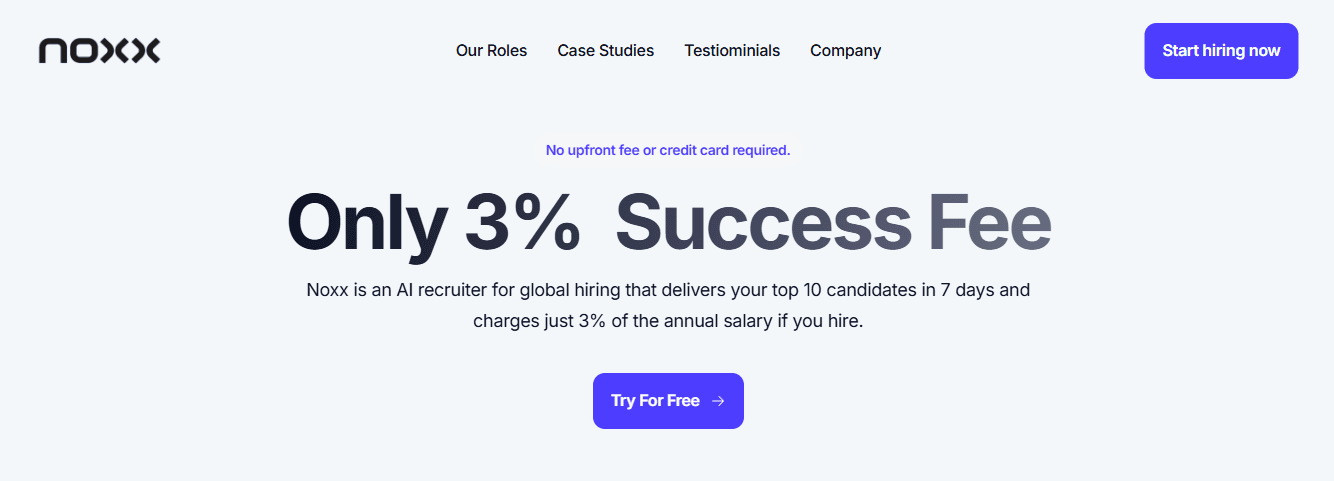
Hiring the right talent should not take months or cost a fortune. Noxx's AI recruiter screens over 1,000 applicants automatically and presents the top 10 candidates in just seven days. You only pay three hundred dollars if you hire someone, with no upfront fees or recruiter commissions. The platform shows salary expectations up front and helps you source engineers, marketers, and sales professionals at up to seventy percent less than US rates by using automated screening and pay transparency. Upload your job description and let the AI handle sourcing so you can focus on choosing the right fit for your team.
2. N iX
N iX brings more than twenty three years of software development and outsourcing experience with a two thousand four hundred strong engineering staff. They work across finance, telecom, healthcare, energy, and manufacturing and provide cloud, data analytics, AI, embedded software, IoT, RPA, and UI UX design expertise. N iX is recognized in global outsourcing rankings and supports clients who need secure, scalable engineering teams.
3. 10Pearls

10Pearls provides end-to-end software engineering, design, and product strategy for startups and enterprises. Their services cover custom development, AI, data analytics, DevOps, and security, supporting digital transformation and platform modernization projects across Latin America and global markets.
4. Kin + Carta
Kin + Carta combines consulting, engineering, and data science to modernize enterprise applications and build cloud native platforms. They help teams adopt modern architectures, improve customer experiences, and accelerate IT modernization with nearshore delivery options.
5. TEAM International
TEAM International offers software staff augmentation, QA, cloud consulting, and business automation services. They support both long-term and short-term engagements and provide teams that work with Java, .NET, and mainstream enterprise stacks.
6. MAS Global Consulting

MAS Global Consulting focuses on nearshore software development with flexible engagement models, including onsite and hybrid teams. They support digital modernization, cloud architecture, IoT software, and custom AI solutions to reduce time to market for US-based clients.
7. Teravision Technologies
Teravision focuses on accelerating product engineering for SaaS companies, with a development center in Bogotá and over two hundred engineers. They provide mobile and web development, cloud consulting, and AI integration for product teams scaling in Latin America.
8. Qubika
Qubika operates across Latin America with over five hundred professionals delivering custom software, cloud services, product design, and AI solutions. They work with enterprises that need scalable engineering and product design resources.
9. Sombra

Sombra offers custom development, software modernization, data engineering, and DevOps services from offices in Eastern Europe and Latin America. With around three hundred engineers, they serve US, UK, and Canadian clients who want reliable nearshore teams.
10. Global MVM

Global MVM focuses on digital transformation for power and energy companies from Medellin. They provide custom software, staff augmentation, and BI and big data consulting for energy management and billing systems.
11. Perficient Latin America

Perficient Latin America offers cloud architecture, AI development, and agile software engineering across finance, healthcare, and education verticals. The firm has decades of consulting experience and local delivery for international clients.
12. Intertec International
Intertec provides IT staff augmentation, custom development, and cloud services with offices across the US, UK, Costa Rica, and Colombia. They help clients scale engineering capacity and handle operational needs like local payroll and compliance.
13. Gorilla Logic
Gorilla Logic delivers web and mobile application development, cloud engineering, and API integrations with Latin America-based delivery centers. They match product-minded teams to US-based companies needing reliable nearshore partners.
14. Forte Group
Forte Group offers full-spectrum outsourcing with delivery hubs in Argentina, Colombia, and Ukraine. Their services include AI projects, custom development, managed services, and staff augmentation for firms building complex applications.
15. Rootstack

Rootstack provides tailored IT outsourcing and managed services and has completed hundreds of projects across North America and Latin America. They focus on rapid hiring, senior engineers, and technologies that include cloud and data platforms.
16. BEON.tech
BEON.tech provides staff augmentation, recruitment process outsourcing, and IT strategy consulting across multiple Latin American countries. Their teams specialize in web and mobile development, as well as local hiring for nearshore projects.
17. DevsData LLC
DevsData LLC operates as an IT recruitment agency with a government-approved recruitment license and a database of more than sixty-five thousand pre-vetted tech professionals. They perform a rigorous multi-stage technical evaluation, including a ninety-minute coding assessment, plus local legal and tax advisory for clients that want to hire directly in Bogotá, Medellín, or Barranquilla. DevsData supports headhunting, BPO, and complete recruitment services for startups and large corporations.
18. Terminal
Terminal provides a vetted global talent pool and end-to-end hiring workflows, including payroll and benefits administration. Their platform uses in-market talent experts for sourcing and matching, and is a good fit for companies that want fast access to senior remote developers, although at a higher price point.
19. Allstarsit
Allstarsit offers staffing, recruiting, dedicated teams, and contractor management from a global presence in over twenty countries. They support fast placements across cybersecurity, IoT, fintech, and other technical domains and can act as an employer of record to simplify hiring compliance.
20. Tecla
Tecla connects US and global companies to a network of more than ten thousand vetted developers across Latin America, including Colombia. Their vetting covers technical skills, English proficiency, and cultural fit, and they report high success rates for rapid hires in Node React JavaScript and mobile stacks.
21. Techie Talent
Techie Talent emphasizes swift hiring, low attrition, and transparent culture while offering nearshore staff augmentation and custom software engineering. They focus on operational efficiency and senior-level expertise for product teams that need close collaboration with Latin America-based engineers.
Questions to Consider When Hiring Colombian Software Engineers
What time zone overlap do you need, and which Colombian cities offer the best English capacity?
How will you handle payroll taxes, benefits, and local labor law?
Do you prefer staff augmentation, a managed team, or a direct hire model?
Which vendors provide pre-vetted technical assessments and product experience for the tech stacks you require?
Where to Source Developer Skills in Colombia
Target Bogotá, Medellín, and Barranquilla for deep developer pools in backend, frontend, mobile, and data science. Use platforms that include technical screening and coding challenges to reduce interviewing overhead. Ask for references and sample engineering work when vetting companies for outsourced development or staff augmentation.
Related Reading
• AI and Recruiting
• Remote Hiring Tools
• Remote Developers Eastern Europe
• AI Recruiters
• AI Recruiting Startups
• Automated Candidate Screening
Key Considerations When Hiring Colombian Developers

You should evaluate technical fit, communication cadence, and legal model first, then match the hiring vehicle to the level of control and compliance you want. Get specific on how you will measure technical ability, how many overlapping hours you need for real-time work, and whether you want an employee on payroll, a vetted contractor relationship, or an Employer of Record to manage benefits and taxes.
What Technical Requirements Should We Set?
When we hire for a specific roadmap, we write a shortlist of concrete outcomes, not vague titles. Require a take-home task or paired session that mirrors the actual stack and obstacles, set a goal for a first measurable contribution within 30 days, and require two verifiable references who can confirm code ownership.
150,000 IT Talent Pool Requires Validation
Colombia has a substantial talent pool of roughly 150,000 IT and software development professionals, allowing hiring teams to be selective, provided they rely on methods that distinguish proper skills and experience from resume polish. Expect tooling depth to vary, so validate through code review exercises, architecture conversations, and a trial sprint to confirm real-world delivery.
How Should We Set Communication and Time Zone Expectations?
If you need synchronous work, state the required overlap windows before interviews. Colombia is on UTC-5 year-round, which provides reliable same-day work hours with US Eastern and Central teams and meaningful afternoon overlap with Pacific teams; that predictability makes daily pair programming and standups practical.
Be explicit about meeting times, response SLAs for async channels, and whether sprint planning will take place during a shared morning slot or be handled asynchronously via written tickets and recorded demos.
How Do I Honestly Assess English and Collaboration Skills?
Don’t assume fluency based on CVs. Test English with a technical interview and a short, live problem discussion that requires explanation, not just coding. Senior candidates often reach a functional level of business English, while mid-level hires may need more transparent written processes or a bilingual product owner to reduce miscommunication.
Evaluate collaboration by observing a pair-programming session and asking about prior experience with distributed teams, code reviews, and async documentation workflows.
What Cultural Work Style and Career-Path Signals Matter?
The truth is, cultural fit is less about nationality and more about expectations. Colombian engineers tend to value relationship-driven interactions and clear leadership, so invest a little time in personal onboarding conversations that build trust.
Async Maturity, 4 to 8-Year Career Paths
Remote work maturity is high in major cities like Bogotá and Medellín, where engineers routinely use async tools and CI/CD pipelines. Career paths typically move from generalist developer to senior engineer to tech lead or engineering manager within 4 to 8 years, and many experienced engineers supplement income with freelance projects, so be clear about moonlighting and IP clauses up front.
How Should We Approach Legal Classification and Contracts?
Most teams choose between direct hires, freelance agreements, and Employer of Record services based on their desired level of control and risk. Direct employment gives maximum control but requires you to register locally or manage full payroll compliance, mandatory social contributions, severance fund arrangements, and statutory benefits under Colombian labor law, so budget for administration and employer-side charges.
Mitigate Reclassification Risk
Freelance contracts lower your administrative load, but they carry reclassification risk if work mirrors employee behavior; mitigate that with clear deliverables, limited-term scopes, and independent contractor attestations. Employer of Record solutions let you spin up local headcount quickly while the provider handles:
Benefits
Payroll taxes
Statutory filings
What Contract Elements Reduce Future Friction?
Always include IP assignment, confidentiality, clear termination and notice terms, a defined scope of work or job responsibilities, and dispute-resolution clauses referencing Colombian law, when applicable. Add probation periods, 30/60/90-day ramp objectives, and explicit acceptance criteria for deliverables to ensure measurable milestones for both sides.
For contractors, require invoices tied to milestones and include a clause that permits transition to direct employment under negotiated terms without creating automatic employment status.
How Should Teams Onboard Developers So They Start Contributing Fast?
Create a 30/60/90 day plan that pairs a new hire with a dedicated buddy, lists two codebase tickets for the first sprint, and schedules weekly product demos. Instrument onboarding with one measurable, time-bound outcome, such as “merge first feature branch and pass CI within 21 days,” and track ramp as velocity versus those expectations.
A focused onboarding reduces churn and clarifies whether you hired for skill or just for headcount.
What Common Hiring Habits Create Hidden Costs, and What Fixes Work Better?
Most teams hire through quick agency searches because they are familiar and fast. That approach works early but creates fragmented onboarding, high first-year churn, and unexpected legal exposure as contractors start acting like employees, slowing product momentum.
Solutions like Noxx focus on building integrated teams with a single onboarding flow, centralized compliance, and measurable ramp plans, thereby reducing hiring friction and improving velocity predictability.
Paired Session is the Engine's Test Flight
A short anecdote to make it concrete: bringing an engineer aboard without a paired session is like installing a new engine without a test flight; you might get movement, but you will not know whether it holds under real stress until it is too late.
What Red Flags Should You Watch for During Screening?
Watch for evasive answers about system design, lack of ownership on past projects, or inability to explain tradeoffs. Be wary when candidates cannot point to one measurable contribution from a past role, and treat rapid job-hopping without clear project reasons as a signal to probe for context. When in doubt, extend the hiring process with a paid, time-boxed trial to reduce risk.
What Metrics Should You Use to Judge Success After Hiring?
Track time-to-first-merge, number of production incidents tied to the new engineer’s code, and alignment with sprint commitments in the first 90 days. Combine those with qualitative feedback from the buddy and product manager to form a composite performance view that informs retention decisions.
That hiring checklist makes sense until you realize how quickly talent supply and policy shifts can change the playbook.
Software Development Industry Trends and Forecasts in Colombia

Colombia’s tech sector is maturing into a focused export engine, driven by concentrated work in AI, fintech, cybersecurity, and industrial IoT; growing regional hubs and targeted public programs have accelerated capital and talent formation, but rising senior wages and uneven late‑stage funding mean scaling excellence will be uneven across cities.
Investment and Regulation Deepen Specialization
Expect specialization to deepen where private investment and university partnerships align. At the same time, gaps in high-end research talent and consistent regulatory frameworks will determine how quickly those pockets become globally competitive.
Which Technologies Are Moving Fastest Right Now?
The clearest momentum sits in applied AI and fintech infrastructure, where product teams are embedding machine learning into fraud detection, personalization, and credit scoring, and financial platforms are building cross‑border rails for remittances and payments.
Blockchain experiments persist in trade finance and provenance projects, while IoT deployments in agriculture and logistics are becoming production-grade rather than proofs of concept, creating concrete integration work for software teams and cloud architects.
How Are Investment and policy shaping regional innovation?
Public and private capital are concentrating around city‑level innovation centers that act as staging grounds for startups and corporate R&D. Medellín’s Ruta N, founded in 2009, remains a visible example of how municipal backing plus venture and corporate partnerships can convert talent into exportable services and products, and national agencies have layered programs to subsidize accelerators and training cohorts to reduce early‑stage friction.
Spreadsheets, Fragment Velocity, and Obscure Fit
Most teams coordinate vendor selection and candidate flow with spreadsheets and ad hoc processes because those methods feel familiar and low-cost. That approach scales until it creates weeks‑long bottlenecks in decision-making and inconsistent quality. As complexity grows, those manual workflows fragment hiring velocity and obscure skill fit.
Teams find that solutions like Noxx centralize candidate pipelines, automate skill scoring and routing, and shorten evaluation cycles from days to hours while preserving audit trails and measurable outcomes.
What Are Wages, Talent Availability, and the Education Pipeline Telling Us?
Over multiple hiring cycles from 2020 to 2023, I tracked senior engineering offers rising by 20-30% in Bogotá and Medellín as international demand intensified, pushing firms to rethink team composition and retention.
Colombia’s universities, including Universidad de los Andes, Universidad Nacional, and EAFIT, continue to graduate strong pools of junior engineers, and a growing private upskilling market of bootcamps and corporate academies fills role‑specific needs.
Senior Specialist Supply Remains Tightest Constraint
Still, the supply of experienced product engineers, security specialists, and ML researchers remains the tightest constraint. That gap is shaping hiring strategies toward blended teams that pair local mid‑level talent with a smaller share of senior specialists and remote advisors.
Where is Colombia Likely to Sit in the Global Market Over the Next Several Years?
Colombia is building the scaffolding to be a top nearshore engineering option for the US and other markets, especially in fintech, managed engineering teams for AI products, and cybersecurity services where trust and proximity matter; success will depend on sustained venture capital depth, consistent regulatory signals, and expanded postgraduate and industry‑grade research capacity.
Frictions Require Selective Specialization
The opportunity is real, but so are the frictions: wage inflation at the senior level, competition for late‑stage capital, and gaps in advanced R&D create tethered upside rather than guaranteed acceleration, so companies that plan for selective specialization and invest in local skill development will capture the most significant returns.
How to Start Outsourcing Software Development in Colombia

1. Define Your Project Needs Clearly and Fast
Start by stating the project goal, deliverables, and deadline in plain language. List features, user journeys, and acceptance criteria so every developer knows what success looks like. Break the work into modules or milestones, for a mobile app, separate UI, backend API, iOS, Android, and QA tasks. Specify required tech stacks and integrations, for example, React Native or Swift for iOS, Kotlin for Android, Node.js or Python for backend, and Shopify or Magento for e-commerce.
Decide skill levels per module:
Junior for routine UI
Mid-level for integration work
Senior for architecture
Fintech components
Add non-technical needs too:
Bilingual product owner
DevOps
Security
Compliance experience
2. Research Colombian Agencies and Freelance Talent Efficiently
Use global marketplaces like Upwork, Freelancer, and Toptal alongside Colombian platforms such as Torre and Workana to find software development talent. Search LinkedIn for developers and teams in Bogotá, Medellín, and Cali, and scan profiles for full-stack, front-end, mobile app, Colombia experience, or DevOps engineering. Filter for industry experience when needed, such as when looking for Shopify, Magento, or payment gateway work for e-commerce projects, and for previous fintech or health tech clients when those domains matter. Check agency web pages for case studies tied to nearshore development, startup partnerships, or scaling engineering teams in LATAM.
3. Vet Candidates with Practical, Measurable Steps
Read portfolios and GitHub to confirm code style and project history. Review client ratings and testimonials on platforms and ask for references. Run short technical screens:
Focused coding exercise
Pair programming
Take-home task limited to a few hours
Use language checks over video to assess English and collaboration skills. Automate initial screening with your ATS or recruitment automation tools, then assign paid test sprints to evaluate delivery speed and quality. Track metrics such as time to complete, defect rate, and responsiveness during the trial phase.
4. Set Up Clear Communication and Project Tracking
Choose a single chat tool for daily messages:
Slack
Microsoft Teams
Discord
Use Trello, Asana, or Jira for backlog management and task tracking, and enforce ticket discipline so work status is visible. Schedule regular video calls with Zoom or Google Meet for demos and planning sessions. Record sprint demos and decisions and store them in your shared drive.
Define a meeting cadence:
Weekly planning
Mid-sprint check
End of sprint demo
Create a shared glossary and onboarding guide so terms and expectations stay consistent.
5. Establish a Strong Legal Framework That Protects Both Sides
Create a written contract covering the scope of work, deliverables, milestones, payment schedule, and change control. Specify payment terms and consider escrow for larger milestones. Define intellectual property ownership clearly and include confidentiality and non-disclosure clauses. Add dispute resolution steps and governing law preferences. When you use contractors across borders, consult a lawyer familiar with international freelance agreements and Colombian contract norms. Consider an employer of record or local counsel for long-term engagements that might blur contractor boundaries.
6. Manage Payments, Taxes, and Procurement
Set up international payment routes:
Wise
PayPal
Direct wire transfers
When paying agencies or contractors, require invoices and keep records for accounting and VAT rules. Understand tax rules for cross-border contractors and track local withholding obligations. Consider payroll services or an EOR if you want local employment without establishing an entity. Use escrow or milestone payments to reduce risk and align incentives with delivery.
7. Onboard and Kick Off with Purpose
Run a kickoff meeting that aligns product vision, scope, timeline, and reporting rhythm. Share a consolidated project brief, access to repos, design systems, API keys, and staging environments. Assign a single product contact on your side and request a local lead from the Colombian team. Use a short initial sprint to test processes:
CI/CD pipelines
Code review flow
Deployment practices
Set up regular status reports and define KPIs such as cycle time, deployment frequency, and open bug count.
8. Stay Compliant with Colombian Labor Rules and International Regulations
Learn the difference between contractors and employees under Colombian law to avoid misclassification risks. Check national holiday schedules, mandatory benefits, and contract limits if you hire people directly. Keep up with changes in international freelancing regulation and data protection rules that affect cross-border work. If you need full compliance without running payroll, use an EOR or local partner that handles statutory contributions and labor obligations.
Trust and Collaboration Across Time Zones: Build Real Relationships That Scale
Plan for time overlap. Colombia is on GMT minus five and does not use daylight savings, so ensure there are at least two hours of core overlap for synchronous work. Schedule meetings during those windows and keep the rest of the collaboration asynchronous with clear tickets and recorded demos. Use shared calendars and set explicit SLAs for response times. Build trust with early face time, such as video calls, occasional onsite visits, or local partner meetings, to create rapport faster than messaging alone. Foster small rituals:
Weekly demos
Public recognition of wins
Transparent backlog grooming sessions
Invest in bilingual documentation and a single source of truth for product decisions.
Use Recruitment Automation to Speed Hiring and Reduce Bias
Integrate coding assessment tools such as HackerRank, Codility, or GitHub Actions into your hiring pipeline. Automate interview scheduling with Calendly and sync candidate data to your ATS. Use structured scorecards in interviews to compare candidates fairly across technical, communication, and cultural fit criteria. Automate background checks and reference requests where appropriate. For volume hiring, set up a candidate funnel with clear pass fail gates and metrics so you can scale nearshore hiring in Colombia predictably.
Practical Security, IP, and Quality Practices for Nearshore Teams
Require code reviews, enforce branch policies, and use automated CI pipelines for testing and deployments. Place sensitive data behind secure VPNs and use role-based access control in cloud accounts. Sign NDAs and include IP assignment in contracts so product ownership transfers cleanly. Run periodic security audits and vulnerability scans, and require documented release notes for each deployment.
Questions to Ask Your Colombian Partner or Freelancer Before Hiring
Do you have experience with this tech stack and industry?
Can you share code samples or case studies?
What is your team size and typical sprint cadence?
How do you handle QA, DevOps, and incident response?
What are your hourly rates and payment terms?
What is your availability in our overlap hours?
What local holidays will affect delivery?
Quick Checklist to Start Hiring in Colombia
Create a concise project brief and module list.
Post roles on both global and Colombian platforms.
Screen candidates with automated tests and short interviews.
Run a paid trial sprint before committing long-term.
Sign contracts that cover IP, payments, and dispute resolution.
Set up payments, compliance checks, and record keeping.
Agree on communication tools, meeting windows, and SLAs.
Monitor KPIs and schedule periodic process reviews.
Final practical tip: treat the relationship as a strategic partnership.
Upload a Job and Get 10 Candidates within 7 Days with Noxx (No Risk, No Upfront Fees)
Noxx uses AI recruiting to find the best matches quickly. The system screens over 1,000 applicants automatically, runs skill checks, and ranks candidates by relevance and performance. Noxx delivers a tight shortlist of the top 10 candidates in seven days so you can focus on interviews and team fit.
Salary Expectations Shown Upfront So You Can Budget
Noxx lists expected salary bands for every candidate upfront. That includes market rates for developers in Bogota and Medellin, standard pay bands for full-stack developers in Colombia, and realistic expectations for senior engineers. You see salary ranges, notice periods, and willingness to work remotely before you schedule the first interview.
Quality Control: Technical Assessments and Culture Fit Checks
Candidates undergo coding tests, take-home exercises, live technical interviews, and English communication checks when requested. Noxx verifies work history and references and surfaces collaboration notes about teamwork, agile experience, and time zone reliability. Each profile includes assessment scores, sample projects, and a recruiter summary.
Security and Compliance for Remote Teams
Noxx supports NDAs, IP assignment clauses, and compliant contracting models for hiring in Colombia. We work with local payroll and legal partners to help with contractor or full-time employment options. You get contract templates, vetted vendors, and advice on payroll to protect your IP and meet local requirements.
Related Reading
• Toptal Alternatives
• Companies using AI for Recruitment
• AI Screening
• Toptal vs Gigster
• Andela Competitors
• Turing Alternatives

Noxx is an AI recruiter for global hiring that delivers your top 10 candidates in 7 days and charges just 3% of the annual salary if you hire.