20 Best Andela Competitors for Hiring Top Tech Talent
Noxx Team

When a sprint deadline approaches and you need senior developers quickly, the traditional recruitment process can become a costly delay. Hiring great developers shouldn’t feel like searching for a needle in a haystack, yet for many companies, that’s precisely what it is. Andela has long been a trusted solution for finding vetted engineering talent worldwide. However, it’s not the only option available. Whether you’re scaling a remote engineering team, launching a new product, or seeking specialized skills like AI, blockchain, or mobile development, there are plenty of other platforms that can match or even surpass Andela’s offerings in cost, speed, and flexibility.
Noxx's AI recruiter narrows the choices, screens for hands-on experience, and delivers curated candidate matches so you spend less time searching and more time building.
Table of Contents
- What is Andela, and Why Do Companies Choose It?
- Why Would You Need Alternatives to Andela?
- 20 Best Andela Competitors to Scale Your Development Team
- Upload a Job and Get 10 Candidates within 7 Days with Noxx (No Risk, No Upfront Fees)
Summary
- Global talent networks can supply deep benches for scaling engineering teams, with some providers claiming pools exceeding 100,000 developers to draw from.
- Rigorous, multi-step vetting plus AI-assisted matching correlates with high client satisfaction, with platforms reporting up to a 95% client satisfaction rate.
- Managed placement models can be costly for smaller teams, with placement fees around 20% on top of salaries, increasing per-hire operational expense, and stressing the runway.
- When speed matters, algorithmic and marketplace approaches compress hiring cycles from weeks to days, with some delivering vetted shortlists in seven days or a typical time-to-hire of around 72 hours.
- Extreme selectivity for niche skills concentrates scarcity, as acceptance rates under 1% or roughly 2.3% for elite networks force teams to broaden role scopes or budget for premium hires.
- Remote-first hiring is mainstream, with over 70% of companies considering remote work permanent. Software developer demand is expected to grow by 22% from 2020 to 2030, making flexible, fast-sourcing models strategically important.
- This is where Noxx's AI recruiter comes in; it addresses these challenges by narrowing down choices, screening for hands-on experience, and delivering curated candidate shortlists to shorten sourcing time and reduce administrative overhead.
What is Andela, and Why Do Companies Choose It?
Andela is a global talent network that connects companies with vetted software engineers and other tech professionals, primarily drawn from emerging markets. It operates by sourcing, rigorously screening, and placing remote talent into long-term engagements. The platform conducts multi-step technical and communication assessments, utilizes AI-assisted matching, and provides support for clients with payroll, compliance, and onboarding, enabling teams to integrate hires without establishing a local entity.
How Did Andela Begin and Expand So Quickly?
Andela started in 2014 as an experiment to invest in overlooked talent markets, train developers to world-class standards, and export that capability to global teams. The firm moved from an Africa focus into Latin America and beyond, scaling its sourcing footprint; today, they point to Andela, 2025, “Over 100,000 developers”, which signals a deep supply of engineers across multiple regions rather than a small, localized bench.
How Does Andela Vet and Match Candidates?
Andela’s screening pipeline layers objective coding assessments, English proficiency checks, and live technical evaluations, then incorporates AI scoring to align candidate profiles with role requirements. That combination reduces early-stage mismatch risk and is coupled with a hands-on onboarding cadence, including active monitoring during the first 90 days to smooth ramp and retention.
What Kinds of Roles and Collaboration Models are Available?
You can staff individual contributors, product designers, data and machine learning engineers, DevOps specialists, and full cross-functional teams on either a full-time or part-time basis. Collaboration is inherently remote, with clients utilizing standard asynchronous tooling, along with Andela’s integration support for payroll and legal, allowing engineering managers to add capacity without a local entity or additional HR overhead.
Why Do Companies Pick Andela Over Other Recruitment Platforms?
Access to diverse global talent, predictable vetting, and the operational convenience of compliance and payroll make Andela attractive for teams that need reliable hires at scale. Clients point to consistent delivery and trust in the model, reflected in Andela’s “95% client satisfaction rate,” which underscores how their quality controls translate into positive outcomes for hiring organizations. For growing teams, the ability to quickly stand up multi-person squads and keep them on a single billing and support plan matters in ways that go beyond raw headcount.
Alternative Approach to Urgent Hiring
Most teams handle urgent hiring by sending roles to marketplaces, recruiters, and talent networks, as these options are familiar and minimize administrative setup. As hiring demands accelerate and timelines shorten, the familiar approach exposes friction:
- Interview cycles lengthen
- Coordination costs rise
- Fees compound
Against the time spent on engineering. Platforms like Noxx provide a different route, delivering a vetted top ten shortlist within seven days and charging a single 3 percent success fee when hires are made, while utilizing over 40 regional signals to enhance relevance and reduce the calendar time between need and productivity.
Balancing High-Touch Talent Sourcing with Algorithmic Alternatives
Think of Andela as a high-quality talent agency that scouts, trains, and places skilled engineers on tours worldwide. It reliably solves scouting and early vetting, but it still follows a model where human curation and managed placements add predictable steps and costs. That distinction explains why some teams treat Andela as a core sourcing channel while others layer faster, algorithmic alternatives to shorten hiring cycles and lower per-hire spend. That looks solid on paper, but what quietly prompts teams to seek other options even after a successful placement?
Related Reading
- Recruitment Automation Tools
- Software Development Outsourcing Costa Rica
- Hire Software Developers in Chile
- Software Development Colombia
- Hire Developers in Argentina
- Hire Software Developers in Brazil
Why Would You Need Alternatives to Andela?

We look for alternatives when a hiring need is urgent, narrowly skilled, or budget-constrained, because the managed, long-term placement model can create real drag on speed and runway. For many startups, the mismatch is not about quality; it is about cadence, cost structure, and the kinds of engagements they actually need.
Why Do Costs Push Smaller Teams Away?
High fees matter more to small teams than big ones. According to the Lemon.io Blog, Andela charges a 20% fee on top of the engineer's salary, which converts a single hire into a significant operational expense and forces trade-offs between hiring and product investment. When you add payroll taxes, onboarding time, and the opportunity cost of a slow hire, that percentage compounds into the runway you cannot recover with faster product iteration.
How Does Hiring Cadence and Flexibility Break Down?
Short-term work and fast pivots expose a structural mismatch. Teams that require a three-month sprint, a rapid backfill, or a one-off integration often find themselves shoehorning a subscription-style placement model into a project-based need, which inflates timelines and drives up the effective cost per deliverable. Time zone overlap, staggered onboarding, and a multi-week vetting window interrupt sprint velocity, resulting in delayed releases rather than improved outcomes.
The Hidden Costs and Modern Solutions for Specialized Talent Hiring
Most teams rely on managed talent networks because they provide a comprehensive solution for payroll, compliance, and initial vetting, which is perfectly reasonable. But as hiring becomes episodic or hyper-specific, that familiar route hides real costs:
- Slower time-to-product
- Fewer hiring permutations
- Opaque total spend
Teams find that third-party platforms, which automate sourcing, apply regional signals, and deliver a vetted top-10 shortlist in a day, can compress hiring cycles from weeks to business days while significantly reducing placement overhead.
What Happens When You Need Rare Skills or Specific Seniority?
When roles require narrowly focused expertise, scarcity shifts power and price. A 2023 write-up on Lemon.io notes that Andela's acceptance rate is less than 1%, which concentrates talent into highly selective cohorts and can push teams toward either overly broad role definitions or premium budgets. For product teams hiring for ML infrastructure, embedded systems, or sector-specific compliance experience, that means either settling for a near-fit or paying above-market to secure the exact profile.
Which Hiring Models Actually Match Different Needs?
If you need a short, tactical sprint, project-based outsourcing, or a vetted freelancer marketplace often wins on speed and cost. If you must scale a core team quickly with consistent day-to-day collaboration, longer-term placements remain a sensible approach. And when the role is niche and strategic, specialized talent networks or boutique search can surface hidden senior candidates. The key is matching the engagement model to the work, not forcing work to fit a single platform.
The Mismatch Driving the Search for Alternatives
Think of the standard approach like ordering a tailor-made suit when you actually need a sturdy jacket that ships tomorrow, fits well enough, and costs a fraction of the price. That mismatch is what drives teams to explore Andela competitors that trade human-heavy curation for algorithmic reach and predictable economics. That tension explains why many hiring leaders continue to look and why the following choices they make often surprise them.
Related Reading
• Remote Developers Eastern Europe
• AI Recruiting Startups
• Automated Candidate Screening
• AI Recruiters
• AI and Recruiting
20 Best Andela Competitors to Scale Your Development Team
These are some of the top alternatives to Andela, each offering a distinct mix of vetting, pricing, and talent models, allowing you to match the hiring approach to the project's needs rather than forcing one platform to do everything. With remote-first hiring now mainstream and talent demand accelerating, these providers trade off speed, cost, and specialization in different ways, allowing you to choose the best fit for short sprints, long engagements, or niche skill hunts. According to 1840 & Company, “Over 70% of companies are now considering remote work as a permanent option.” That structural shift makes regional expertise and contract flexibility more valuable than ever.
1. Noxx
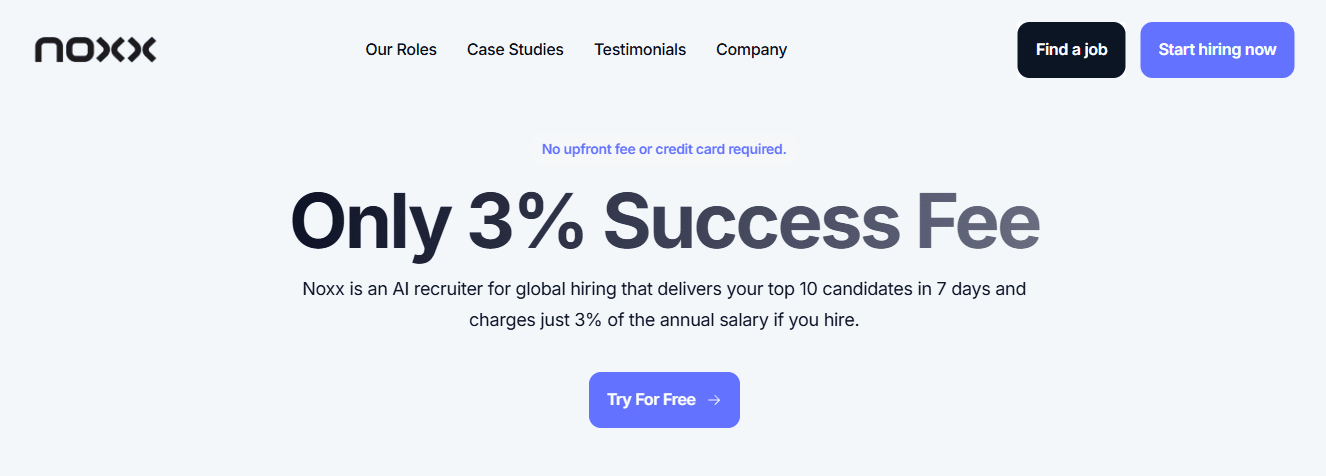
Noxx automates candidate sourcing with an AI recruiter that screens over 1,000 applicants and delivers a vetted top 10 shortlist in seven days, charging a single 3 percent success fee only when you hire. The platform emphasizes transparent salary expectations up front and targets engineers, marketers, and salespeople at up to 70 percent below typical US rates. Best for startups and hiring teams that need fast, low-risk, data-driven shortlists without the agency retainer or long recruiter cycles.
Key Features
- Fast AI sourcing, high volume, low friction: The AI scans 1,000+ applicants per role to deliver a ranked top 10, reducing calendar time between job posting and meaningful interviews.
- Pay-for-success pricing: A single 3 percent success fee keeps cash tied to results, not promises, preserving runway for early-stage teams.
- Transparent compensation signals: Salary expectations are shown before interviews, reducing offer friction and counteroffer surprises.
- Regional signal intelligence: Localized datasets and over 40 signals enhance the fit for LATAM, Asia, and other markets, reducing early mismatch risk.
Why Choose Noxx over Andela?
Noxx favors algorithmic scale and predictable economics for rapid hires, rather than longer managed placements that increase per-hire overhead.
Better for sprint hires and budget-constrained teams that need speed and measurable outcomes. The shortlist model keeps hiring focused and minimizes time invested in poor fits.
2. CloudDevs
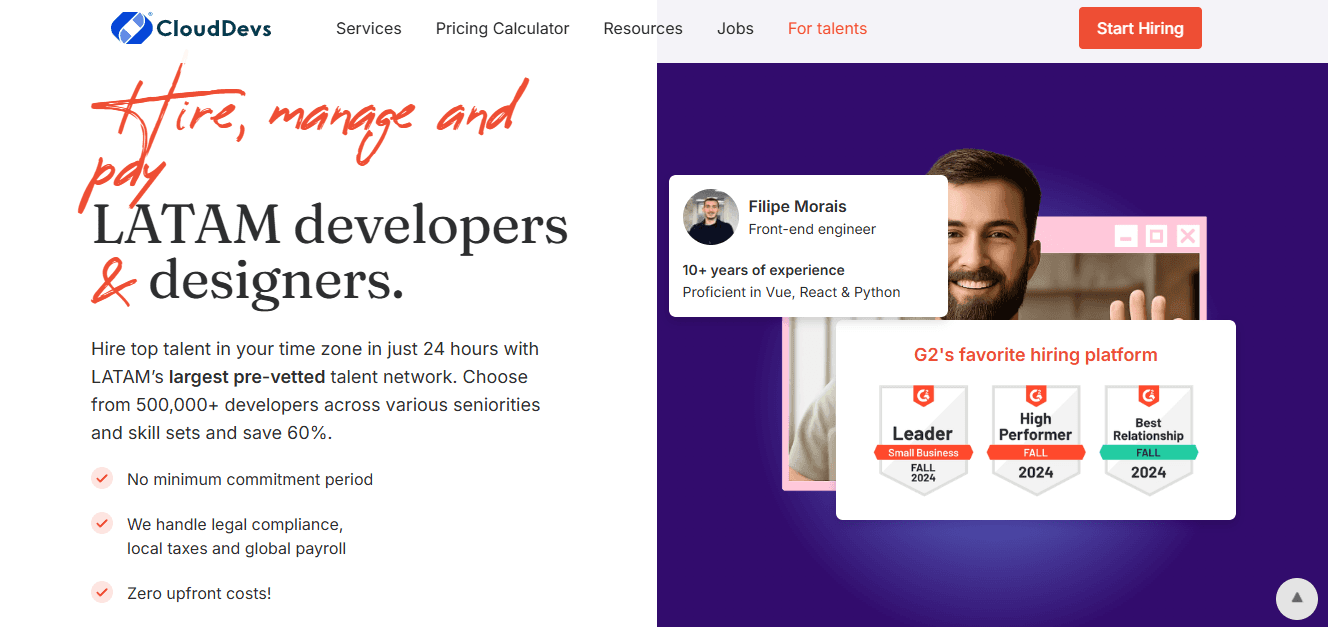
CloudDevs connects startups with more than 8,000 Latin American developers and designers, using a five-stage vetting process and timezone-aware matching to speed collaboration. The platform emphasizes 24-hour responsiveness and a weekly rolling contract model to minimize commitment friction. Best for early startups that prioritize nearshore communication and cost predictability.
Key Features
- Five-stage vetting: Technical checks and interviews reduce early mismatch, improving first-week productivity.
- Timezone alignment: Matches are prioritized by client timezone to maintain high synchronous overlap.
- Risk-free trial: A seven-day trial allows you to validate your fit without long-term contracts.
- Flexible weekly contracts: Cancel or scale quickly with no long-term lock-in.
Why Choose CloudDevs over Andela?
- Faster, timezone-centric matches suited to teams needing real-time collaboration.
- Lower minimum commitments with weekly rolling contracts, which is attractive for unpredictable early-stage budgets.
- A good cost-to-quality balance for teams focused on Latin American talent pools.
3. Unicorn.Dev
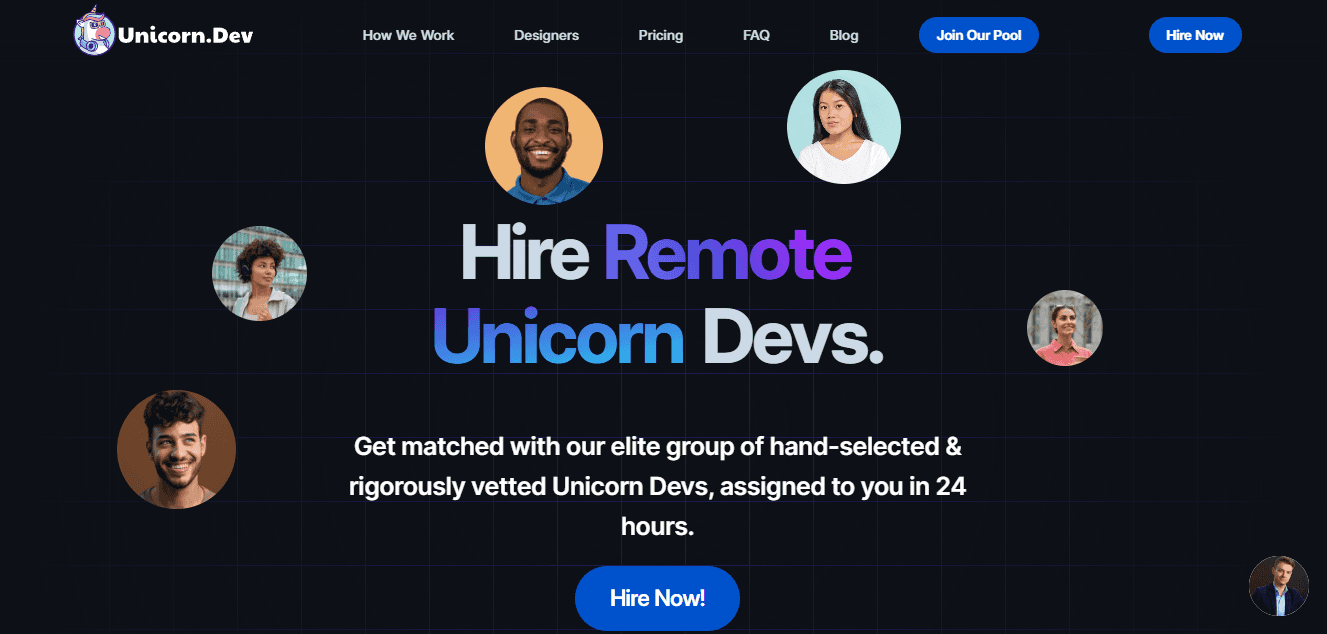
Unicorn.Dev focuses on highly experienced freelance developers and designers, accepting only candidates with at least five years of relevant experience. The company utilizes a multi-stage vetting process to maintain consistent quality. They promise matches within 24 to 48 hours and offer both individual freelancers and teams for startups that need scale without traditional agency fees. Ideal for small tech teams seeking senior freelance expertise quickly.
Key Features
- Senior-only talent pool: Minimum five-year experience threshold preserves senior-level throughput.
- Multi-stage vetting: Reduces false positives in technical and communication skills.
- Fast matching window: Candidates can be presented within two days for urgent needs.
- Trial period: A one-week trial helps avoid long-term mismatches.
Why Choose Unicorn.Dev over Andela?
- Lower friction for short contracts and freelance-first engagements.
- Faster turnaround for urgent senior hires without adopting a managed placement model.
- Simple pricing that favors project-based work.
4. Toptal
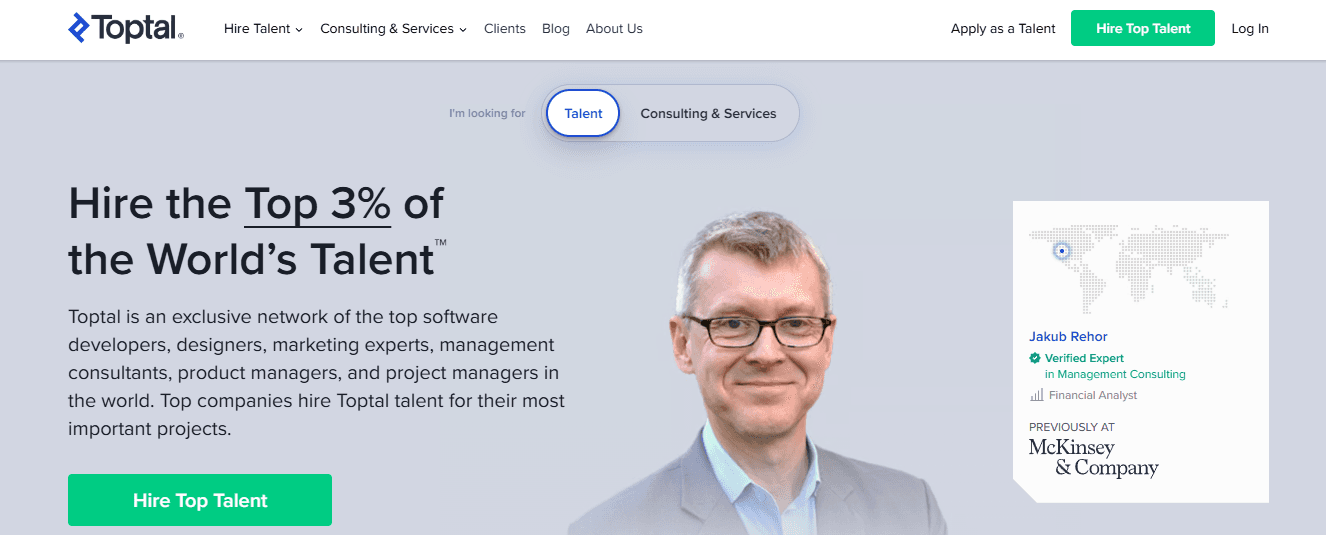
Toptal curates elite freelancers across engineering, design, finance, and product, admitting roughly the top three percent of applicants and pairing clients with specialists for project-based or longer-term work. It suits companies that need vetted senior talent with domain experience and a high assurance of professional conduct. Best for firms that value strict vetting and are willing to pay a premium for top-tier freelancers.
Key Features
- Elite screening: Rigorous filtering ensures the selection of highly experienced professionals.
- Personalized matchmaking: Human recruiters align talent to domain-specific requirements.
- Flexible engagements: Hourly, part-time, or full-time models accommodate scaling needs.
- Collaboration emphasis: Focus on interpersonal fit and communication, rather than just technical skills.
Why Choose Toptal over Andela?
- Broader cross-functional talent beyond engineering, making it a one-stop shop for multiple specialized roles.
- Higher assurance of senior-level freelancers through intense vetting, useful when you cannot tolerate onboarding risk.
- Better fit for one-off, high-stakes projects where quality trumps cost.
5. Fiverr
Fiverr is an open freelance marketplace best suited for short-term, well-scoped tasks, such as design, content, and minor technical fixes, where budget and turnaround time are primary constraints. It’s a good option for teams that need cheap, fast work and are comfortable investing time in vetting at the job level. Best for low-budget projects and single deliverable needs.
Key Features
- Wide skill variety: Quick access to many specialties at low price points.
- Marketplace pricing pressure: Competitive bids often reduce cost per deliverable.
- Fiverr Pro option: Vetted professionals for higher-quality outcomes.
- Fast turnaround: Many tasks can be completed in days.
Why Choose Fiverr over Andela?
- Lower cost for clearly scoped, tactical work that does not require long-term engagement or deep integration.
- Speed and price make it a practical choice for prototypes, brand assets, and one-off tasks.
6. 99designs

99designs specializes in graphic and web design, utilizing a platform model that prioritizes quality through designer rankings and curated contests, rather than relying on general freelancing. It works well for small and medium businesses seeking brand identity, packaging, and visual assets. Best for teams focused solely on design outcomes.
Key Features
- Curated design talent: Designers are ranked and matched to projects.
- Direct contact or managed matching: Choose hands-on collaboration or a curated assignment.
- Portfolio Transparency: Preview Designer Styles Before Engagement.
- Quality checks: Regular reviews help maintain output standards.
Why Choose 99designs over Andela?
- A design-only focus delivers deeper creative options and higher quality controls compared to generalist engineering marketplaces.
- Better for brand and creative tasks that require iterative visual collaboration.
7. Guru
Guru is a general freelance marketplace with a large talent base and flexible payment models, including fixed, hourly, and recurring terms. It focuses on secure, manageable contracts and cost-effective hiring for varied tasks across functions. Ideal for organizations that require flexible payment options and a diverse talent pool.
Key Features
- Multiple payment options: Fixed, hourly, task-based, and recurring terms fit different budgeting needs.
- SafePay escrow: Protects payments until deliverables meet expectations.
- WorkRooms collaboration: Enables teams to coordinate freelancers in one place.
- 24/7 support: Helps resolve platform or transaction issues.
Why Choose Guru over Andela?
- Lower fees and a broader mix of contract structures, offering tighter control over how you pay for work.
- Useful when you need ad hoc specialists across marketing, design, and admin functions, as well as engineering.
8. Upwork
Upwork offers a massive marketplace of freelancers across many disciplines, and it is best when you prefer open marketplace dynamics and granular search filters over curated placement. Upwork suits teams willing to invest in their own vetting to find cost-effective talent for both long-term and short-term engagements. Best for teams that want control over hiring and the patience to screen candidates.
Key Features
- Robust search and filters: Narrow searches by skill, experience, and hourly rate.
- Detailed Work Diary: Verify billed time on hourly contracts.
- Bid system: Freelancers propose terms, which can drive competitive pricing.
- Platform protections: Policies and dispute resolution help reduce fraud risk.
Why Choose Upwork over Andela?
- More hands-on control of candidate selection, pricing, and contract terms.
- Often, lower hourly costs for commoditized work come with the tradeoff of doing your own vetting.
9. PeoplePerHour
PeoplePerHour connects clients with freelancers on an hourly or project basis, relying on AI to identify and invite highly qualified matches to your posting. The platform is helpful for medium-term contractor relationships that require centralized communication and escrow protections. Best for managers who expect recurring freelance work with clear deliverables.
Key Features
- WorkStream for management: Centralized communication, proposals, and payments.
- Escrow buyer protection: Funds held until delivery reduces financial risk.
- AI-assisted matching: Suggests candidates based on job specs.
- Hourly and fixed-rate flexibility: Suits running engagements or project bursts.
Why Choose PeoplePerHour over Andela?
- Easier management of hour-based contractors with built-in payment protections.
- Best suited for situations where you require frequent, time-bound external contributions rather than extended placements.
10. Bark.com
Bark automates the initial sourcing stage by sending client requests to relevant local and remote professionals, acting as a lead marketplace across many service categories. It is beneficial when you prefer the platform to do outreach on your behalf. Best for buyers who want many proposals without manual outreach.
Key Features
- Automated outreach: The platform connects you with matching professionals, saving you time.
- Wide professional scope: Access to many service categories, including niche providers.
- Secure messaging: Bark Messenger keeps estimates and conversations organized.
- Local and remote options: Ability to find on-site or remote vendors.
Why Choose Bark.com over Andela?
- The service-first lead model reduces the time spent manually sourcing multiple vendors.
- Practical for non-technical procurements and services where you want a quantity of options fast.
11. Grid Dynamics

Grid Dynamics, formerly Daxx, is a digital engineering firm that builds and embeds development teams quickly, supporting training, certifications, and secure collaboration tools. It is structured for companies that want managed engineering capacity and co-innovation, and it suits enterprises or scaleups needing multi-person squads. Best suited for product teams seeking long-term engineering partnerships with transparent governance and IP protection.
Key Features
- Co-innovation model: Transparent IP handling and shared roadmaps.
- Training and certification programs: Continuous skill uplift for long-term projects.
- Enterprise tooling and security: Strong focus on secure collaboration.
- Team assembly speed: Faster ramp for multi-person squads compared to building locally.
Why Choose Grid Dynamics over Andela?
- Stronger emphasis on enterprise-grade processes and training, which matters for regulated or large-scale initiatives.
- Better fit when you need able teams with long-term support, not just individual contractors.
12. Crewmate
Crewmate provides dedicated developers and designers who work exclusively on a client’s project, reducing context-switching and increasing alignment with in-house teams. The platform handles HR, payroll, and monthly pricing, enabling teams to scale efficiently without additional administrative overhead. Best for product teams that need near full-time, integrated talent without the overhead of hiring locally.
Key Features
- Dedicated contributors: Exclusive allocation improves focus and accountability.
- Fast matching: Candidates can be connected within 48 hours.
- Transparent monthly pricing: Budget certainty for planning sprints and releases.
- Complete HR support: Onboarding, contracts, and payroll managed end-to-end.
Why Choose Crewmate over Andela?
- A dedicated staffing model more closely mimics the work of in-house engineers compared to that of multi-client freelancers.
- Financial and operational clarity for teams that want predictable monthly costs.
13. Lemon.io
Lemon.io specializes in matching startups with vetted developers, primarily from Eastern Europe, with a focus on web technologies such as:
- PHP
- JavaScript
- Python
They emphasize sub-24-hour matching and senior-level candidates for bootstrapped startups that need reliable, cost-efficient engineers. Best for early-stage companies optimizing for price and speed in web stacks.
Key Features
- Speedy match times: Often under 24 hours for typical web roles.
- Multi-stage vetting: Language and technical checks to reduce onboarding surprises.
- Senior-heavy pool: Focus on experienced developers for immediate impact.
- Web technology coverage: Strength in standard stacks used by startups.
Why Choose Lemon.io over Andela?
- Faster, lower-cost matches for startup web development needs, especially when teams in Latin America or Eastern European time zones are a good fit.
- Suitable for straightforward web projects where tight cost control matters.
14. X-Team
X-Team staffs full engineering teams as a single unit, investing in developer welfare and continuous learning to sustain long-term engagement quality. They prioritize team cohesion and rapid onboarding, enabling organizations to scale product delivery without assembling individuals piecemeal. Best for companies that want multiple engineers already accustomed to working together.
Key Features
- Team-based approach: Cohesive squads reduce onboarding friction across members.
- Curated vetting: Background and skills checks with focus on workplace skills.
- Quick onboarding: Developers can commit in days to minimize downtime.
- Flexible engagement models: Part-time and full-time options for scaling.
Why Choose X-Team over Andela?
- Team-first model reduces integration overhead when you need several engineers who can collaborate immediately.
- Transparent pricing and account management make scaling predictable.
15. Arc.dev
Arc.dev offers an extensive network of vetted remote talent and utilizes an AI recruiter, HireAI, to rapidly surface candidates. With a strict acceptance rate of approximately 2.3 percent and a typical time-to-hire of around 72 hours, Arc.dev focuses on fast and high-quality placements for engineering needs. Best for teams that want to hire interview-ready remote engineers quickly, with recruiter support.
Key Features
- HireAI assistance: Combines AI and human recruiters to speed discovery.
- Deep vetting: Coding challenges, interviews, and pair programming for validation.
- Large talent pool: Access to many remote developers for quick scaling.
- Compliance Support: Assistance with contractor compliance and logistics for long-term hires.
Why Choose Arc.dev over Andela?
- Faster placement windows for vetted engineering hires with recruiter-backed support.
- Combines automated search with hands-on matching, proper for teams that want both speed and curation.
16. Gigster
Gigster assembles managed development teams drawn from a vetted network of top engineers, taking full responsibility for project delivery and using AI to coordinate resources and timeline. It suits organizations that prefer a project-managed outsourcing option over hiring individual contributors. Best for companies that prefer a single accountable vendor to produce a discrete product or feature.
Key Features
- End-to-end responsibility: Gigster manages the project and delivers outcomes.
- AI-assisted team assembly: Matches specialists for the project plan within one to three weeks.
- Project dashboard: Real-time milestone tracking and reporting.
- Free cancellation: Projects can be stopped without penalty in many cases.
Why Choose Gigster over Andela?
- Full project ownership shifts delivery risk off the hiring company, useful for teams lacking product delivery bandwidth.
- Strong for short-medium engagements where you want one vendor accountable for the outcome.
17. Trio.dev
Trio.dev offers pre-screened developers specializing in JavaScript, Python, and mobile stacks, complemented by hands-on HR support to enhance retention and onboarding. The platform is ideal for companies that require reliable mid-to-senior talent and seek assistance with managing payments and compliance. Best for teams seeking straightforward developer placement with operational support.
Key Features
- Pre-screened developers: Reduces screening time and interview cycles.
- Dedicated HR support: Assists with onboarding and ongoing engagement.
- Experienced talent: Senior and mid-level developers who can hit the ground running.
- No recruitment fees: A cost model that favors direct hiring without additional placement charges.
Why Choose Trio.dev over Andela?
- Cleaner, no-fee access to vetted talent with extra HR support for global hires.
- Good match for teams that want to avoid placement fees and administrative overhead.
18. 1840 & Company
1840 & Company offers global staffing and outsourcing, combining AI-powered Talent Cloud sourcing with managed payroll and compliance, to deliver rapid vetted candidate delivery from 150+ countries. The model is designed for enterprises and companies that require coverage across multiple departments and complex compliance management. Best for organizations that want comprehensive outsourcing beyond pure engineering.
Key Features
- AI Talent Cloud: Rapid pre-vetted candidate delivery across multiple regions.
- Complete managed services: Payroll, compliance, and benefits for international hires.
- Flexible engagement models: BPO, RPO, direct hire, and nearshore options.
- Broad functional coverage: IT, finance, HR, marketing, and more.
Why Choose 1840 & Company over Andela?
- Better for multi-department staffing and enterprise-level compliance needs.
- Reduces hiring friction when you need payroll and benefits administered globally.
19. Worksome
Worksome focuses on the end-to-end contractor lifecycle, automating onboarding, contracts, and payments, while providing hiring teams with analytics and compliance safeguards. It is ideal for companies that need to manage multiple contractors and ensure accurate classification and reporting. Best for mid-market firms centralizing freelance workforce administration.
Key Features
- Contract and payment automation: Streamlines invoicing and compliance.
- Classification and legal safeguards: Helps avoid misclassification risk.
- Analytics and reporting: Insights to control spend and contractor performance.
- Flexible pricing: Custom plans are tailored to fit company size and needs.
Why Choose Worksome over Andela?
- Superior contractor lifecycle management and compliance automation for businesses scaling external workforces.
- Useful when the administrative burden of contractors overshadows sourcing concerns.
20. Trio.dev
Trio.dev returns as a specialized source of pre-screened developers in standard stacks, providing hands-on support for payments and compliance, and offering a practical no-fee access model that helps companies hire without recruitment markup. Best suited for teams that require vetted engineering hires, along with operational support for international payments.
Key Features
- Pre-screened candidate network: Shortens time-to-interview and improves first-week productivity.
- HR and administrative support: Eases onboarding and ongoing engagement logistics.
- Experienced mid-senior talent pool: Focus on reliable contributors who can integrate quickly.
- Cost transparency: Models that avoid hidden recruitment fees.
Why Choose Trio.dev over Andela?
- Simpler, lower-fee hiring for standard engineering stacks with operational assistance.
- Effective when hiring managers want straightforward access to vetted talent without long placement commitments.
Status Quo Disruption
Most teams are still familiar with sourcing talent, posting role after role, and relying on lengthy vetting cycles, because that method feels safe and straightforward. As roles multiply and timelines shrink, interviews pile up, coordination consumes engineering time, and offers go stale, creating hidden costs in delay and burned runway. Platforms like Noxx offer teams an alternative route, presenting a concise, ranked shortlist with salary signals and a pay-for-success fee that reduces time-to-hire from weeks to days while keeping administrative overhead low.
The demand for software developers is expected to grow by 22 percent from 2020 to 2030, according to 1840 & Company, “The demand for software developers is expected to grow by 22% from 2020 to 2030.” That growth makes choosing a hiring model that scales without multiplying hidden costs a strategic decision, not an administrative one.
Curiosity loop
What most teams do next looks small, until you see how a single change in process rewrites hiring timelines and runway.
Upload a Job and Get 10 Candidates within 7 Days with Noxx (No Risk, No Upfront Fees)
When every open role threatens product velocity, we need a low-friction hiring option that preserves runway and keeps your team focused on shipping. If speed matters, consider how Noxx, “10 candidates within 7 days,” and Noxx, “10 candidates within 7 days,” produce focused shortlists for active roles. Then, run a short pilot to assess their suitability for your team.
Related Reading
• Toptal Alternatives
• Companies using AI for Recruitment
• AI Screening
• Toptal vs Gigster
• Turing Alternatives