Top 15 Toptal Alternatives to Hire Skilled Developers Faster
Noxx Team
Recruitment Automation now powers hiring by automating sourcing, screening, and vetting, yet many teams still face a trade-off between cost, speed, and reliability. This guide to Toptal alternatives walks through vetted freelance platforms, developer marketplaces, talent networks, and hiring platforms. It covers technical screening, interviews, and quality assurance, so you can quickly find and employ top-tier, reliable developers at a lower cost than with Toptal, without sacrificing quality or project speed.
Noxx's AI recruiter helps you do precisely that, turning recruitment automation into fast, cost-effective talent sourcing and matching so you can onboard vetted remote developers sooner and keep projects moving.
Table of Contents
- Why Seek Toptal Alternatives?
- Top 15 Toptal Alternatives to Hire Skilled Developers Faster
- How to Choose the Best Alternative to Toptal
- Upload a Job and Get 10 Candidates within 7 Days with Noxx (No Risk, No Upfront Fees)
Summary
- Premium, tightly vetted marketplaces bundle account management and vetting into higher invoices, with typical platform markups around 20 percent and initial deposits of roughly $500, which raises project costs and onboarding friction for budget-constrained teams.
- Extreme selectivity on curated platforms can create talent scarcity, with acceptance rates reported as low as 3 percent, making niche stacks and regional specialists harder to source quickly.
- Freelance platforms and automated sourcing can cut hiring time dramatically, with some channels reducing time-to-hire by up to 70 percent and delivering a top-10 shortlist in about seven days.
- Cost pressure is driving migration, as 70 percent of businesses report seeking alternatives due to high marketplace fees, and comparisons show average total hiring costs on alternative platforms can be around 20 percent lower.
- Short engagements are now the norm, with 75 percent of companies preferring freelancers for short-term projects, which shifts the priority toward speed, flexible contracts, and pilots that measure time-to-productivity and 90-day retention.
- This is where Noxx's AI recruiter fits in, automating sourcing and screening across 1,000+ applicants to deliver a ranked top-10 shortlist within seven days while using a 3% success fee.
Why Seek Toptal Alternatives?
Yes. You should consider Toptal alternatives when cost, speed, or flexibility matter more than a rigid, premium marketplace model. For startups and fast-moving hiring teams, there are practical trade-offs to weigh: Toptal offers predictability and quality, but other approaches can deliver similar talent faster and at lower fees.
Why Does Price Push Teams Away?
The premium positioning is deliberate. Toptal’s model bundles tight vetting and account management into every hire, and that shows up in the invoice. Toptal charges clients a 20% fee on top of freelancer rates, which effectively raises project costs for teams managing tight budgets or many concurrent roles. When you multiply that by long engagements or several hires, the math quickly favors lower-fee sourcing options.
What About Upfront Friction and Commitment?
Many teams balk at the initial friction, not because the talent is poor, but because the process adds time and cash strain. Toptal requires a $500 deposit on first invoices, a policy that protects their vetting flow but also acts as a friction point for early-stage teams watching runway. That deposit, combined with multi-step screening and scheduled interviews, turns a two-week hire into a month-long project in real situations.
Why is Talent Supply Sometimes a Problem?
The supply side is narrower than people assume. Toptal has a 3% acceptance rate for freelancers, which signals extreme selectivity and creates scarcity for specialists outside mainstream stacks. In practice, that means you can get exceptional Angular or React engineers quickly, but finding someone with deep fintech Rust experience or a rare ML stack can take longer or fail.
What Happens When You Need Niche or Regional Coverage?
If your project requires niche tech or region-specific expertise, the enterprise-matching approach can feel like a precision tool that only works on certain screws. Hiring managers often exchange calendar slots and refined briefs, only to be told the platform has no ready match. It’s like ordering a bespoke suit that requires three fittings when you really needed a well-made jacket off the rack for next Tuesday.
What Does Toptal Still Do Well?
The truth is, Toptal nails reliability and enterprise requirements. Their documentation, standardized screening, and handoff processes make them a safe bet for regulated projects and teams that prize process discipline over speed. Those strengths explain why many companies default to them, even when the fit is imperfect.
How Do Faster, Lower-cost Options Compare?
For teams prioritizing speed and cost, alternatives often win on three fronts, such as quicker shortlists, broader regional reach, and lower, scalable fees. Some platforms deliver a top-10 shortlist in about 7 days and charge a small success fee rather than a hefty platform markup, allowing hiring teams to iterate faster without blowing budgets. That approach shifts the trade-off from manual agency work to data-driven sourcing, uncovering candidates that major marketplaces might miss.
Related Reading
- Recruitment Automation Tools
- Software Development Outsourcing Costa Rica
- Hire Software Developers in Chile
- Software Development Colombia
- Hire Developers in Argentina
- Hire Software Developers in Brazil
Top 15 Toptal Alternatives to Hire Skilled Developers Faster
You need alternatives because teams vary on time, cost, and control, and no single marketplace fits every hiring constraint. Below, is a profile of 15 practical Toptal alternatives, with clear signals on who each serves, how hiring works, three pros and three cons, and when another platform may be a better fit.
1. Noxx
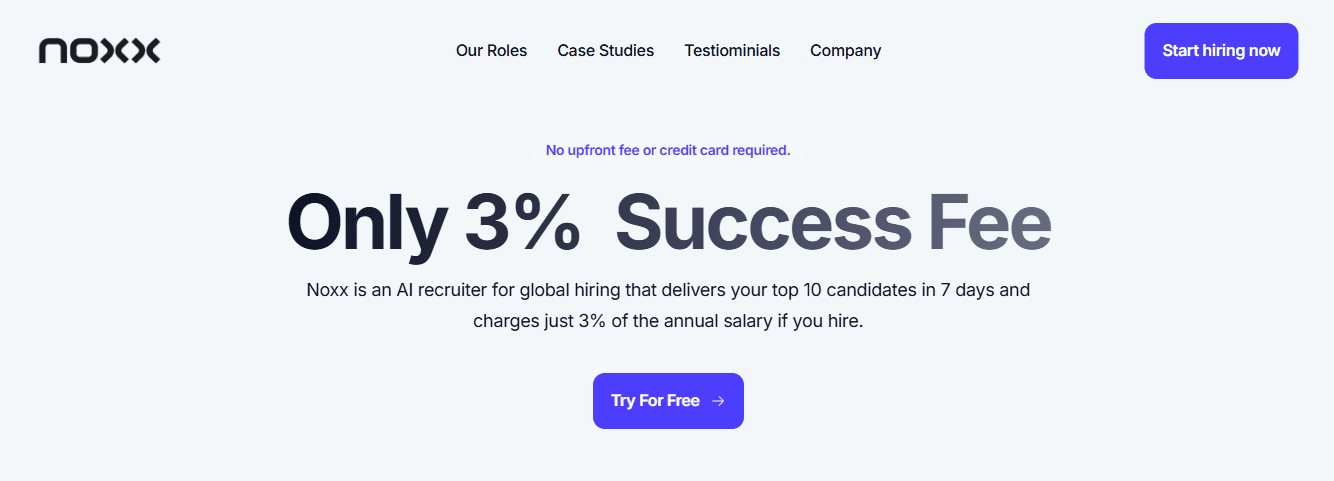
Noxx automates candidate sourcing with an AI recruiter that screens 1,000+ applicants to deliver a top-10 shortlist in 7 days, serving startups and hiring teams that want fast, affordable hires across engineering, marketing, and sales. It stands out for a success-fee model, salary transparency upfront, and regional datasets that surface hidden talent in LATAM and Asia.
How It Works
You upload a job description and select role parameters, then Noxx’s AI runs a 40+ signal screen across its regional datasets, returning a ranked top-10 shortlist within seven days. Interviews and offers proceed directly with candidates, and you pay a 3% success fee only if you hire someone.
Pros:
- Very fast shortlists, suitable for tight deadlines.
- Pay-on-hire success fee, no upfront recruiter commissions.
- Transparent salary expectations and regional rate visibility.
Cons:
- Less managed delivery compared to full-service agencies.
- The success-fee model may not suit organizations that prefer subscription services.
- Smaller pool for niche, ultra-senior specializations relative to large marketplaces.
Why is Noxx a Better Alternative to Toptal?
Noxx compresses sourcing from weeks to days and shifts cost from high markups to a low success fee, so teams that prioritize speed and predictable hiring costs choose it over a premium marketplace.
2. Lemon.io
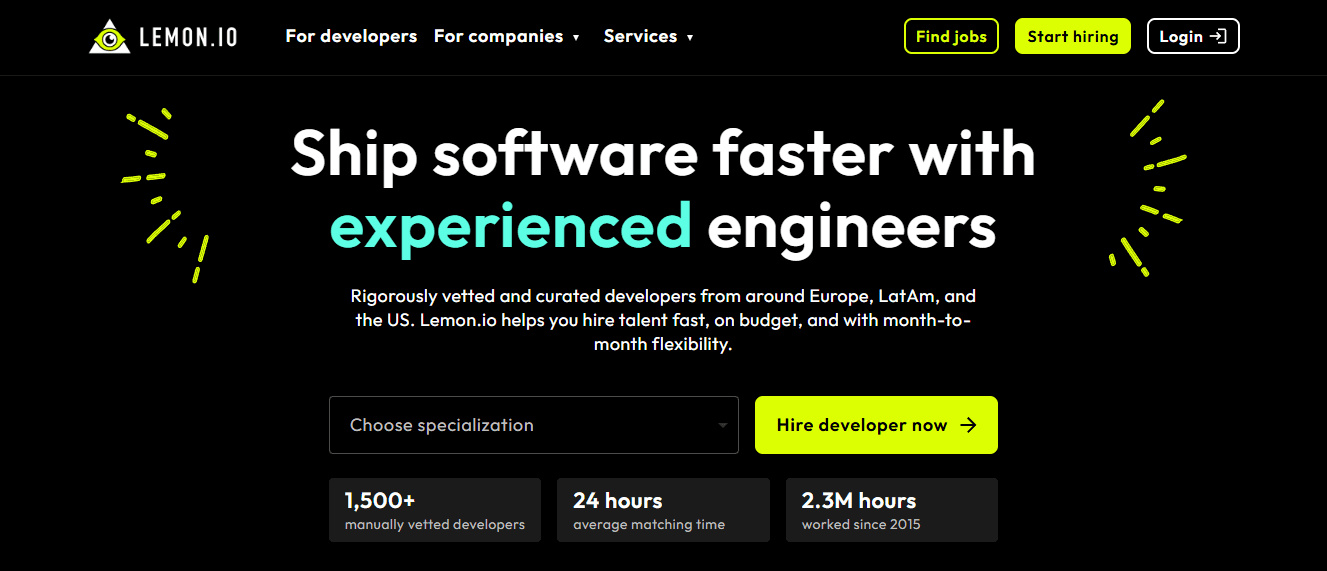
Lemon.io focuses on startups and scale-ups, delivering rigorously vetted developers primarily from Europe and Latin America, often matching candidates in 24 to 48 hours. It emphasizes boutique quality and fast time-to-start, with monthly engagements and no fixed-price options.
How It Works
Describe your role and priorities, then Lemon.io presents 2 to 3 vetted developers within 24 to 48 hours. You interview, choose, and the developer can begin within a week, with Lemon.io handling contracts and payments.
Comparison
If you need an instant, algorithmic match without handling logistics, Arc’s instant matching can be faster and more flexible for short-term freelance bursts.
Pros:
- High vetting standards, strong match accuracy.
- Fast candidate delivery, suitable for startups.
- Handles contracts and payments for you.
Cons:
- Minimum 160-hour commitment, not ideal for short tasks.
- No fixed-price project options.
- Regional concentration may limit access to some niche skills.
Why is Lemon.io a Better Alternative to Toptal?
Lemon.io gives many startups a faster, lower-friction path to vetted talent, balancing boutique vetting with startup-oriented speed and simpler billing.
3. Arc.dev
Arc.dev uses AI-assisted matching to pair companies with pre-vetted freelance and full-time talent across engineering and product roles, serving startups to enterprise teams looking for speed and compliance support. It focuses on instant matching and transparent vetting.
How It Works
Enter role requirements into Arc’s HireAI, and you get immediate matches that meet your constraints. Review profiles, interview, and let Arc handle paperwork; most hires close within 24 to 72 hours.
Comparison
For clients prioritizing stricter consistency in developer quality, Lemon.io may offer more predictable results because of its narrower regional focus and boutique screening.
Pros:
- Instant matching, often within 24 to 72 hours.
- No deposit required to start the process.
- Integrations for cross-border compliance.
Cons:
- Algorithmic matching can prioritize availability over exact skill fit.
- Quality can vary across individual freelancers.
- Less transparency into the matching algorithm.
Why is Arc.dev a Better Alternative to Toptal?
Arc.dev removes upfront deposits and uses fast AI matching to shorten time-to-hire while keeping quality controls, making it useful when speed and lower friction matter more than a single premium guarantee.
4. Upwork
Upwork is a generalist freelance marketplace with millions of profiles across every discipline, best for teams that have the internal capacity to screen candidates and want wide price flexibility. It’s a fit when you need scale and direct access.
How It Works
Post a job or search profiles, invite proposals, interview, and hire directly through the platform with built-in escrow, time tracking, and contract tools. You control filtering and screening.
Comparison
If you prefer a curated pre-vetted pool to reduce screening effort, Arc or Lemon.io will cut time and vetting overhead compared to Upwork’s open marketplace.
Pros:
- Massive talent supply across many skills and price points.
- Flexible pricing from budget to premium hourly rates.
- Integrated tools for contracts and time tracking.
Cons:
- Quality varies widely and requires heavy screening.
- Agencies can misrepresent individual contributors.
- Platform fees and review mechanics can distort signals.
Why is Upwork a Better Alternative to Toptal?
Upwork offers scale and price flexibility that Toptal’s curated model cannot match, which helps teams with internal screening capability lower per-hour costs and experiment with many profiles.
5. Fiverr Pro
Fiverr Pro presents vetted freelancers offering fixed-price packages, suited for quick deliverables, design work, or defined engineering tasks that can live in discrete scopes. It targets buyers who value clear deliverables and fast turnaround.
How It Works
Browse Pro listings by deliverable, compare portfolios, purchase a package, then manage delivery within Fiverr’s platform. Fixed-price structures set expectations up front.
Comparison
For ongoing engineering engagements that require collaboration and iteration, platforms with hourly or month-to-month billing like Arc or X-Team are a better match.
Pros:
- Clear, package-based offerings with defined deliverables.
- Fast turnaround for one-off tasks.
- Strong portfolio emphasis for evaluation.
Cons:
- Not ideal for complex, iterative engineering work.
- Vetting transparency is limited.
- Platform takes a substantial commission that raises costs for long-term work.
Why is Fiverr Pro a Better Alternative to Toptal?
Fiverr Pro works when you want a defined deliverable quickly and at a predictable price, avoiding the multi-step interview and deposit processes of premium marketplaces.
6. Gun.io
Gun.io focuses on highly technical hires and provides a white-glove experience for engineering managers who need senior contractors with specialized skills and alignment with the North American time zone.
How It Works
You brief Gun.io on requirements, they run a three-stage technical assessment and source candidates from their curated pool. Gun.io manages matching and can place contractors quickly when the skill exists in their network.
Comparison
When price sensitivity is key, Noxx or Arc may offer similar speed with lower cost, while Gun.io emphasizes premium vetting and hands-on account support.
Pros:
- Rigorous technical vetting process.
- Strong for complex technical roles and senior hires.
- High-touch account management.
Cons:
- Premium pricing, often higher than other marketplaces.
- Smaller talent pool can delay rare-skill placements.
- Variable project management experiences reported by clients.
Why is Gun.io a Better Alternative to Toptal?
Gun.io matches Toptal on vetting and service but is attractive for teams that prefer North American alignment and hands-on matching without Toptal’s platform pricing model.
7. Twine
Twine is a large freelance marketplace with 750K+ freelancers, useful for teams assembling multi-person contractor groups, especially across creative and digital specialties. It supports scalable contractor teams and collaboration.
How It Works
Post jobs for free, browse talent, and hire directly or through Twine’s tools. Twine supports workrooms for collaboration and has optional Pro/Premium tiers for freelancers.
Comparison
If strict technical vetting for engineering is the top priority, Gun.io or Codementor will provide deeper, role-specific technical guarantees than Twine.
Pros:
- Free job postings and large candidate pool.
- Scales well from single freelancers to large contractor teams.
- Collaboration-focused workrooms for project coordination.
Cons:
- Competition among freelancers can make hiring noisy.
- Advanced features sit behind freelancer subscriptions.
- Quality varies across categories.
Why is Twine a Better Alternative to Toptal?
Twine shines when you need flexible team scaling across creative and digital roles, giving you a broader pool at lower entry friction than a highly curated marketplace.
8. Gigster
Gigster takes ownership of software projects end to end, assembling managed teams and delivering to scope, timeline, and budget, targeted at companies that want project-level accountability rather than individual contractors.
How It Works
Share project requirements and goals, then Gigster designs a plan and assembles a team to execute it. They manage delivery, milestones, and communications until handoff.
Comparison
If you want direct control over talent selection and faster, cheaper hires, Arc or Noxx will usually be faster and less expensive because they provide direct matches rather than full managed delivery.
Pros:
- Managed teams with end-to-end responsibility.
- Rapid staffing and project planning.
- Focus on delivery and predictable outcomes.
Cons:
- Non-transparent pricing and higher fees.
- No trial period for assessing talent fit.
- Less flexible for ad hoc or discovery-phase work.
Why is Gigster a Better Alternative to Toptal?
Gigster offers a managed project model that removes hiring and delivery risk, ideal when you want a vendor to own execution rather than a marketplace to provide individual contributors.
9. Codementor
Codementor blends on-demand developer help, mentoring, and freelance hiring, best for teams that need technical guidance, pair programming, or short consulting engagements alongside hiring.
How It Works
Search mentors or post a request, then schedule hourly sessions, pair-programming, or longer-term contracts. Codementor connects you quickly to subject matter experts for hands-on help.
Comparison
When you need fully embedded, ongoing development rather than mentorship and hourly help, X-Team or BairesDev provide more sustained full-time resources.
Pros:
- Strong for mentorship, code review, and technical fixes.
- Flexible hiring from hourly to multi-week contracts.
- Large community of experienced engineers.
Cons:
- Less suited for business-scale engineering teams.
- Rates can be higher for top mentors.
- Availability varies for highly specialized skills.
Why is Codementor a Better Alternative to Toptal?
Codementor delivers targeted technical help and mentorship faster than Toptal, and it is particularly useful when you need immediate hands-on expertise, not long engagements.
10. Hired
Hired matches vetted candidates to companies based on skills, salary expectations, and cultural fit, with emphasis on transparent compensation and candidate advocacy for higher-quality role matches.
How It Works
Post roles and salary ranges, then Hired presents curated candidates with transparent salary expectations. Candidates receive support from talent advocates during the interview and offer process.
Comparison
For on-demand freelance or short-term engagements, Arc or Lemon.io provide faster, less selective matches; Hired is geared toward curated, longer-term placements.
Pros:
- Transparent salary info helps calibrate offers.
- Talent advocates smooth the hiring journey.
- Curated candidate lists reduce time wasted on irrelevant applicants.
Cons:
- Selective application process limits candidate volume.
- Higher competition among candidates for roles.
- Fewer gig-style or short-term freelance options.
Why is Hired a Better Alternative to Toptal?
Hired emphasizes salary transparency and candidate experience, which helps companies close offers faster for full-time or longer-term roles without extensive sourcing.
11. Guru
Guru connects businesses and freelancers with secure payment flows and collaborative work rooms, aimed at teams needing flexible payment arrangements and straightforward project collaboration.
How It Works
Post a job, invite freelancers, and use Guru’s WorkRooms for file sharing and milestone tracking. Guru’s SafePay escrow protects both parties during delivery.
Comparison
If you need intensive technical vetting and senior engineering talent, Gun.io or BairesDev offer deeper technical assessments and stricter candidate selection.
Pros:
- Secure SafePay escrow system safeguards payments.
- Flexible payment models including hourly and recurring.
- Centralized collaboration with WorkRooms.
Cons:
- Commission rates can be higher than competitors.
- Less stringent vetting may increase variability in quality.
- Fewer enterprise compliance features.
Why is Guru a Better Alternative to Toptal?
Guru provides payment flexibility and collaborative tools that reduce administrative friction for small teams who can manage vetting internally.
12. Arc
Arc is a global marketplace for vetted freelance or full-time talent across engineers, designers, and product roles, promising instant matches and affordable global hires with transparent vetting.
How It Works
Use HireAI to enter requirements and budget, then review instant candidate matches. Conduct interviews and let Arc handle paperwork; many hires occur within 24 to 72 hours.
Comparison
For a more boutique, regionally focused hiring solution with tighter match accuracy, Lemon.io may outperform Arc for certain startup use cases.
Pros:
- Instant matches that accelerate hiring cycles.
- Transparent vetting and flexible hiring options.
- Cost savings from global talent pools.
Cons:
- The remote-only model may not suit on-site needs.
- Verified freelancers may command higher rates.
- Algorithmic matches can sometimes miss niche cultural fit.
Why is Arc a Better Alternative to Toptal?
Arc blends fast matching and vetting at lower friction, making it a strong choice when you want vetted global talent without Toptal’s enterprise orientation.
13. BairesDev
BairesDev supplies teams with bilingual developers across Latin America, prioritizing timezone alignment, regional talent, and longer-term team augmentations rather than short task hires.
How It Works
Discuss goals and timelines with BairesDev, finalize engagement models, and onboard a dedicated team. BairesDev manages milestones and performance tracking throughout the engagement.
Comparison
If you need fast, individual contractor matches instead of team augmentation, Arc or Lemon.io will get you a single resource more quickly.
Pros:
- Strong regional focus and bilingual talent.
- Rigorously vetted candidates from Latin America.
- Better timezone alignment for U.S. teams.
Cons:
- Pricing is often non-transparent.
- Not optimized for very short-term projects.
- Less agile for single-hire, ad hoc needs.
Why is BairesDev a Better Alternative to Toptal?
BairesDev is suited for teams that want regional depth and long-term team builds with language alignment, reducing the friction of remote collaboration across the Americas.
14. Turing
Turing matches companies with remote developers who overlap at least four hours with your time zone and offers AI-vetted talent and a 2-week trial. It targets teams that need predictable overlap and continuous delivery.
How It Works
Discuss needs with a technical matching expert, receive recommended developers within days, and start a free 2-week trial before committing to a full engagement.
Comparison
For short mentorship sessions or ad hoc technical fixes, Codementor is faster and cheaper; for integrated, month-to-month full-time developers, X-Team may offer better developer growth programs.
Pros:
- 2-week trial reduces hiring risk.
- Emphasis on time zone overlap for collaboration.
- Fast matching, typically within 3 to 5 days.
Cons:
- AI-vetted talent may still miss soft-skill nuances.
- Not ideal for very short projects.
- Trial candidates can vary in quality.
Why is Turing a Better Alternative to Toptal?
Turing provides structured trials and timezone-aware matching, lowering the risk of remote misalignment while keeping hires flexible and production-focused.
15. X-Team
X-Team supplies full-time developers on flexible monthly contracts, investing in professional growth to keep talent engaged and productive. It fits managers who want team-like continuity and developer development.
How It Works
X-Team assigns a dedicated account manager, integrates developers into your workflows, and provides ongoing support and professional development to retain motivation and reduce churn.
Comparison
If you need pay-per-hire speed and minimal ongoing management, Noxx or Arc will be faster and less binding than month-to-month developer placements.
Pros:
- Pre-vetted developers integrated as ongoing team members.
- Emphasis on professional development to reduce churn.
- Simple monthly billing and dedicated account management.
Cons:
- Pricing is non-transparent up front.
- Not suitable for short-term or one-off projects.
- Less flexible for highly variable capacity needs.
Why is X-Team a Better Alternative to Toptal?
X-Team focuses on long-term developer retention and team continuity, which reduces turnover overhead for companies that prefer stable engineering capacity over spot hires.
Related Reading
• Remote Developers Eastern Europe
• AI Recruiting Startups
• Automated Candidate Screening
• AI Recruiters
• AI and Recruiting
How to Choose the Best Alternative to Toptal

Choose the platform that enforces the single constraint you will not bend, then design a short, evidence-driven test to prove fit before scaling. Start with precise cost comparisons, vetting quality metrics, and a low-risk paid pilot so you trade opinion for measurable outcomes.
Who Is Choosing Alternatives, and Why Does That Matter?
Most companies now favor short engagements as product cycles speed up, as shown by Coding Crafts: 75% prefer hiring freelancers for short-term projects, which pushes hiring toward faster sourcing and lighter commitment structures. That preference shapes how you value speed, onboarding friction, and contract flexibility when selecting a provider.
What Exact Costs Should You Calculate?
List every dollar and every week. Include hourly or monthly rates, platform commissions, required deposits, minimum-billing windows, and payroll or compliance surcharges, then add the hidden items: recruiter time to screen, onboarding hours from engineering, and the opportunity cost while a role sits open. Suppose the budget is the primary axis; factor in platform-level price differences too, because Coding Crafts, the average cost of hiring a developer through alternative platforms is 20% lower than that of Toptal. That 2025 comparison reflects typical fee and rate gaps after initial month costs are included.
How Do You Evaluate Vetting Quality Beyond a Checklist?
Score vendors on outcomes, not promises. Track interviewer-to-offer conversion, trial-to-hire success rates, and reference verification depth. Require sample work under NDA or a short paid task, and measure time-to-first-merge or time-to-first-closed-ticket as early signals of fit.
Ask for Data
Pass rates on technical screens, average years of experience in the requested stack, and how many regional signals the platform uses to surface candidates. Those numbers beat marketing claims every time.
How Should You Design a Low-Risk Pilot?
Frame the pilot like a focused experiment. A one- to two-week paid engagement with explicit acceptance criteria, measurable deliverables, and a checklist for onboarding steps. Define success in plain terms, for example:
- Feature implemented
- 80 percent unit test coverage
- Code review approvals
- Integration into CI pipelines
Use escrow or short-term contracting to settle legal and IP terms up front, and set a conversion window if you want to hire the contractor after the pilot.
What Operational Metrics Matter After You Hire?
Track time-to-productivity, measured as days until the new hire completes their first accepted work item; 90-day retention and performance; defects per feature delivered; and business outcomes tied to the hire, such as conversion lift or latency reduction.
Combine These with Simple Cost Metrics
Total cost of hire over 90 days, including platform fees and onboarding hours, and cost per shipped milestone. Benchmarks help you decide whether to continue with the same sourcing channel or switch.
Decision Checklist: How to Make an Informed Choice Step by Step
- Define needs and nonnegotiables: Role scope, overlap hours, seniority, and duration.
- Compare real total pricing: Base rates, platform commissions, minimums, deposits, and onboarding time.
- Evaluate vetting rigor with quantifiable data: Pass rates, trial conversion, and reference checks.
- Test with a paid pilot that has clear acceptance criteria and IP protections.
- Measure outcomes against your operational metrics for 30 to 90 days, then decide whether to scale, iterate, or switch vendors.
Related Reading
• Companies using AI for Recruitment
• AI Screening
• Toptal vs Gigster
• Andela Competitors
• Turing Alternatives
Upload a Job and Get 10 Candidates within 7 Days with Noxx (No Risk, No Upfront Fees)
Consider Noxx when you need top talent fast and without upfront fees, so you can focus on choosing the right person instead of chasing applicants. Noxx's AI recruiter delivers 10 candidates within 7 days, and operates with no upfront fees, meaning you only pay when a hire actually moves your team forward.