
17 Best Platforms To Hire Top PHP Developers For Your Next Project
Get instant access to vetted talent. Check out the 17 best places to hire top PHP developers for remote or contract work.
You have a product deadline and need reliable PHP talent now, but screening resumes, running code tests, and checking references can eat weeks. Hiring teams often get a pile of profiles that claim Laravel or WordPress experience yet fail on performance, security, or database work. This article shows how to hire top PHP developers and build a hiring approach that finds senior-level PHP engineers, backend and full-stack developers, and freelancers who can handle API integration, MySQL or PostgreSQL tuning, and production-ready code. Read on to learn how to quickly and confidently find highly skilled developers from trusted platforms who deliver your project efficiently and to a high standard.
To reach that goal, Noxx's AI recruiter finds and screens candidates across vetted platforms, highlights proven skills such as Laravel, Symfony, and API development, and matches you with developers who meet your timeline and quality bar.
Summary
PHP remains the dominant web backend, with 78.9 percent of sites using PHP when a server-side language is known and about 40 million websites relying on PHP, making in-house expertise critical for integration and legacy support.
A focused senior PHP hire delivers measurable returns: a nine-month ecommerce effort that applied SQL tuning, Redis caching, and profiling cut average server response time by 30 percent and increased checkout conversion by 12 percent.
A practical two-stage technical funnel reduces false negatives and speeds decisions, combining a 3 to 6 hour take-home task with a 45 minute pair programming session and a rubric weighted 30 percent code correctness, 25 percent maintainability, 20 percent security, and 25 percent communication.
Budgeting for seniority matters, with the US average PHP salary around $86,003 per year and Laravel experience earning up to 20 percent more, so expect framework premiums to affect total hire cost.
Make onboarding and evaluation time-bound and measurable, for example, a two-week paid trial sprint, a 30-day expectation for the first production merge, and a 30/60/90 roadmap to track ramp and reduce risk.
Noxx's AI recruiter addresses this by screening over 1,000 applicants to surface top 10 shortlists within seven days and applying a $300 placement fee only if you hire.
Table of Content
Why Hire a PHP Developer

You should hire PHP developers when your product needs reliable server-side ownership, measurable backend performance gains, or long-term maintenance that generalist teams cannot sustain. A skilled PHP developer turns backend complexity into predictable delivery, from database architecture to security hardening and scalable deployment pipelines.
What Specific Value Does a PHP Developer Bring to a Project?
They own server-side logic and the interfaces that other teams build on, so you stop guessing how features will behave under load. Senior PHP developers design APIs, normalize databases, and implement caching layers so pages render faster and queries cost less, and they do it with framework patterns that reduce future technical debt.
They also translate security requirements into concrete defenses, for example, using prepared statements, input sanitization, and dependency patching schedules to keep compliance audits from becoming emergency war rooms.
When Should You Move From a Generalist to Hiring a Dedicated PHP Engineer?
When custom business rules, complex transactions, or sustained traffic exceed quick fixes, bring in someone focused on the backend. If you are building multi-step checkout flows, real-time reporting, or integrations with legacy databases, a PHP specialist will save you weeks of rework.
On a nine-month ecommerce rebuild I worked on, focusing an engineer on SQL tuning, Redis caching, and route-level profiling cut average server response time by 30 percent and lifted checkout conversion by 12 percent, because the work targeted clear bottlenecks rather than cosmetic front-end tweaks.
How Do They Improve Performance and Reduce Risk in Practice?
PHP developers use concrete tools and routines:
Query explain plans
Full-page and fragment caching
Opcode caches
Queueing for heavy jobs
Continuous profiling is tied to deployment pipelines
That means you go from occasional slow pages to predictable response-time percentiles, and you replace reactive firefighting with a cadence of targeted optimizations.
They also set up monitoring and alerting that tie symptoms back to specific code paths, so resolving incidents does not rely on guesswork.
Centralizing Handoffs for Faster Feature Velocity
Most teams coordinate releases through ad hoc handoffs because it feels quicker early on, but that way of working fractures when services multiply, deployment windows lengthen, and rollback paths are unclear. As the number of integrations grows, deployment friction slows feature velocity and prolongs outages.
Platforms like Noxx centralize talent routing, vetting, and role-based handoffs, helping teams reduce onboarding time and maintain consistent code standards while scaling engineering capacity.
Why Hire PHP Talent Now, Not Later?
The ecosystem still anchors a considerable portion of the web, which matters for integration risk and legacy support. W3Techs reports that PHP is used by 78.9% of all websites with a known server-side programming language, a 2025 metric that explains why PHP expertise buys compatibility across a wide range of platforms and CMS systems.
And because so many live sites depend on PHP, Netcraft found that PHP is used by 40 million websites worldwide, a 2023 figure that underscores the staffing reality: you will encounter PHP either in migration projects or in ongoing operations, so having in-house knowledge changes upgrade and security economics.
What Senior Skills Separate a Hire-You-Will-Keep Developer From a Short-Term Contractor?
Look for people who can own a module from schema to observability: they should write idempotent migrations, document performance contracts, and accompany releases with rollback plans and runbooks. Ask for examples where they reduced P95 latency, stabilized deployment frequency, or removed single points of failure in stateful services. Those are the behaviors that turn backend code into a durable product asset rather than a brittle pile of hacks.
Hiring Triggers You Can Use as a Checklist
You need complex custom features that touch multiple systems.
Your database has grown beyond simple CRUD patterns and needs normalization or sharding.
Peak traffic creates repeatable outages or unexplained slowdowns.
You must meet regulatory or security obligations with demonstrable controls.
You plan to own the product for multiple years and need a sustainable backlog.
Addressing Technical Debt with Specialized PHP Expertise
The familiar path is to patch problems with temporary fixes, because that preserves short-term velocity. The hidden cost is technical debt that compounds, turning what was cheap to ship into expensive, risky maintenance.
Teams find that bringing in PHP specialists and pairing them with a platform for consistent hiring and onboarding compresses that cost, turning months of firefighting into predictable sprint work that produces measurable outcomes. That pattern is clear, but the surprising question is which exact capabilities you should demand first when you hire.
Related Reading
17 Best Hire Top PHP Developers
I’ll lay out the platforms I recommend when you want to hire top PHP developers, with a quick sense of why each one deserves a spot on the shortlist and what type of engagement they are best for. Keep pay expectations realistic, since the average salary for a PHP developer in the United States is Indeed, $86,003 per year, which sets a baseline for budgeting US hires.
1. Noxx
Noxx’s AI recruiter compresses sourcing time, screening over 1,000 applicants to surface the top 10 candidates in seven days, and charges only $300 if you hire, no upfront fee. This model is built for hiring speed without a large recruiting bill.
Services & options:
Full-time, part-time, contract, and freelance placements; support for engineers, marketers, and sales hires.
Key points:
Pay only on hire, $300 placement fee
Top-10 candidate shortlists delivered in 7 days
Salary expectations shown up front, claims up to 70% cost savings versus US rates
2. Toptal (founded 2010)
Tight vetting, elite talent pool, dependable for senior-level backend work where architecture, scaling, and security matter. I recommend Toptal when you cannot compromise on seniority.
Services & options:
Full-time, part-time, contract engagements; broad language coverage beyond PHP, including JavaScript and Ruby on Rails.
Key points:
Risk-free 5-day trial
60,000+ projects completed for 25,000+ clients
Trustpilot rating around 4.8 out of 5
3. Hired (founded 2012)
Suitable for active job-market hires where candidates are already interviewing, their matching algorithm reduces sourcing hours and surfaces vetted profiles quickly.
Services & options:
Permanent and contract roles, pay-per-hire or unlimited annual subscriptions.
Key points:
AI-assisted sourcing saves ~45 hours per candidate
Candidate skill assessments are visible to employers
Strong presence in 14 global cities
4. We Work Remotely
Straightforward remote job board that reaches developers specifically seeking remote work, practical when you need distributed or timezone-flexible PHP engineers.
Services & options:
Remote full-time and contract postings; works well for teams hiring distributed developers or remote-focused roles.
Key points:
Flexible posting and bundle pricing
Manual prioritization options to reduce sift time
Job distribution across partner networks
5. RemoteOK (founded 2015)
Broad remote reach and affordable posting options are good when you want to find international candidates and review detailed profiles quickly.
Services & options:
Remote full-time, part-time, freelance hires; supports multi-skill searches across PHP, Python, iOS, and more.
Key points:
Global reach of 1+ million professionals
Posting discounts for multiple listings
Used by companies like Microsoft and Stripe for remote hires
6. Upwork
Massive marketplace for short-term to ongoing freelance work, practical for quick prototypes, bug fixes, or augmenting capacity without long hiring cycles.
Services & options:
Hourly, fixed-price, short-term contracts, or long engagements; also offers Expert-Vetted talent for higher confidence.
Key points:
12+ million users
Talent Specialists program to surface similar-experience freelancers
Client feedback badges and ratings to guide selection
7. Arc.dev
Strong technical vetting and modern PHP focus, especially when you need PHP 8.x, Laravel, or up-to-date practices from developers who can hit the ground running.
Services & options:
Part-time, full-time, project-based placements with a 72-hour candidate presentation promise.
Key points:
3-stage technical assessment including live interviews
Risk-free trial period for placements
Fast matching with AI recommendations
Note: 11% platform fee may raise total costs
8. Guru

Relationship-oriented platform that supports longer-term partnerships and project management through features like Work Rooms, making it easier to convert short gigs into steady collaboration.
Services & options:
Freelance and contract work, milestone payments via SafePay, and long-term engagements.
Key points:
Flexible payment with milestone releases
Lower platform fees than some competitors
Strong collaboration tools for ongoing projects
Transitioning from Fragmented Hiring to Centralized AI Solutions
Most teams still use spreadsheets and siloed job posts because that feels quick and familiar. As candidate volume grows, hiring work fragments across inboxes, notes, and one-off trial tasks, stretching time to hire and increasing the risk of a poor cultural or technical fit.
Platforms like Noxx’s AI recruiter centralize sourcing and screening, reducing candidate noise and compressing the hiring loop from weeks to days while maintaining auditability and salary transparency.
9. 99designs

Best when design and frontend integration matter, for example, custom WordPress themes or PHP-driven UI prototypes where visual iterations matter alongside code.
Services & options:
Project contests, fixed-price projects, designer-developer pairings.
Key points:
Contest model produces multiple prototypes
Money-back guarantee if unsatisfied
Strong WordPress and theme/plugin specialization
10. Codementor
Ideal for on-demand help, code reviews, or short-term debugging sessions with senior PHP mentors; use it when you need rapid, expert troubleshooting rather than a full hire.
Services & options:
Hourly mentoring, short project contracts, and pairing for specific tasks.
Key points:
5,000+ experienced PHP mentors
Instant help sessions for debugging or learning
Best for targeted, small-scope work
11. Stack Overflow Jobs
Reach developers who actively contribute to technical Q&A and open source, making it effective when you want candidates with visible problem-solving histories.
Services & options:
Primarily full-time, permanent roles with company branding opportunities.
Key points:
Developer story profiles include technical contributions
Integration with technical screening tools
Subscription model for employers
12. PHPJobs
Niche PHP board, useful when you need framework-specific filters like Laravel, Symfony, or WordPress, and want community curation rather than general job noise.
Services & options:
PHP-focused listings, framework filtering, community-driven candidate pool.
Key points:
Manual review of job postings
No fee for developers to join
Highly targeted audience
13. Limeup
Experienced agency with a decade of work in cybersecurity and scaling, useful for enterprise projects that need secure, scalable PHP solutions and a managed delivery model.
Services & options:
Staff augmentation, dedicated teams, full software outsourcing.
Key points:
200+ completed projects
Senior consultants available for ongoing oversight
Emphasis on reliability and on-time delivery
14. impltech (founded 2017)
Good when you want a structured match for niche or narrowly scoped PHP needs, especially in European markets where organization and predictable delivery matter.
Services & options:
Specialist placements and team boosts for short or mid-term assignments.
Key points:
Focus on organized teams and timely updates
Matches for narrowly scoped projects
Client reviews are available to assess fit
15. GitHub Careers (founded 2008)
Reach developer-centric candidates who use GitHub daily, which helps when you value public code history, open source contributions, and a developer-first culture in hires.
Services & options:
Permanent and remote roles, exposure to developers skilled in frameworks like Laravel.
Key points:
Developer-centric employer branding
Access to contributors and maintainers
Suitable for building teams that value open source experience
16. Workana (founded 2012)
Strong Latin American talent pool and secure escrow payments, which makes it efficient and cost-effective to hire competent PHP developers with clear reputation systems.
Services & options:
Freelance contracts, milestone tracking, and reputation tiers from bronze to platinum.
Key points:
Free project posting, pay after hire
Built-in messaging and milestone management
Regional strength in Latin America
17. DevSquad
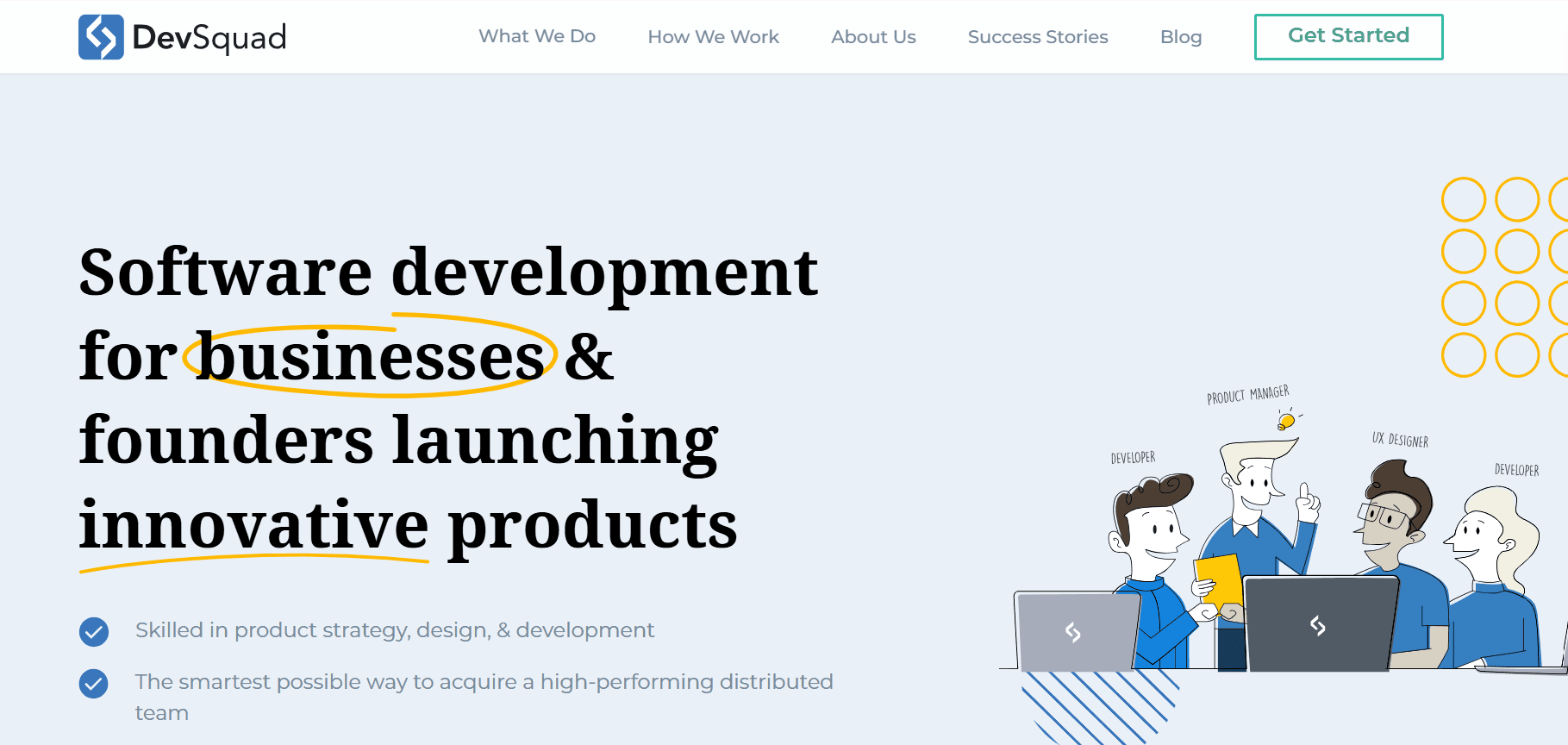
Full-service, managed teams are ideal for SaaS companies that prefer handing product delivery to an external team that covers strategy through QA, useful when you want one accountable partner.
Services & options:
Fully managed teams, end-to-end product development, including Laravel back-end and Vue front-end.
Key points:
Scalable team composition to match needs
Product strategy, DevOps, QA and UX included
Higher cost than single-hire models, but less management overhead
Hiring Analogy
Hiring through scattered job posts is like panning a river for gold; it finds flakes but rarely yields a steady vein. Curated platforms and managed teams bring the vein to you. When you need Laravel expertise specifically, expect to pay a premium because Stack Overflow Developer Survey found that PHP developers with Laravel experience can earn up to 20% more, so factor framework premiums into your compensation plan.
The platform you choose depends on whether you need immediate senior hands, long-term team ownership, or quick, scoped work, and each option maps to a different hiring rhythm and risk profile. That surface still hides a tricky question about how to structure interviews, compensation bands, and trial work without burning time or goodwill.
Related Reading
• How Can I Hire Someone From Another Country
• How To Improve The Hiring Process
• Best Sales Recruiting Firms
• Top IT Recruiting Firms
• Software Development Argentina
• Software Development Colombia
• Software Development Mexico
How to Hire PHP Developers

Define the project before you chase candidates:
List required PHP skills
Related front-end and database tech
Clear feature scope
Milestones
A timeline with demanding deadlines and upgrade windows
Then design measurable success criteria for the hire, for example, first production-ready feature within 30 days and a 90-day stabilization checklist, so every interview and test maps back to a concrete outcome.
What Should I Document First?
Start with a short spec that answers three questions, written as acceptance criteria:
What the feature does
How it will be measured in production
What counts as done
Include the tech footprint, minimum seniority, and nonnegotiables like framework versions or database ownership. Attach a realistic timeline with buffer days for integration and security reviews, and convert that into interview focus areas so technical screens test the actual work to be delivered.
How Do You Evaluate Portfolios And Past Work?
Treat a portfolio as a working hypothesis, not proof.
Scan for recent, relevant projects and then ask for the commit history or a pull request where the candidate actually touched business logic, not just UI tweaks.
If they can point to a 3 to 6 month feature they led, ask for the before/after metrics, and tell me the one bug they underestimated, and how they fixed it.
Those concrete stories reveal ownership and debugging discipline more than keywords on a resume.
How Should You Assess Technical Skills Without Wasting Time?
Use a two-stage technical funnel:
A focused take-home task that mirrors a real piece of your codebase, capped at 3 to 6 hours
Followed by a 45-minute pair-programming session that explores design decisions from the take-home.
Score candidates against a rubric with weighted categories, for example, code correctness 30 percent, maintainability 25 percent, security practices 20 percent, and communication 25 percent.
That gives you an objective shortlist and reduces false negatives from artificial whiteboard tests.
What About Soft Skills and Communication?
Treat written communication as a core skill, especially for remote work. Require a short design note before the pair session, answerable in 200 to 400 words, and run a simulated async thread where the candidate clarifies requirements and responds to a scope change.
Observe how they acknowledge uncertainty, propose mitigation measures, and document trade-offs. Good communicators create fewer incidents; that is measurable in reduced clarification tickets during the first sprint.
How Do You Structure Interviews to Get Real Answers?
Use structured interviews with a single scoring sheet per competency.
Open with a 10-minute behavioral story about a past outage or a complex integration, then move to 25 minutes of scenario questions tied to your codebase, and end with a 10-minute culture alignment or expectations conversation.
Keep the panel to two people to reduce interview fatigue and provide a debrief within 48 hours so decisions stay crisp.
How Should You Choose Between Freelancers, In-House, and Agencies?
If speed and short-term cost are the constraints, freelancers win for discrete tasks or prototypes, provided you require a binding milestone and escrow.
If long-term product ownership matters and you expect continuous feature development, hire in-house to capture institutional knowledge.
If you want turnkey delivery with less management overhead, choose a managed team that accepts SLAs and code ownership handoff.
Map decision tradeoffs to three axes, cost, control, and ramp time, and pick the model that places your highest priority at the origin.
What Trial and Guarantee Structures Work Best?
Use paid, time-boxed trials that mirror production work, for example, a two-week paid sprint with a deliverable and a defined test plan, and a written SLA for bug response times during the trial. For hires from agencies, insist on a contractual replacement window or refund if the outcome is not met, and require escrow or milestone payments for freelancers to align incentives.
Centralizing Recruitment to Increase Hiring Speed
Most teams recruit by scattering job posts and juggling email threads, because it feels familiar and low-effort. As candidate volumes rise and hiring windows tighten, that familiar approach fractures, context gets lost across messages, and qualified candidates drop out under slow follow-up.
Teams find that platforms with AI recruiters, centralized shortlisting and transparent salary data compress decision loops and reduce candidate falloff from days to hours, easing the pressure that comes when hiring speed matters more than volume.
Designing Realistic, Impact-Focused Technical Tests
When you pick technical tests, make them realistic and short, and require evidence of impact.
Give candidates a tiny production-like problem, such as a database index change with a before/after query profile, or a caching change with documented P95 improvements, and ask for a short notes file with trade-offs and rollback steps.
That forces practical thinking and separates engineers who can ship from those who only theorize. Think of it like testing a cook by asking for a plated dish, not a recipe.
How Do You Onboard so that The Hire Produces Quickly and Stays?
Create an onboarding sprint that leads to a measurable first success: access and a “first issue” on day one, paired reviews for the first three merges, and a 30/60/90 roadmap reviewed weekly. Provide a short runbook, coding standards, and a central docs page with architecture diagrams and deployment steps.
Assign a senior buddy for four weeks whose job is explicitly to unblock the new hire, not to carry their workload. Expect the new engineer to merge a production change within the first 30 days, and treat that as the key milestone for evaluating fit.
How Do You Set Expectations and Maintain Healthy Collaboration?
Set explicit working agreements: overlap hours, response SLAs for async messages, on-call boundaries, and a cadence for demos and retrospectives.
Tie compensation conversations to clear performance checkpoints, and write simple role-based KPIs such as cycle time for assigned tickets and post-deployment defect rate.
These metrics help feedback feel less personal and make performance conversations more factual. Hiring today moves fast because the talent pool is shrinking, and Candidates worth hiring are gone fast, so your process must be sharp and predictable. Make speed safe by building a repeatable funnel, short paid trials, and objective scoring, rather than speeding up ad hoc.
Structured Funnel
Hiring without a structured funnel is like assembling a bridge from spare parts; you might span the gap, but you will not predict when the next bolt will fail. Structured trials and measured onboarding turn that bridge into an inspected, rated crossing.
That next part flips the usual tradeoff between speed and risk in a way most teams do not expect.
Related Reading
Upload a Job and Get 10 Candidates within 7 Days with Noxx (No Risk, No Upfront Fees)
If you need to Hire Top PHP Developers without dragging out timelines or inflating recruiter costs, consider Noxx. Platforms like Noxx shift sourcing and technical screening into automated workflows, so you can focus on evaluating senior PHP engineers, Laravel specialists, and backend hires and close the right candidate faster, not sift through resumes, like swapping a hand crank for a power drill.

Noxx is an AI recruiter for global hiring that delivers your top 10 candidates in 7 days and charges just 3% of the annual salary if you hire.