How to Conduct Online Coding Test for Technical Hiring
Learn how to conduct online coding tests effectively with setup tips, test case creation, and result evaluation to assess technical skills accurately.
Hiring engineers matters more than ever, and your recruitment strategy depends on strong technical screening. This guide on how to conduct online coding test walks through test design, candidate evaluation, automated scoring, proctoring, code review, and analytics to help you run fair, efficient, and accurate programming tests. You will learn to build a reliable question bank, set clear rubrics, prevent cheating, and measure skill gaps so you can hire top technical talent with confidence.
Noxx's AI recruiter solution streamlines those steps into a simple, candidate-friendly workflow that automates test delivery, flags suspicious activity, ranks results with clear scoring, and generates reports ready for hiring decisions, allowing you to focus on selecting the right person, not on administrative tasks.
Summary
Standardized online coding assessments are now mainstream, with approximately 70 percent of companies utilizing them and over 1 million developers taking assessments annually, making test design a crucial hiring lever.
Well-calibrated automated assessments compress hiring timelines, with studies reporting a reduction of up to 40 percent in time-to-hire when platforms automate scoring and candidate routing.
Designing level-specific challenges is crucial: use three calibrated tiers, with baselines of 25–40 minutes, intermediate levels of 45–75 minutes, and senior levels of 90–180 minutes, so that signals align with role expectations and regional norms.
Combine automated gates with focused manual review, for example, weighting correctness at 50 percent, code quality at 30 percent, and problem-solving at 20 percent, and apply a computerized pass threshold, such as 70 percent, to maintain reproducible and defensible screening.
Anti-cheating and robust signal design require both visible and hidden checks, such as 3–8 visible test cases and 4–6 hidden cases, randomized inputs, plagiarism detection, and timestamped submission histories to reveal true problem-solving.
Manual review breaks down as volume rises, since reviewer time balloons and inconsistency grows; multi-signal rankers can evaluate 1,000 plus submissions quickly and surface a vetted top 10 slate within about seven days using 40 plus signals.
Noxx's AI recruiter addresses this by automating test delivery, flagging suspicious activity, ranking results with clear scoring, and producing reviewer-ready reports to speed hiring decisions.
What are Online Coding Assessments?

Online coding assessments are tests conducted on digital platforms that measure programming skills, problem-solving abilities, and the capacity to complete real coding tasks, helping recruiters screen candidates objectively before any live interview.
They combine language-specific editors, automated scoring, and scenario-based questions so you can separate baseline fluency from higher-order judgment early in the funnel.
What Do These Assessments Actually Measure?
They measure three overlapping skill sets:
Implementation accuracy
Algorithmic problem solving
Implementation accuracy covers syntax, language idioms, and debugging. Problem-solving checks data structures, algorithms, and edge-case thinking. Practical judgment encompasses system design choices, architectural trade-offs, and how a candidate translates requirements into working code.
Clarity and Fairness in Technical Interviews
This pattern is evident across early-stage startups and larger engineering teams. When interview questions are vague or artificially complex, candidates who would perform well in the job often do not get a fair chance, and hiring teams lose trust in the process.
How Do These Platforms Evaluate Code?
Code editors on modern platforms enable candidates to write in languages such as Python, Java, C++, and JavaScript, with syntax highlighting, auto-completion, and test-run support, ensuring submissions closely mirror day-to-day work.
Platforms execute submissions against predefined test cases that validate correctness and edge behavior, enforce time limits to simulate pressure, and provide instant runtime feedback, allowing candidates to iterate quickly.
Automated Grading for Consistent Evaluation
Automated grading systems then score correctness, complexity, and sometimes style, converting subjective review into reproducible signals that can be ranked across hundreds of submissions.
What Types of Assessments Should You Use?
Multiple-choice and short-answer items are helpful for language fundamentals and API knowledge. Timed, single-problem live coding exercises reveal on-the-spot debugging and thought process.
Project-based take-homes reveal real-world engineering habits, such as repository layout, tests, and documentation. System design prompts probe senior candidates’ scalability and tradeoff reasoning.
Role-Aligned Pair Programming Interviews
Pair-programming sessions with built-in video allow interviewers to watch collaboration and communication in real-time. Choose form factors by role level; ambiguous, open-ended problems are appropriate for senior hires, narrow execution problems work for entry-level screening.
Why Does This Matter for Fairness and Scale?
When hiring scales are used, manual screening fragments occur, and bias creeps in. Inconsistent prompts, variable grading, and gatekeeping-style puzzles all favor insiders. According to CodeSubmit Blog, over 70% of companies now use online coding assessments as part of their hiring process.
This shift toward standardized testing has become mainstream in 2024, and it is no accident. Standardized, well-calibrated assessments provide teams with a consistent baseline for comparing candidates across regions and diverse backgrounds.
What Practical Gains Should Teams Expect?
Well-designed tests reduce the need for repeat interviews, identify ready-to-interview candidates, and compress recruiting cycles. For many organizations, platforms that automate scoring and candidate routing have already shortened hiring timelines, with one report noting that online coding assessments have reduced the time-to-hire by 40% for many organizations.
That kind of compression is crucial for startups competing for talent globally, where even a few weeks lost in the funnel can cost offers and momentum.
Related Reading
How to Conduct Online Coding Test

Design the test as a short, structured mission. Define the candidate you need, select a platform that matches your scale and regional needs, create a three-tier challenge, communicate the rules clearly, and score with automated gates plus targeted manual review. Follow precise rubrics, keep timing realistic, and calibrate graders so that every submission is judged consistently.
Who Exactly Are You Trying to Find?
Write a one‑line role brief that answers core responsibility, primary tech, two nonnegotiable skills, and one measurable outcome in the first 90 days.
For example: "Backend engineer, Node.js microservices, production experience with PostgreSQL and observability, owning a periodic jobs pipeline that lowers lag to under 2 seconds."
Turn that brief into a skills matrix with must-have, nice-to-have, and bonus columns. Assign each skill a target assessment method, such as unit tests for code hygiene, a timed problem for algorithmic fluency, and a brief design prompt for architectural sense. This clarity stops vague or noisy evaluations later.
How Do You Choose a Platform and Set Difficulty Levels?
Prioritize platform capabilities that match your volume, not feature checklists:
Customizable test templates
Scalable automated grading
Integrations with your ATS
If you plan to screen many applicants, a single platform that runs code, snapshots history, and exports detailed logs will save hours per hire. According to Shadecoder, 70% of companies now use online coding assessments as part of their hiring process, which makes platform choice a practical gating decision rather than optional experimentation.
Tiered and Regionally Calibrated Assessments
Define three calibrated difficulty tiers, with target completion windows and outcomes:
Baseline: 25–40 minutes, one focused task that verifies fluency and common idioms.
Intermediate: 45–75 minutes, one multi-case problem that checks edge cases and design tradeoffs.
Senior: 90–180 minutes, a project prompt with architecture sketch, performance constraints, and test coverage expectations.
Use regionally calibrated difficulty when hiring globally. Adjust time allowances and language sets based on local norms and internet constraints, so a fair signal from LATAM or Asia is not penalized for different development habits.
How Do You Build the Test, Step by Step?
Start with objectives, then map tasks to them. For each candidate level, create three components:
Warm-up (low risk)
Core problem (primary signal)
Stretch challenge (differentiate top candidates)
That three-part structure allows you to observe progression and reduces false negatives. Write clear acceptance criteria before you write test cases.
For each problem list, required behaviors, performance targets, and unacceptable shortcuts are provided. Provide 3–8 visible test cases and 4–6 hidden cases that verify edge behavior or timing. Hidden cases deter hard-coded answers while revealing robustness.
Keep Test Surface Area Tight
One deep task beats three shallow puzzles. Include a README prompt that specifies inputs, outputs, expected complexity, and evaluation priorities. A candidate should never guess what matters.
What Anti-Cheating Measures Should You Configure?
Combine deterrents and detection. Use randomized inputs or parameterized problem variants so each candidate sees a slightly different instance.
Enable plagiarism checks that compare submissions against the pool and public repos. Limit copy-paste to control keystroke logging only if you notify candidates and comply with relevant data protection and privacy laws.
Balanced Proctoring and Solution Traceability
Offer optional proctored sessions only when necessary, not by default, as excessive surveillance can deter strong candidates. When you do use proctoring, clearly explain its scope and data retention policy upfront.
Track timestamps and iterative history so you can see how the solution evolved, not just the final snapshot. Evolutionary traces reveal honest problem solving versus pasted answers.
How Should You Communicate Expectations to Candidates?
Send a short checklist with details such as total duration, allowed languages and frameworks, required submission format (single file, repository link, ZIP), whether screen sharing or webcam is needed, and the retake or appeal policy.
Pre-Test Setup and Transparent Scoring
Provide a one‑page sample challenge and a 5-minute environment tutorial link so that candidates can check for local configuration issues ahead of time. That slight reduction in friction raises completion rates and produces cleaner data.
Be explicit about scoring rubrics and timelines for feedback. Candidates remember whether an interview felt fair; clarity in this aspect keeps your employer brand intact.
How Do You Evaluate Automatically and Manually, Step by Step?
Automated gates first, manual review second. Run each submission through the test suite and static analysis to capture correctness, performance, and basic style metrics. Use those outputs to filter out submissions that fail to meet critical requirements automatically.
Then, run a brief manual checklist for each passing candidate, covering readability, test coverage, defensive coding, modularity, and provide a brief note on architecture choices. Score each area on a 1 to 5 scale and capture one line that justifies the score. That short justification is the single most helpful thing for consistency during later calibration.
Weight Scores Transparently
A sensible default, correctness 50 percent, code quality and tests 30 percent, problem solving and architecture 20 percent. Raise the manual weight for senior roles. Set an automated pass threshold, for example, 70 percent, with a documented manual override path for edge cases.
Run weekly or biweekly calibration sessions where reviewers score 10 shared submissions and align on expectations. This prevents slow drift and keeps the scoring objective as candidate volume grows.
How Do You Combine Fairness and Efficiency as Volume Rises?
The familiar approach is to pile more manual review onto a broken funnel because it feels controlled. That works when you have tens of candidates, but as volume reaches hundreds, reviewer time balloons, and inconsistency appears.
The hidden cost, evident in metrics such as longer time-to-hire and uneven pass rates, is that top candidates slip through because reviews were noisy or delayed. Manual rework and reinterviews multiply calendar churn and raise cost per hire.
Automated Screening for Faster, Stronger Hiring
Teams find that platforms with automated, regionally calibrated screening and multi-signal rankers compress review time and surface stronger slates. Solutions like these can evaluate thousands of submissions quickly and surface a vetted top 10 using multiple signals, allowing reviewers to focus on judgment rather than triage.
What Practical Checks Do You Add Before Making an Offer Decision?
A short code-review discussion or a system design sketching session. This validates that the candidate can explain and extend their written solution. Keep this step under 30 minutes and use the same rubric.
Maintain an audit log for each hiring decision, including test results, manual scores, reviewer notes, and the rationale behind the decision. That trail reduces legal and bias risk, making future hiring improvements measurable.
Related Reading
14 Coding Test Platforms to Use in Developer Interviews
These platforms eliminate manual setup, automate scoring, and transform messy candidate piles into ranked, comparable slates, allowing you to focus interviewer time where it matters. Below is a list of the platforms, detailing what each does best, and the hiring scenarios where they excel.
1. Noxx
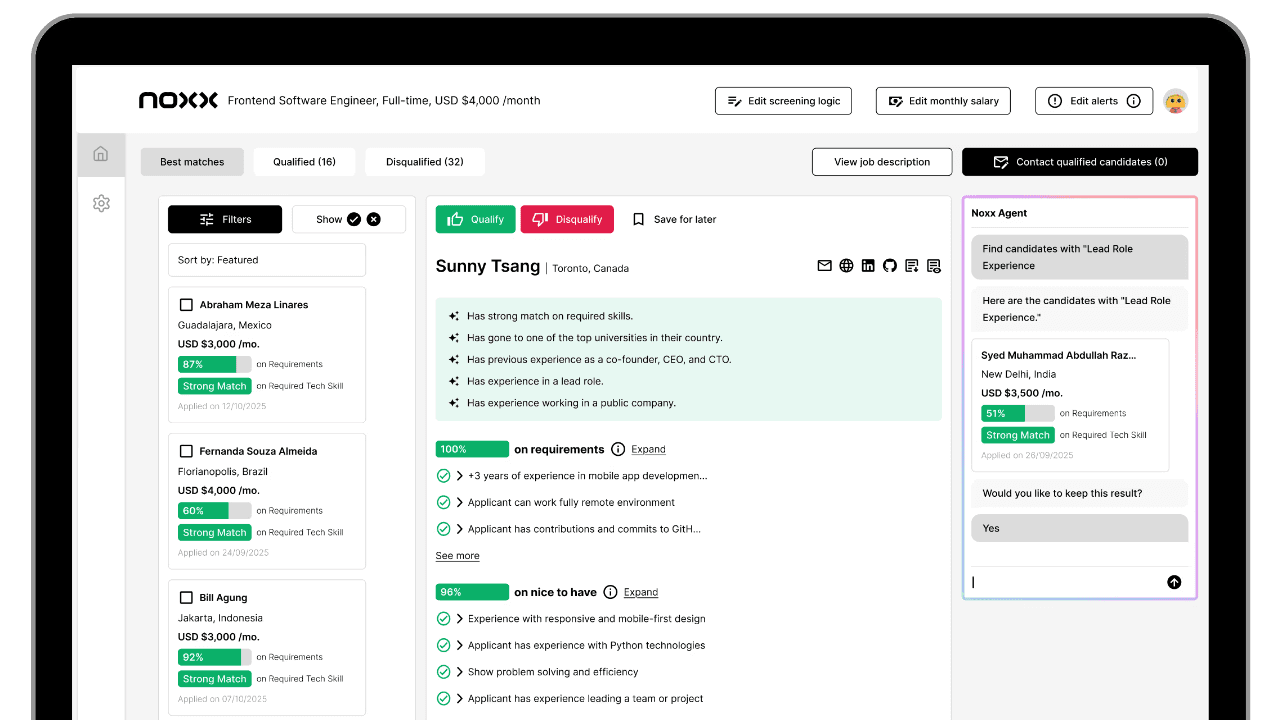
Hiring the right talent shouldn't take months or cost a fortune. Noxx's AI recruiter screens over 1,000 applicants automatically and surfaces a vetted top 10 in seven days, showing salary expectations upfront and charging only if you hire ($300 or a small success fee).
Strengths
Ultra-fast sourcing, cost predictability, regional calibration for LATAM and Asia, and a pay-for-success model that reduces upfront risk. Ideal for early-stage startups and lean hiring teams that need speed and affordable global talent without heavy recruiter fees.
2. Qualified
A full-stack hiring workspace that blends ATS features with deep analytics and project-based exams.
Strengths
Prebuilt, job-ready assessments, project coding tasks, and integrations with BambooHR, Zapier, and Workable. Use it when you want tight candidate funnels, predictable scoring, and a single place to post jobs, run tests, and track progress across multiple roles.
3. CodeSignal TechScreen
A validated technical-screening product focused on objective skill signals and psychometric rigor.
Strengths
IO psychologist–validated assessments, human-reviewed plus automated scoring, advanced coding editor, and compliance with GDPR and CCPA. Best when you need defensible, bias-reducing screens for volume hiring or technical roles tied to promotion or credential gates.
4. Codeaid
Simulated, Git-centric testing designed to mirror real workflows and detect AI-assisted answers.
Strengths
Long-form tests, Git-based repos as the execution surface, automated structural scoring, and plagiarism similarity metrics. Choose Codeaid for mid-senior hires where repo layout, tests, and API design matter more than single-problem speed.
5. Adaface
A candidate-friendly platform built to block rote Googling and surface genuine problem-solving.
Strengths
Non-searchable questions, multi-language support, strong anti-cheat, and an extensive library of ready exams. Ideal for companies that want high completion rates and a respectful candidate experience while still catching hard-to-fake skill signals.
6. Mettl
Enterprise-ready testing with a huge question bank and role-based simulators.
Strengths
Extensive competency catalog, robust IDEs, scalable proctoring options, and detailed performance analytics. Use Mettl when you need to standardize evaluation across many job families and run proctored certification-style assessments.
7. Codility
Practical, time-boxed coding tests with automated scoring and plagiarism detection focused on reducing time-to-hire.
Strengths
Realistic problem sets, remote interview whiteboard tools, and fraud detection. Best for teams that want fast, consistent screening and to shave interview loops by weeding out unfit candidates early.
8. DevSkills
A developer-first platform with Gitpod-hosted IDEs and GitHub workflow integration.
Strengths
Real-world assessments, immediate scorecards for code review, and flexibility for any stack. Use DevSkills when candidate workflow and reviewer ergonomics are crucial, especially for distributed teams that use Git-based reviews.
10. Evalground
Language-diverse testing with tight customization and leaderboard-style benchmarking.
Strengths
Rich question database, copy-detection modules, window-blocking, and tailored reports. Ideal for volume hiring where you want quick comparisons across languages and standardized output for HR dashboards.
11. Tests4Geeks
A mix of practice content, live head-to-head challenges, and branded reporting for employer marketing.
Strengths
White-labeling, PDF and web-publishable results, and real-time challenge modes. Use Tests4Geeks when you want to engage talent pools with contests while still getting actionable evaluation data.
12. CoderPad
Live interview and take-home hybrid with broad language support and gamified sessions to reduce test anxiety.
Strengths
80+ role templates, a large question bank, live code playback, and interviewer-friendly tooling. Best for teams who want to run interactive, paired-programming interviews that mirror production editing.
13. TestCandidates
Lightweight, GDPR-compliant testing with clear dashboards and intelligent automation for candidate experience.
Strengths
Simple UI, fast feedback loops, and compliance-first design. Use it when candidate throughput and straightforward reporting are the top priorities for small to medium-sized hiring programs.
14. Elitebrains
Interactive problem sets that emphasize rapid problem solving and algorithmic reasoning under time pressure.
Strengths
Tight, competitive-style tasks and multi-language coverage. Ideal for sourcing contest-oriented talent or for junior-to-midlevel funnels where time-based ranking matters.
15. Hackerrank
Broad adoption across large enterprises, offering tutorials, competitions, and a deep library of challenges.
Strengths
Scale, community, and the ability to run contests as a sourcing channel. Use Hackerrank when you need a broad reach and want to combine practice-to-hire pipelines that attract high-volume applicants.
16. TestDome
Practical, role-specific tests with built-in interview orchestration and automated scoring.
Strengths
Flexible question formats, video and chat interview integration, detailed candidate reports, and ATS connectors. Choose TestDome for hiring workflows that require rapid switch between asynchronous tests and live interviews.
Related Reading
Upload a Job and Get 10 Candidates within 7 Days with Noxx (No Risk, No Upfront Fees)
I recommend you consider Noxx when hiring feels like a distraction from building your product, because better screening should free your team to focus on outcomes. The results speak for themselves. Noxx, 10 candidates within 7 days, and Noxx, with a 3% success fee, so you get a short, vetted slate quickly and only pay when a hire is made.

Noxx is an AI recruiter for global hiring that delivers your top 10 candidates in 7 days and charges just 3% of the annual salary if you hire.